
Review by Duncan Lunan

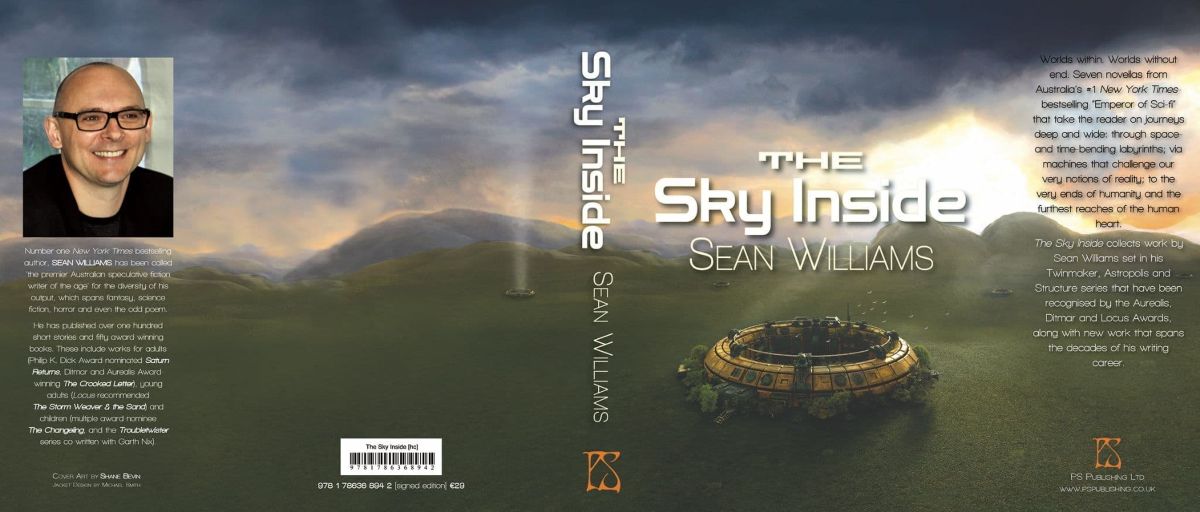
Sean Williams, “The Sky Inside”, pbk, 293 pp., £14.99, PS Publishing, (1st edition Drugstore Indian Press), 2023.
First published in slightly different form, ParSec # 9, 9th February 2024.
The Sky Inside is a collection of seven stories, drawn from the author’s ‘Twinmaker’, ‘Astropolis’ and ‘Structure’ series – all new to me, I must confess. The jacket says they’re all novellas, but two of them, ‘Cenotaxis’ and ‘A Glimpse of the Marvellous Structure (& the Threat it Entails)’, are over 80 pages, and the rest are around 30 – so if they’re novellas, the other two have to be short novels, it seems to me. It’s not a problem unless you dive into one of the longer ones expecting a shorter read, and find yourself out of your depth. I found ‘Cenotaxis’ to be like that: seemingly it’s packed full of references to literary works of past centuries, except for one character who talks only in lines from Gary Numan, and I have to say it all left me cold. It reminded me of a couple of Iain Banks’s novels (not Iain M. Banks), featuring minor characters in obscure wars, which did nothing for me.
‘The Marvellous Structure’, by contrast, gripped me completely. It’s set within the Structure, a vast mining complex which spans worlds, linked by matter-transmitters which operate on elevator journeys from one level to the next. It’s not on the scale of the Well initially reached by tunnel in Michael Cobley’s ‘Humanity’s Fire’ novels, which is a cosmos big enough for fleets to manoeuvre within it, and in Ancestral Machines (review, ON, 24th March 2024), has an antechamber big enough to be strewn with the wreckage of worlds. The mines linked by the Structure are just tunnels and galleries, on human scale, and mostly inhabited by human workers. Nevertheless, as Sean Williams says in the Introduction to ‘Inevitable’ a Structure story earlier in the book, it may be “bigger in its own way than the universe we live in”. Topologically that’s possible: in his essay ‘The Universe and the Future’, Isaac Asimov pointed out that a single 10-mile-diameter asteroid, similarly tunnelled out, could hold the entire population of the Earth, as it then was (Is Anyone There?, Ace, 1967). Who built the Structure and where all those people came from is a question not directly addressed; but even ‘Inevitable’ makes the point that entering the Structure is like stepping into a river – you can never do it at the same place twice, but in this instance, the shift could be forward or back.
‘A Glimpse of the Marvellous Structure’ is written in the form of reports, by an agent of a somewhat bureaucratic external spacefaring culture, describing to a distant superior what he finds within one of the Structure planets. The messages are supposed to be relayed by his ship outside the planet he begins on, but as they go on, it becomes increasingly doubtful that they’re going anywhere. As he accompanies a woman who’s apparently already dead, on a quest for a scientist who supposedly knows the answer to it all, he refuses to accept that he’s being transferred from planet to planet, and possibly from universe to universe, each time they take an elevator – and each time they do, an unseen entity called ‘The Director’, kills or ‘disappears’ somebody nearby. As we’ve read ‘Inevitable’ earlier in the book, and we know what the Structure is, for readers of this book the suspense lies in how long it will take the agent to catch on to what’s really happening.
In a backward way, it was perhaps fortunate that personal circumstances forced me to read this story a few pages at a time, over many weeks. Essentially I was exploring the Structure, or at least the part of it reached by single transfers away from where the agent starts, one level at a time. It’s hard to say whether I would have found it so gripping, had I read through in one piece as reviewers normally do – I have an uneasy feeling that the transfers and their consequences might have become repetitive. I’d like to find out how someone else would respond to it, reading it that way – and I might have found out, because Sean Williams put out an email recommending the book to all and sundry as a Christmas present; but I’ve now (August 2025) done a search of online reviews without finding the answer.
The other stories in the book include ‘Murdering Miss Deboo’ and ‘Face Value’, detective stories set in a world with matter-transmitters, in the ‘Twinmaker’ universe, as is ‘All the Wrong Places’, the last story in the book, which is interesting for the number of comparisons it invites with other stories. The central character remains on Earth while the woman he loves departs for the Moon, then Mars. Deciding he’s made a mistake, he sets out after her, and fails to catch her – further and further into space, as humanity expands outwards to the stars.
Superficially it’s ‘just’ a story of frustrated love. At first I thought, this is how The Forever War would end if Joe Haldeman had given us the downbeat ending which he led us to expect, in which the characters separated by time dilation would be separated forever. But Joe’s characters do find a way to get back together. This story recalls ‘The Man’ by Ray Bradbury (in S Is For Space) where a starship captain becomes a Flying Dutchman, trying to meet Jesus on planet after planet, around star after star, always arriving after He’s completed his mission and gone – because, as any true believer would tell you, that’s not the way to find Him.
And then, as Williams’s character clones himself, and discovers that his beloved has done the same, they have many different endings to their story, in only one of which do they actually meet again and renew their relationship. The final ending, in which the protagonist is the last individual human alive, definitely recalls The Forever War – but still more powerfully David Gerrold’s The Man Who Folded Himself (1973), with the same issues about individuality and relationships. That was a book which I really didn’t like, but as John Kelk of the original Glasgow SF Circle said at the time, the mere fact that it raises such issues makes it worth reading. The Sky Inside (a book with a great cover, as Williams remarks) definitely gives one a lot more to think about.





Leave a Reply