
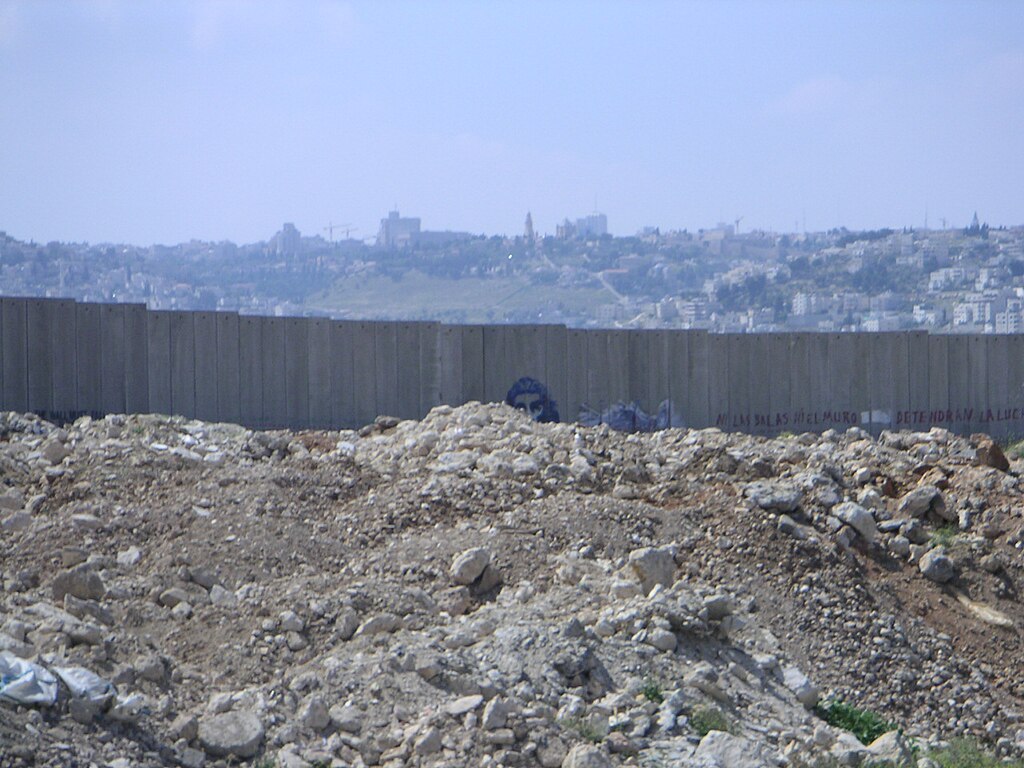
Military occupation vehicles patrolling through the narrow streets, armed settlers descending from the surrounding hillside to burn olive trees, to destroy wheat fields, and indiscriminately murder unarmed civilians. That is the every day reality of Palestinians living in The West Bank.
Brendan Stephens visited The West Bank last year and his first hand account of what he had witnessed shocked the hushed audience who came to listen to his presentation in Kirkwall’s St Magnus Centre.

Hosted by Orkney Friends of Palestine and Amnesty Orkney Brendan Stephens produced evidence of the casual and systematic use of violence by Israeli settlers, and the IDF (Israeli Defence Force), of the oppression of the Palestinian rural population.
There are 1,000 steel barriers erected across roads in the occupied West Bank. Constructed by Israel to separate and divide villages and small towns, these barriers are randomly closed preventing vehicles from using the roadways. Their function – to isolate and cut off Palestinians living in these areas with their workplaces, and trade.
What we are seeing in The West Bank, stated Brendan Stephens, is the largest population displacement since 1967. Many of those living in the villages he visited are descended from those who were displaced in ’67. A people suffering generations of trauma, but yet resilient.
The IDF has provided Israeli settlers who illegally occupy Palestinian land with over 100,000 automatic weapons. One in five of the Palestinians killed in The West Bank are children. In the latest available verifiable figures, between 7 October 2023 and 15 March 2026, 1,071 Palestinians – at least 233 of them children – were killed in the occupied West Bank, including East Jerusalem. Of these, 25 have been killed since the beginning of 2026.

As the world’s attention has turned away from the Gaza Genocide and The West Bank, to the US/Israel War of Choice engulfing the region, violence by Israeli settlers has reached an horrific level. This is Israel’s settler/ colonial project to drive Palestinians from the land – ethnic cleansing.
The Israeli project creates non-contiguous areas where Palestinians are living and farming. This Apartheid system will increasingly fragment the communities from their links with other towns and villages. An isolation which will make living and farming increasingly unsustainable.
Wheat fields, planted and allowed to grow to almost harvest time – burned to the ground. Olive groves, some dating back 1,000 years, uprooted and destroyed. Water courses interfered with and diverted to the growing number of Israeli settlements. A motorway structure constructed to service the settlements and to control the movement of Palestinians from their villages and towns.

Brendan Stephens described it as ‘a salami slicing effect’, taking the land piece by piece, illegally occupying it, and making what is left more and more difficult to live in for Palestinians – before moving in demolishing what is there and taking that over.
And yet in all of this incredible oppression and casual brutality meted out with impunity, the Palestinians carry on their daily lives. They refuse to be defined as victims of Israeli oppression. Continuing to tend their wonderful olive trees, cultivating their small gardens (most livestock has been robbed from them or killed by settler invasion), and their children taking part in activities as ours do, especially football.
Brendan Stephens’ first hand account was invaluable in telling the story of what is actually happening in The West Bank. Shocking in what it revealed but also a story of the courage and resilience of Palestinian farmers living under an oppressive and apartheid regime intent on ethnically cleansing the land.
If you would like to support Palestinian farmers you can do so by buying their produce.
Zaytoun is a social enterprise established to support marginalised farming communities in Palestine through fair trade, and which reinvests all its profits in this mission. They offer a range of high quality products that are ethically sourced, sustainably grown and sourced from farmers in Palestine, and where possible these products also have organic and Fairtrade certification.

Click on this link to find out more about Zaytoun and to buy their products.
Today, 30 March is Palestine Land Day. On this day in 1976 Palestinians in Israel went on a general strike and organized mass demonstrations to protest Israel’s expropriation of huge tracts of their lands. Israeli police killed six Palestinian citizens of Israel during the protests.
Fiona Grahame




Leave a Reply