
“At the request of the Lebanese Government, the UN education and cultural agency, UNESCO, has placed 39 World Heritage sites under so-called “enhanced protection” – a special status aimed at safeguarding cultural heritage during times of conflict.” UN News.
18 April is World Heritage Day. It’s a time when we celebrate the cultural heritage that we share across the globe. War, conflict and climate change are affecting many of the wonderful sites which as humans we have come to admire and wish to preserve.
Some of the world’s most wonderous sites have over the last few years suffered partial or total destruction, including the looting of precious objects, in places where the indiscriminate bombings and murder of hundreds of thousands of civilians has decimated the communities where they are/were located.
Sudan, Ukraine, Palestine, Lebanon – the list could go on and on where the onslaught of modern warfare is destroying everything that lies in its way – in some cases in an attempt to obliterate a people and their culture – as in the Gaza Genocide.
Sudan
Sudan has three UNESCO World Heritage sites. Over 100 cultural sites have been damaged and 22 museums have been looted or destroyed since 2023. UNESCO working alongside partners in Sudan have recovered 570 objects looted from the Sudan National Museum.
Ukraine
In Ukraine 526 cultural sites have been verified as damaged since February 2022.
Why bother about culture and heritage when thousands of people are being killed and many hundreds of thousands more injured ?
Ernest Urtasun Domènech, the Minister of Culture of Spain, explained:
“Culture is not only a victim of war, it is also a source of resilience, dignity and hope. Through the Lviv Culture Hub, we see how international cooperation can help protect cultural life, strengthen professional capacities and support communities in shaping recovery and peace.”
Palestine

Israel has been not only destroying important heritage sites in Palestine, but it is attempting to re-write the history of the region, blotting out the ancient Palestinian culture and in some cases appropriating it .
There are 5 World Heritage Sites inscribed in Palestine:
- Ancient Jericho/Tell es-Sultan (2023)
- Birthplace of Jesus: the Church of the Nativity and the pilgrimage route, Bethlehem (2012)
- Monastery of Saint Hilarion/ Tell Umm Amer (2024)
- Palestine: Land of Olive Trees and Vines – Cultural Landscape of Southern Jerusalem, Battir (2014)
- Old City of Hebron/Al-Khalil (2017)
In April 2025, UNESCO adopted an updated Emergency Programme for the protection and safeguarding of cultural heritage in all its forms in the Gaza Strip, including remote monitoring of heritage sites using satellite imagery in coordination with UNITAR/UNOSAT, protection and management of rubble, emergency first aid interventions as well as urgent structural stabilization of identified damaged property, and, where possible, on-site verification of damage.
UNESCO also gives reports on the status of sites. Here are the latest ones:
- Monastery of Saint Hilarion/ Tell Umm Amer2025 (In Danger)
The continuing deterioration of the situation in the Gaza Strip has severely hampered conservation efforts at the Monastery of Saint Hilarion.
27 June 2025 – “ongoing serious threats to the Monastery of Saint Hilarion” and stating that the armed conflict “ has devastated the surrounding area, causing damage to the site’s setting and buffer zone ,” which has led to the suspension of all conservation and monitoring measures.
- Old City of Hebron/Al-Khalil2025 (In Danger)
29 January 2025 – vulnerable to “illegal actions and violations” carried out by Israel, the occupying power, including new plans for the construction of Israeli settlements and the expansion of existing settlements; illegal archaeological excavations; numerous violations against the local community; the sealing of the doors of the old municipality building; as well as the closure of the Al-Ibrahimi Mosque/Tomb of the Patriarchs and interventions without consultation: changing windows, beginning the covering of the open courtyard, installing an electrical cabinet, excavating and extending sewer pipes in the courtyard. Furthermore, on December 9, 2024, Israeli authorities verbally notified the Director of Islamic Endowments of their intention to cover the open courtyard of the Al-Ibrahimi Mosque/Tomb of the Patriarchs, which they said would constitute “a grave threat to the architectural integrity, environmental balance and cultural heritage of this World Heritage Site, recognized for its outstanding universal value.”
- Palestine: Land of Olives and Vines – Cultural Landscape of Southern Jerusalem, Battir 2025 (In Danger)
Several threats with a negative impact on Outstanding Universal Value (OUV) were identified in 2024: Construction of a tunnel and bypass road continued in 2024, resulting in the destruction of the property’s landscape. The expansion of the illegal Israeli settlement outpost, established in 2020 within the property, continued in 2024, altering the landscape, Establishment of a settlement outpost in 2024 within the property, with intensified construction activities, causing considerable damage. Destruction of agricultural land and obstruction of farmers’ activities, arson on agricultural land and demolition of agricultural elements.
- Birthplace of Jesus: the Church of the Nativity and the pilgrimage route, Bethlehem 2021 (In Danger)

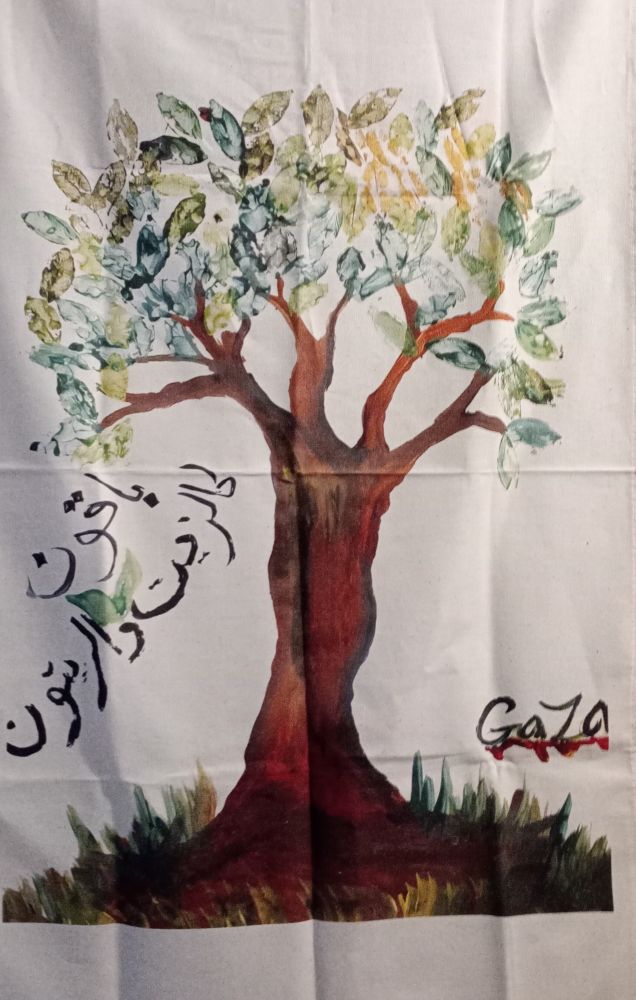
Iconic to Palestine are its ancient olive trees. A reader of The Orkney News highlighted to us this excellent article , The trafficking of ancient olive trees, by David Lambert
He writes:
“Over decades I have been an appalled witness to the campaign of the Israeli state against the residents of Gaza and the West Bank. One of the tactics I, as a gardener, have found particularly shocking is the seemingly wanton destruction of Palestinian olive trees by Israeli soldiers and settlers. This essay considers how these two stories are linked.”
And he continues:
“Arboricide, or what should really be called ecocide, is a tactical strategy intended to undermine the economic viability of Palestinian life. In the West Bank and Gaza, before the chaos of the last three years, olives have always been the single biggest crop in what is a predominantly agricultural economy, accounting for nearly 45% of cultivated land, and contributing 15-19% of agricultural output in an economy where agriculture represents 25% of GDP. In Gaza, over three-quarters of olive groves have been destroyed by Israeli attacks since October 2023. In August 2025, the Israeli military destroyed some 3000 olive trees at al-Mughayyir, a Palestinian village of about 4,000 residents near Ramallah, in the West Bank.”

The displacement of millions of civilians in Lebanon, Gaza and The West Bank is followed by swathes of destruction, whole villages blitzed and erased. Farms and businesses gone – as Israel expands ever deeper into those territories.
Lebanon has 6 World Heritage sites:
- Anjar (1984)
- Baalbek (1984)
- Byblos (1984)
- Ouadi Qadisha (the Holy Valley) and the Forest of the Cedars of God (Horsh Arz el-Rab) (1998)
- Rachid Karami International Fair-Tripoli (2023)
- Tyre (1984)
Lebanon has contacted Lazare Eloundou Assomo, the director of Unesco’s World Heritage Centre, and Krista Pikkat, the director of the Culture and Emergencies Entity in Unesco’s culture sector with their “deepest concerns” over reports indicating the “destruction and complete demolition of the Citadel of Chama’ by military bulldozing operations. “. The area is occupied by Israeli forces where a 10 day ‘ceasefire’ has commenced.
The Art Newspaper reports:
The Chama’ Citadel, located in southern Lebanon’s Mount Amel (Jabel Amel), was constructed as part of early Crusader military posts and remained in use until the late 19th century. It was granted the highest level of protection in 2024 by Unesco after it was damaged by Israeli attacks.
At that time, “parts of the fortified village surrounding the site were blown up, causing significant damage to the citadel itself.”
The enhanced protection designation prohibits sites from being targeted or used for military purposes, with violations potentially constituting serious breaches of the 1954 Hague Convention and grounds for criminal responsibility.
Orkney’s Gaza Vigil.
On Saturday 18 April, islanders in Orkney will meet in vigil to remember the tens of thousands murdered in the Gaza Genocide and the hundreds of thousands injured. The vigil takes place on the Kirk Green, Broad Street, in front of St Magnus Cathedral, Kirkwall, between 1 and 2pm. All are welcome who wish to see an end to the bloodshed and destruction, the unhindered delivery of humanitarian aid, and for peace to come to the people of the region.
In Orkney we have 1 World Heritage Site – The Heart of Neolithic Orkney – it links islanders to the first farmers who came to our islands thousands of years ago.

It has inspired poets, artists, writers, and people of all ages. As precious and central to our heritage as those are, so too are the sites in those war torn countries so far from us but yet part of our shared humanity.
Fiona Grahame




.jpg)
Leave a Reply