
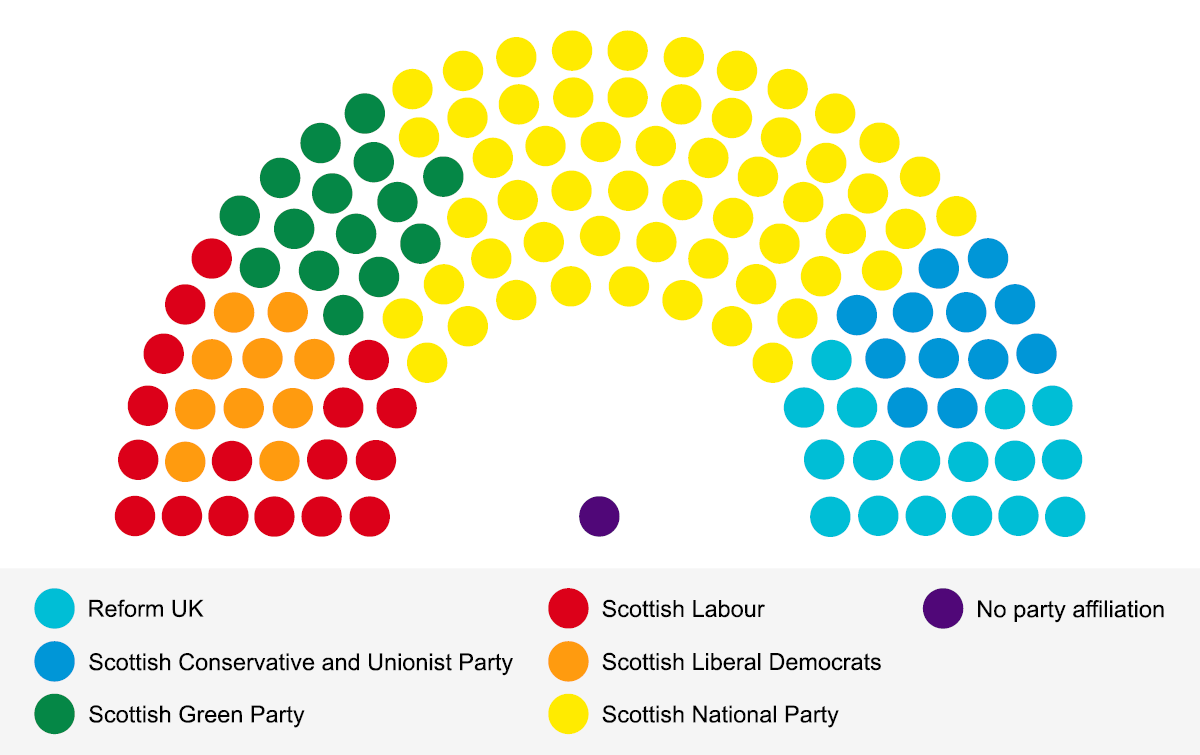
Today, 26 May, business in The Scottish Parliament will see the newly elected MSPs debating asking the UK Parliament in London “to devolve the powers to the Scottish Parliament to hold a referendum on Scottish independence.”
Scotland’s Parliament has a majority of pro Scottish Independence MSPs which were elected at the beginning of this month, 7 May. MSPs supporting Scottish Independence : 72, MSPs supporting continued union in the UK : 56.

In the debate, ‘Ambitious for Scotland’, the First Minister of Scotland will lay out his priorities for the Parliament, including holding a referendum on Scottish Independence. When the question was last put to the people of Scotland in 2014 the result was a win for remaining in the United Kingdom, with 55.30% saying No to Independence, and 44.70% saying Yes. Turnout was high at 84.59%, reflecting how important the electorate considered the referendum to be.
Since then, great changes have occurred – the most significant being the UK leaving the European Union, the world’s largest free trade market, on an advisory referendum. Coming less than 2 years after the Scottish Independence Referendum, the Brexit vote recorded striking differences between Scotland and England. The result for the whole of the UK recorded a narrow win for Leave at 51.89%, with 48.11% to Remain, and on a Turnout of 72.21%. The vote in Scotland was completely different: Leave , 38% ; Remain, 62% ; Turnout, 67.2%. The whole of Scotland voted to Remain in the EU.

The result was particularly galling for pro EU voters in Scotland who had been assured that only by voting No to Scottish Independence would they continue to be in the European Union. A pledge by Unionist party leaders in Scotland: Labour, Conservative, LibDem – known as ‘The Vow’, was spread across the media as Scots went to the polling booths in 2014 to decide their future.

Although the vote to Leave the EU was an Advisory one, the UK Parliament decided it would do so. After a period of Transition, the UK, left the largest Free Trade Market in the world, with huge consequences not only for trade, but for education, pharmaceutical supplies, the movement of people, and security.
Now with instability at the heart of leadership in the UK Government, a US/Israel War of Choice with Iran causing a massive economic impact worldwide, the ever threat of what another virus pandemic could do, and the rise of the extremist views of Reform UK, especially (but not confined to) England – First Minister of Scotland, John Swinney with a pro Independence cohort of MSPs “believes this majority affirms a clear mandate that decisions about Scotland’s future are best taken in Scotland and that mandate must be respected.”
Tuesday’s debate, will allow Scots to view the performance of the new MSPs and of the leaders of their Parties.
John Swinney will lead the SNP with his emphasis on the referendum for independence and the Scottish Government’s continuing commitment to eradicating child poverty and to delivering a stronger NHS. He will be mostly supported by the Scottish Greens through their Co-Leader, Ross Greer, who will remind the SNP that they require the support of the Greens and that the “Scottish Government’s stated ambitions will require a significant escalation in action and ambition.”
Anas Sarwar, Labour leader, will argue that although agreeing with the SNP commitment to stronger public services that an Independence Referendum will be divisive and that the powers Scotland has through Devolution are sufficient to tackle the issues of the nation. He will mostly have the support of the Conservative Leader Russell Findlay who ” urges the Scottish Government to drop its demands to hold a second independence referendum.” The LibDems will also provide their support with their leader, Alex Cole Hamilton, who argues that the SNP does not have a majority from the Scottish people to ask for an Independence Referendum.
The motion by John Swinney, Ambitious for Scotland, has attracted 4 amendments (as at 25 May) from the party leaders listed above. Reform UK which has 17 MSPs has, at writing this article, not put forward an amendment to the motion.
Before the motion is taken, John Swinney, will lay out in his official Statement, the Scottish Government’s priorities for this Parliament. Last week the First Minister gave us the first indicator of what this would mean when he stated:
“Every child in Scotland deserves a future free from the scourge of poverty. It will be the defining mission of my government to support families with the cost of living and eradicate child poverty.
“Our policies are already helping to keep an estimated 100,000 children out of relative poverty this year – but we are determined to deliver truly ambitious change to reduce the cost of living.
“This includes expanding all year round childcare to all children from nine-months to the end of primary school, introducing a £2 nationwide cap on bus fares, increasing the Scottish Child Payment to £40 for under-ones and delivering comprehensive ‘Whole Family Support’ that wraps around families in their communities, helping break the cycle of poverty.”
Scots will be able to judge the performance of the MSPs through the Scottish Parliament livestream.
Fiona Grahame


Leave a Reply