
By Ian Cooper from his excellent series ‘Records of a Bygone Age’ first published in The Stronsay Limpet, and republished here with kind permission.
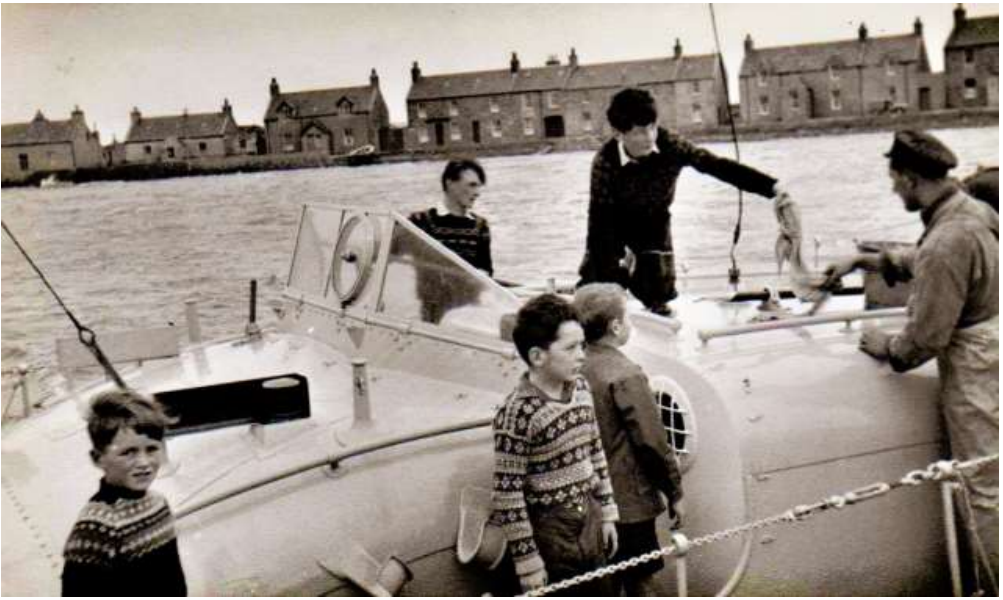
During the mid-1950s and on until the early 1960s a number of the young boys from Whitehall Village were members of what was termed the Junior Lifeboat Crew. The intention of this was to teach the young lads seamanship and navigation, which would stand them in good stead if they wished to pursue a career at sea, or to volunteer as Lifeboat crew. Michael Rendall, himself one of those young lads, recalls them going to Helmsley to be taught to ‘box the compass’, which involved learning the names of all 32 points of the compass. This was taught to them by Captain Clements, a veteran of sail and steam who was then the Honorary Secretary of the Stronsay Lifeboat Station. On a Saturday they would row out to the John Gellatly Hyndman, which was anchored between the piers, and there they would polish the brass and copper, also getting the opportunity to test the radio by calling up Wick Radio, all of which was supervised by lifeboat mechanic Sydney Swanney.
They were also occasionally taken out with the lifeboat on exercise and were allowed to take over its controls and operation in the middle of Sanday Sound, which was quite an adventure for them at the time.

We move on now to 12th August 1960, when Queen Elizabeth 2nd visited Stronsay as part of a tour of Orkney and Shetland aboard the Royal Yacht Britannia, a tour which had been postponed from August the previous year due to the imminent arrival of Prince Andrew. Included in the tour whilst on Stronsay was a meeting with ex-service men and women, a visit to the local shop owned by 2nd coxswain John Dennison and his wife, and the presentation of a number of local dignitaries to the Queen and Prince Philip.
Among these dignitaries were Captain Edward (Ted) Clements DSC and his wife Josephine. Captain Clements had been King’s Harbourmaster at Kirkwall throughout the Second World War. He returned to Stronsay after the war to continue his role as Harbourmaster here until retiring from that position in 1958, being succeeded in the post by ex-coxswain Tom Carter. He had been instrumental in getting the Stronsay Lifeboat Station reopened in 1952 and was appointed Honorary Secretary upon its opening, a post he held until he retired in 1971.

Before making their way back to the Royal Yacht Britannia the Queen and Prince also inspected the lifeboat crew and were given a tour of the lifeboat.


Moving on now to more mundane but more important matters, The Scotsman of 19th June 1962 tells the tale of a very lucky man who had been blown out to sea in his home made little 8ft (2.4m) dinghy when out fishing for lobsters.

Reminiscing some years later coxswain Jimmy Stout recalled the rescue, saying that Mr Fergus was a very lucky man as, just as they were pulling him aboard the lifeboat, his boat filled with water and was swamped. Being a little wooden dinghy which remained afloat they were still able to recover the boat and return it and its owner to Pierowall on Westray.

At 10.10 a.m. on 22nd December 1962 the John Gellatly Hyndman was called out once more, this time in response to reports from the Coastguard that a Belgian trawler was ashore between Auskerry and Stronsay. As the lifeboat headed for that area the Coastguard gave an updated report that the trawler was actually ashore on the Corn Holm, Copinsay and asked the lifeboat to make for that position instead.
On reaching the area the coxswain found that the trawler, the Prince De Liege of Ostend was well ashore, stuck hard and fast on the rocks, and there was too little water for the lifeboat to reach the vessel. One of the lighthouse keepers rowed out to the lifeboat in the Copinsay Lighthouse dinghy and ferried the coxswain of the lifeboat ashore, where he found all 13 of the crew had safely landed by liferaft. After conferring with the skipper of the trawler as to what assistance they could offer, the skipper asked that the crew of thirteen could be taken on board the lifeboat and transferred to Kirkwall. This was duly done, with the trawler crew being landed at Kirkwall at 3.50 p.m. The crew of the lifeboat had a meal in Kirkwall before returning to Stronsay, where they had the John Gellatly Hyndman back at her moorings by 9.45 p.m. This particular callout had turned out to be little more than a taxi service, although the crew still had the satisfaction of helping fellow mariners make their way back to their Belgian homes after their ordeal. The Prince De Liege later slipped off into deeper water and became a total wreck.
Part 5 next month.

Leave a Reply