
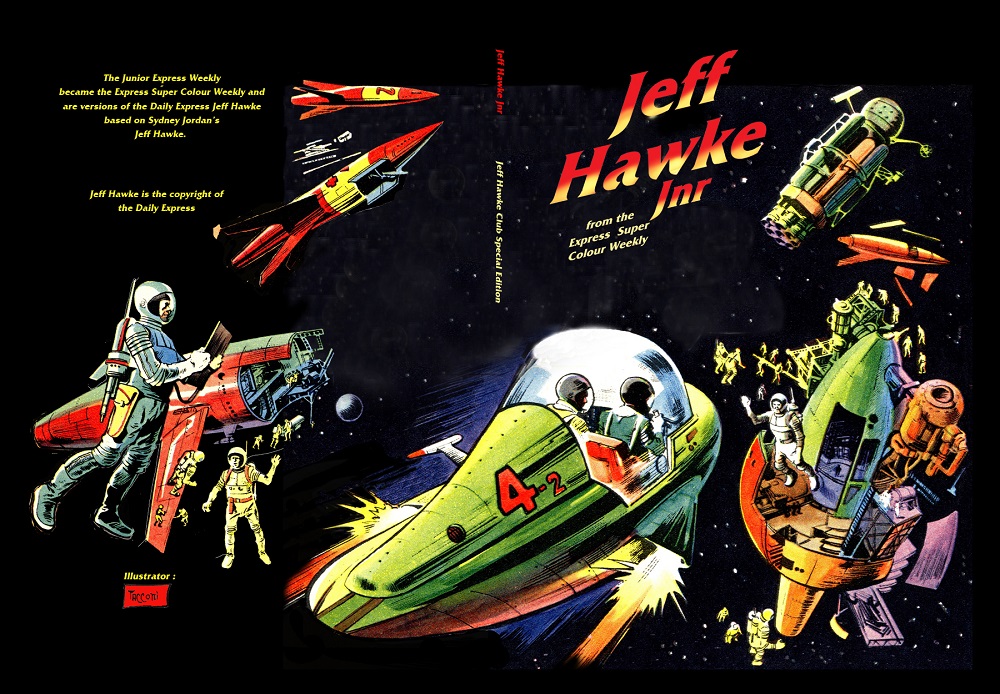
As I wrote last week, the idea of a Prestwick Spaceport first occurred to me in February 1956. when I was 10 years old. What prompted it was a feature in Express Weekly, the colour comic which had grown out of the Junior Express, founded in September 1954 when many of the daily papers tried to attract younger readers that way. Among other things it featured an alternative version of Jeff Hawke, written and drawn initially by Chris Jack, in black and red, and later by Ferdinando Tacconi, with whom it went into full colour. The Junior strip actually persisted with the ‘Shining Ones’ story frame for longer than the original did (see ‘Jeff Hawke, Part 1’, ON, October 8th 2023) before following it in bringing Hawke abruptly back to the RAF, in this case without explanation. The full canon of four stories was published by the Jeff Hawke Club in separate book form in 2016 as Jeff Hawke Jnr (Fig. 1), for which I contributed Notes as I had done for the reprinted adult strip.

The paper also published factual material on space research, starting with ‘Space Gen’ strips at the bottom of the Jeff Hawke page, and going on a giveaway set of colour ‘Space Gen’ cards as well as to news items. I was particularly impressed by the September 10th 1955 issue whose main story (cover and interior) was the Douglas Skyrocket programme (Fig. 2; ‘The M.52 and the Douglas Skyrocket’, ON, 30th July 2023). When the paper went into full colour there were a number of full-page features, for instance on radio astronomy and the rocket sled experiments at Edwards Air Force Base (see ‘Discovery Landing’, ON, July 31st 2022). Those pages hung in my gang hut at the time, but pride of place went to the one showing a giant winged V2 as a rocket airliner, carrying passengers from New York to Heathrow in 30 minutes (Fig. 3).


My immediate question, then and now, is ‘Why not Prestwick?’ Its main runway had already been extended in anticipation of the ‘Big Jets’ (Comet 4, Boeing 707 and Douglas DC-8), and was to be extended further in anticipation of Concorde. The main approach is over water, with a beacon on the Ballast Bank which shelters Troon harbour, but doesn’t actually come inshore until passing the Black Rock on the other side of the town. In the opposite direction, less used because the prevailing wind is from the South-West, the approach is over open country. But the Airport shares with Troon the shelter from the worst of the Atlantic weather which is provided by Goat Fell on the Island of Arran; it’s known locally as ‘the Troon Hole’ in the storms, and the prevailing joke is that if ever it snows on Royal Troon golf course, they’ll cancel God’s membership. (He’s been on His last warning a few times, mind you.)
There’s a sense in which Prestwick has already hosted a spaceship and been a spaceport of sorts. During the first US manned spaceflights, Project Mercury, an abort in the late stages of boost would have brought the capsule down within the recovery area of the US Air Force Air Rescue squadron stationed at Prestwick. They had a ‘boilerplate’ dummy capsule at Prestwick, which they used to drop into the Firth of Clyde with some hapless airman beside it in a rubber raft (Fig. 4), and then they’d practise getting him and the capsule out. In January 1964 they lent it to me for the Glasgow Students Charities Week Parade (Fig. 5), and for a week it was housed in secret in the yard of a sawmill at Anniesland while we gave it a fresh coat of paint. I think I can safely claim to be one of the only two people ever to have painted a US spacecraft in a deserted Glasgow sawmill, by moonlight, with stencil brushes. ‘Mercury Capsule’, ON, August 21st 2022′


(The capsule cost £20,000 (then) and the USAF lent it to me at the age of 17. Would that happen today, I ask myself? It certainly started me, and others, thinking about space operations at Prestwick in the future. With its weather record, its transport links and its industrial facilities, and the 1950s proposals for transatlantic and intercontinental rocket airliners, it seemed the ideal place for them to come in and out of Europe.

The next phase was in the early 70s. The late Chris Boyce (of the Daily Record, later the Herald) and I were working on an idea for a TV series featuring the RLV spacecraft which I had designed for my ‘Interface’ stories in Galaxy and If (Fig. 6) ‘My SF’, ON, 10th September 2023). After the USAF pulled out and HMS Gannet took over the air-sea rescue role, basing our imaginary air-space rescue vehicle at Prestwick seemed one of the promising choices, though that would probably have depended on which film company we sold the rights to, if we had.
The next phase came in 1979 when ASTRA, the Scottish spaceflight society, mounted the largest spaceflight exhibition in the UK to date, at the Third Eye Centre in Glasgow, now the Centre for Contemporary Arts. Again there was a Prestwick connection because the Daily Record sponsored the Scottish Air Show at Prestwick in 1979, which was opened by Apollo 12 astronaut Pete Conrad, and Chris Boyce arranged for us to meet Conrad at the Daily Record hospitality tent and ask him to come back to open our exhibition. Unfortunately he wasn’t free to do so, though he and I met again at the ‘View from Earth, 1984’ seminar in Big Bear Lake, California (Fig. 7).

But one of the events the Third Eye Centre asked me to arrange was a seminar on nuclear waste disposal in space, as an alternative to the proposal of the time for a repository at Loch Doon. With the NASA connections I had at that time, as one of the speakers I was able to get Capt. Chester Lee, the Director of the Space Transportation System (i.e. Space Shuttle) Office at NASA Headquarters in Washington. In July 1979 the Scottish Arts Council sent me to the USA to finalise arrangements for the exhibition and the trip included a series of meetings at NASA Headquarters on 27th July, first with Charles King, Deputy Director of the STS Office, to discuss Chester Lee’s visit, then with Donna Miller, Manager, Small Self-contained Payloads Programme (later known as Getaway Specials), to discuss a proposal by the late John Braithwaite of Braithwaite Telescopes for a Scottish payload on the Shuttle; then with Debra Rahn, Secretary to Dr. Robert Frosch, NASA Director, and Mrs. Anthea Washington, Audio-visual Branch, to arrange borrowing of photo-transparencies for exhibition and access to spinoff material. NASA was then looking for emergency landing sites for the Shuttle and I made a case for Prestwick, but it may not be minuted because it wasn’t the main agenda item.
At that time there was a proposal for a privately-owned Space Shuttle to be built and operated by a consortium including British firms, and it was still thought that Shuttles could be refurbished for flight in only a couple of weeks. I pointed out that in the 1950s it was taken for granted that there would be transatlantic rocket airliners in the future. If Prestwick was upgraded for Shuttle landings, a 30-minute service could be provided from Florida. After refurbishment at Prestwick, the Orbiter could be mated to solid boosters and a dummy fuel tank with a third booster (possibly a larger one) inside, and the stack could be taken by train to Troon and out into the estuary by barge (the rail link to harbour would have to be recreated). That way there would be no need to handle liquid propellants on the ground at Prestwick. Another of the Third Eye Centre events was a weekend seminar on ‘Space and Scotland’, and during one discussion a representative from one of the oil companies said that there were circumstances when they would pay almost anything to be able to get an expert across from the USA in 30 minutes.


In 1984 my main contact at Kennedy Space Centre was assigned to a team evaluating and eventually upgrading the airfield on Easter Island, as an emergency landing site for Shuttle launches from Vandenburg Air Force Base in California (Fig. 8). I pointed out to her that there was already a novel about that, Shuttle Down (Fig. 9), by a retired rocket engineer called Harry Stine (writing as Lee Correy), and as a result the book became so sought-after within NASA that the publisher brought out a second printing! As launches from Vandenburg would be to near-polar orbit, I pointed out that landing sites in higher latitudes would be needed and again suggested Prestwick. In June that year the Shuttle prototype Enterprise had come to Scotland on the 747 carrier, flying over Ayrshire and Renfrew before landing at Gatwick on the way to the Paris Air Show, so there was little doubt that it could be collected and flown back across the Atlantic from Prestwick if it had to land there. Once created, the capability could lead on to further things – but after the loss of the Challenger in 1986 plans to launch Shuttles from Vandenburg were abandoned, so again nothing came of it.
In 1995 at the World Science Fiction Convention in Glasgow I met Pat Bahn, a rocket engineer with the Michelle Corporation, who were working on a rocket-launched platform from which to launch sounding rockets and small satellite boosters. He commissioned me to write two articles about research which could be conducted on short-term ballistic spaceflights, and we talked about Prestwick’s spaceport possibilities. A couple of years later one of the private companies contending for the X-Prize, eventually won by Richard Branson, commissioned him to report on Prestwick’s possibilities for transatlantic rocket flights with winged landing and takeoff, and I arranged a fact-finding visit for him which focussed on the transport links and the hazardous cargo facilities. The company was particularly interested in the possibilities for short-life cargoes such as organs for transplant (see ‘On This Day: Heart Transplants‘, ON December 3rd 2023) or short-lived medical isotopes, and in Prestwick’s links for disseminating these on across Europe. My only condition for helping was that I should be the passenger on the first flight and get to do the write-up.
Between 2000 and 2009 the British Rocketry Oral History Programme held a fascinating series of conferences at Charterhouse School on the past, present and future of the British space programme and in 2002 I met the late Dr. Arthur Hodkin, who had retired to run his own company after a lifetime in environmental consultancy. He was a great fan of Barnes Wallis and his retirement dream was to resurrect Wallis’s plan for a hypersonic airliner as a successor to Concorde (he commissioned me to make a study of the cosmic-ray hazard, which proved to be surprisingly low.) He considered Prestwick to be the ideal base for the project and I arranged a fact-finding visit for him which focussed on the industrial facilities and the space available for expansion. If Richard Branson’s bid to take over Concorde had been successful, Arthur intended to ask for one to be stationed at Prestwick as a flying test-bed – and when it became clear that Branson wouldn’t get them, Arthur approached the Duke of Westminster to buy the whole fleet for him! The venture might have paid for itself by air-launching small satellites, as the Pegasus booster now does and Branson proposed to do from his White Knight carrier. Arthur Hodkins’s plans were nothing if not ambitious, but sadly he died in 2006 and that was the end of the matter.


As Branson’s plans for space tourism firmed up, after his Spaceship One gained the Ansari X-Prize in 2010, interest in a Prestwick Spaceport attracted more attention. One of the leaders of the project was Stuart McIntyre (Fig. 11), grandson of David McIntyre, who piloted one of the first two aircraft to fly over Everest (Fig. 12), and went on to found Prestwick Airport in 1934 (Fig. 13), housing Scottish Aviation Limited in the Palace of Industry from the 1938 Empire Exhibition in Bellahouston Park, Glasgow, which became a major centre for aircraft maintenance during World War 2 and is now owned by Spirit Aerospace. When I met Stuart, he told me that he was puzzled why the central section of the Prestwick main runway was heavily reinforced. I was able to tell him what Arthur Hodkin had told me, namely that if the invasion of southern England had succeeded, Eisenhower intended to make his stand in the Southern Uplands, with Prestwick as his major terminal for supplies by air, while Churchill intended to set up his government in exile (from London, that is!) in the Arches under Central Station.
It was anticipated that both might come under attack by the A4B, the winged version of the V2 (Fig. 14.) see ‘Rocket Aircraft, Part 1′, ON, November 26th 2023. The runway was reinforced to allow near misses and rapid repairs in the event of direct hits – something the Argentinian forces achieved surprisingly fast in the Vulcan raids on Port Stanley, though with limited success (Rowland White, Vulcan 607, Bantam Press, 2006).


In 2017, as the story attracted media attention, the prospects for Prestwick Spaceport looked bright. The Department of Transport was bringing forward a draft Spaceflight Bill, setting out the regulation and licencing of Spaceports and space travel involving rockets, planes and “manned” balloons able to go beyond the stratosphere, the last relating to British Aerospace proposals for communication relays, broadcast power distribution, and tourist flights (Fig.15) ; attempts to launch prototypes in 2003 were unsuccessful (Fig 16) .
The Minister for Universities and Sciences announced grants of up to £10 million, for various space applications including fast-tracking spaceport applications for licensing. The deadline for applications was February 10th 2017, with Glasgow Prestwick (as it’s still misleadingly called), Machrihanish Airbase Community Company, Campbeltown and Stornoway as the main Scottish contenders, vying with Snowdonia and Newquay, Cornwall (Helen Ntabeni, ‘Launch Date May be 2020’, Space & Scotland Issue 2, Spring 2017).
Stuart McIntyre committed himself to a company called Orbital Access (Matt Bendoris, ‘Stuart McIntyre’s grandfather set up Prestwick Airport — now his descendant plans to take one giant leap into space’, The Scottish Sun, March 10th 2017), which was taking shape when I met one of the other Directors at the 2015 AIAA Hypersonics Conference at the University of Strathclyde. Orbital Access would launch a satellite booster called Future Small Payload Launcher (FSPL), to be launched from a wide-bodied jet airliner. It was described in glowing terms by Sean McGovern in Issue 2 of Space and Scotland, op cit, but although he was Managing Director of BAE Systems, Regional Aircraft, curiously Figs. 17-19 show the carrier as a Lockheed Tristar, like the launcher for the US military’s Pegasus booster (see ‘Rockets, for November 5th‘, ON 5th November 2023).


The rear-mounted engine on the fin is very distinctive. You can’t see the tail assembly of the red airliner on the left of Fig. 20, but the engines look like the Tristar’s. I had understood the carrier was to be an Airbus, as you might expect with British Aerospace involvement. An Airbus carrier was shown on the Prestwick runway in an artist’s impression of 2021 (Fig. 21; Andrew Collier, ‘Blue Sky Thinking to Boost Jobs and Fire Up Economy’, The Herald, March 27th 2021), but by then Orbital Access was out of the game, having gone into liquidation in 2018.


In Fig. 20, the two small spacecraft on the apron, and the third on display inside the glass, are the X-Cor Lynx, the 2008 project of a corporation founded in California in 2003 (Figs. 22 & 23). Launched horizontally, under its own rocket power, it would carry two people, one of whom could be a paying passenger, to a height of 103 km, providing up to 4 minutes of weightlessness, and coming back to a horizontal landing (Fig. 24). Instead of carrying a passenger it could carry and launch a small satellite, fired horizontally from the apogee of the trajectory (Fig. 25). The rocket engine was successfully developed and test flown in a small aircraft designed by Burt Rutan (Fig. 26).


The company was strongly interested in basing the Lynx at Prestwick (it would have to be based there, because it wasn’t capable of orbital or transatlantic flight); Stuart McIntyre was very keen on it (Scottish Sun interview above), and one reason why I liked it was that one of the engineer directors was Aleta Jackson, a veteran of Project Gemini and a personal friend since 1984 (Fig. 27). Had we but known it, however, development of the Lynx airframe had been suspended in 2015, and Aleta and other directors had left the company, which folded in 2018. Sadly, Aleta is no longer with us either, since December 2016.

The aircraft on the other side of the covered walkway in Fig. 20, and shown taking off on the left of Fig. 28, is the White Knight carrier developed by Virgin Galactic to launch their Spaceship One and Spaceship Two.


At the Farnborough Air Show in 2012, Richard Branson announced the Launcher One, a 2-stage satellite booster to be air-launched from the same vehicle (Fig. 30). He later switched to launching from a Boeing 747, as Pegasus had switched to the Tristar, and the first successful launch to orbit was in January 2021 (Fig. 31).


In July 2021 the Spaceflight Bill was passed as the Space Industry Bill, permitting the licensing of UK spaceports, and when Newquay in Cornwall gained the first license, Virgin Orbit began its operations there. Following what should have been regarded as a trivial launch failure earlier this year, investor confidence collapsed and Virgin Orbit joined the others in liquidation.

At the rear on the left of Fig. 20 is the Skylon (Fig. 32), designed by Alan Bond and named in memory of the decorative pylon at the Festival of Britain in 1951. It was Alan’s successor to the HOTOL, which dominated the literature in the 1980s. HOTOL would have been launched by a rocket trolley, a very much more powerful version of the one which the late Eric Brown flight-tested during World War 2 for launching Spitfires and Hurricanes to protect the Arctic convoys (see ‘Capt. Eric ‘Winkle’ Brown, RN’, ON, 9th April 2023). A mixed-mode engine burning liquid hydrogen would begin propulsion in jet mode and switch to rocket thrust during the climb; the remarkable thing would be that the oxygen for both phases would be liquefied from the airstream, much reducing the combined mass of fuel and oxidiser which has to be carried by a conventional rocket, and allowing single-stage-to-orbit launches, which are otherwise unattainable with existing propellants and airframes. Prof. John Allen, one of the UK’s top aerospace designers, said, “One of the ongoing problems in the field is that people will keep trying to design for Single-Stage-to-Orbit although the Earth is 10% too big for it”. HOTOL’s design problem was even more basic, that the long nose containing the hydrogen tankage required excessively massive hydraulics for the control surfaces at the rear. As Alan said in a lecture to the Prestwick Branch of the Royal Aeronautical Society, it was turning into a system for putting hinges into orbit, rather than useful payload.
Another problem was that the UK government had classified the engine, in the national interest, but preventing any private development without government backing, which was absent. Alan’s response was to design a new engine, the Sabre, which he patented in Switzerland, and to develop a company, Reaction Engines Limited, founded at Culham next to the Joint European Torus, possible in hopes of sharing technology. For many years development was privately funded, but more recently grants have been awarded by the European and British Space Agencies, still only for work on the engine. If built, Skylon would operate unmanned, carrying up to 17 tonnes of payload into Low Earth Orbit, launching satellites (Fig. 33), delivering to space stations or assembling large structures. Its big advantages are compactness and reusability: whether the first is big enough to make it competitive with Elon Musk’s Falcons on the second remains to be seen.

Currently there are no plans to operate Skylon with passengers, and although a passenger-carrying module could be loaded instead of cargo, it would need a suitable destination. The Orbiter Hilton, mentioned near the end of ‘Rocket Aircraft, Part 2‘, would be a candidate. It may be some time before it happens, but a ‘HOTOL Shuttle’ drawn by Sydney Jordan appeared in ‘Time and Ms. Jones’ by Marise Morland, during the strip’s run in the 1989 Funday Times (Fig. 34), so something like it may happen with Skylon in due course.

The one aircraft hard to identify in Fig. 28 is the one on the rigbt at the terminal building. The position of the wings might suggest that it’s a HOTOL, but for the outboard-mounted engines and the air intake before the fin. It might be an early version of the Lapcat A2, a Mach 5 airliner with Sabre engines designed by Reaction Engines Limited (Fig. 35), as part of the European Union-funded Long-Term Advanced Propulsion Concepts and Technologies (LAPCAT) programme in 2006-2008. As Managing Director of Reaction Engines (now retired), Alan Bond said at the time, “Our work shows that it is possible technically; now it’s up to the world to decide if it wants it”. But if it’s running on liquid hydrogen with Sabre engines, cruising at over 4000 mph and around 92,000 feet up, it’s near enough to space technology that one could easily lead to the other.

In April 2021 South Ayrshire Council and the UK and Scottish governments signed the Ayrshire Growth Deal, whose commitments include over £80 million to fund a UK Space Centre of Excellence at Prestwick, including creation of the spaceport. But at present, the only users in prospect are Astraius Ltd, who signed a deal in March 2023 with Spirit Aerosystems, Inc (currently the owners of the Palace of Industry, as above) to bring forward the plan for air-launches of satellites from a C-17 carrier, a type which frequently comes in and out of Prestwick in its military capacity. Launches are still planned to begin in 2024, and much looked forward to. But with all the other potential users either out of the game, or nowhere near entering it, the relevant movie quote might not so much ‘If you build it, they will come’, as The Right Stuff’s ‘Who’re you gonna get?’

Leave a Reply