
First published in different form as ‘The Solar System’s First Interstellar Visitor ’Oumumua Revisited’, Concatenation, September 14th 2021; revised and updated, Analog, May-June 2023; follow-up letter, ‘Brass Tacks’, Analog, September 2023.
Part 2 – Purposeful Explanations
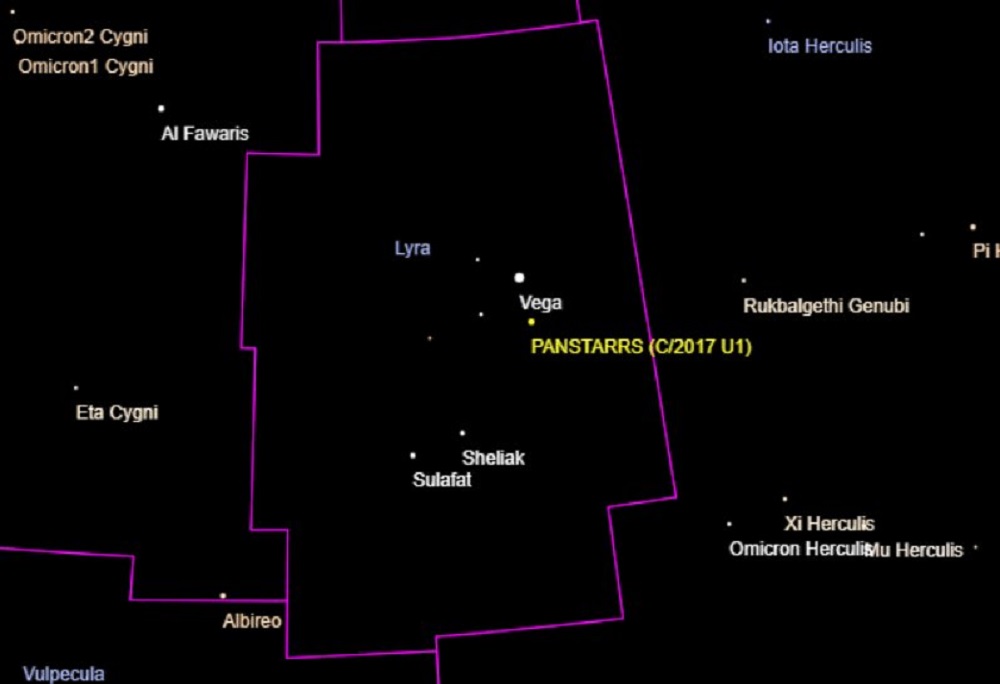
Most sources say that `Oumuamua came from very near Vega, in the constellation Lyra. Vega is a young blue-white star 25 light-years away, surrounded by what may be a disc of planet-forming material, and `Oumuamua might have been ejected from there; but the agreement isn’t all that close. `Oumuamua came from Right Ascension 279º.55, declination 33º.87, and the corresponding figures for Vega are 270º.61 and 38º.78 (Fig. 1).

Using the Gaia satellite’s all-sky astrometric survey, scientists at the Max Planck Institute identified four possible candidate stars, assuming that the object hasn’t changed course since escaping from its source [1]. Closest to `Oumuamua, about one million years ago, was the reddish dwarf star HIP 3757, at about 1.96 light-years, though with a relative speed of around 25 km/s. The other three candidate stars are no better fits. Those possible origins may not be significant, but where `Oumuamua was, immediately before it came into the Solar System, probably is. Its entry point was very close to the Apex of the Sun’s Way, the point towards which the Solar System is heading. There’s some disagreement about the exact location of the Apex, but the closest fit to `Oumuamua’s entry point is at Right Ascension 277º.5, declination 30º, and its angular separation from it is only 4 degrees.
The Sun is moving through the interstellar medium with a velocity of 20 kps. When `Oumuamua began to respond to solar gravity, around 1605 AD [2], it had zero velocity up, down or sideways with respect to us and to the galactic plane, but was coming towards us through the interstellar medium with a velocity of 11 kps,giving it a resultant velocity of 26.3 kps with respect to us [3]. It was effectively at the Local Standard of Rest, as Loeb describes it, but it is something of a relief that it wasn’t precisely stationary in our frame of reference. If it were, and had come precisely from the Apex of the Sun’s Way, we might suspect that it wasn’t from interstellar space at all, but from the future, like the Tachyon signals of Gregory Benford’s novel Timescape [4].
Nevertheless, it was almost exactly in our path. Even a small diversion from that line would have allowed it to enter from anywhere on the leading hemisphere of the celestial sphere, causing it to pass the Sun more slowly and at a much greater distance. (My story, ‘The Comet, the Cairn and the Capsule’, envisaged an interstellar comet passing further from the Sun and taking six months to cross the inner Solar System – ‘My SF’, ON, 10th September 2023.) In a recent online discussion, it was put to me that `Oumuamua’s reflectivity could be explained if it previously had a dark crust, which flaked off during the approach to the Sun. But spalling on that scale would surely affect the orbit, which would have given `Oumuamua a different apparent point of origin, of no particular significance. The loss of the supposed crust might make it look as if it came from the Apex; the odds against that are very large, but it’s not inconceivable – but that doesn’t, or shouldn’t, mean that therefore it must be what happened. If `Oumuamua was actually floating virtually at rest in the interstellar medium, and so closely aligned with the Sun’s path, that’s either an extraordinary coincidence or it implies deliberate placing. It might tie in with Loeb’s ideas that it could be a buoy, or an interstellar beacon – although either would imply that it is indeed still functional. Then it had either been there for a very long time or it was left in the Sun’s Way by accident, which negates purpose, shows astonishing carelessness, and is coincidence piled upon coincidence.
If `Oumuamua’s path through the Solar System was deliberately chosen, did the supernovae shortly beforehand (Tycho’s Star in 1572 and Kepler’s Star in 1604) provide some useful fine-tuning of the approach? With 400 years to take effect, even a small impulse might make quite a difference to the apparent point of entry. But where `Oumuamua is going as a result of that gravitational slingshot is highly significant. In 29,000 years ’Oumuamua will pass the star Ross 248 at 0.459 parsecs (1.5 light-years) with a velocity of 104 km/s. For living beings that wait would be unconscionable, but for an artificial intelligence the time spent in transit is nothing – literally, neither here nor there.
But in that time, if the sail or the swarm can adjust its orientation to starlight, could `Oumuamua tack to another close encounter? The average shift required is only 3.337 Astronomical Units per year, i.e. just under 3.4 times the Earth’s distance from the Sun. There was disagreement among experts I consulted as to whether or not this was possible. However, soon after my article went to press, Prof. Gregory L. Matloff published a paper on a related topic [5]. His concern was that on a mission to Alpha Centauri, for example, a one-second delay in unfurling a solar sail at a perihelion of 0.1 Astronomical Units (10 million miles approx.) could lead to a miss distance at the target star of 2.384 AU. On a 20-year mission to the Sun’s gravitational focus at 600 AU, sunlight pressure might correct such an error within 10 years of launch, but would be unlikely to achieve the correction required for more distant targets.
I therefore asked Prof. Matloff whether starlight pressure could achieve the 1.5 light-years deflection required to close with Ross 248, over 29,000 years. After a stimulating correspondence, the answer we came to was that with current light-sail technology, the maximum deflection to be achieved by the light from a single first-magnitude star such as Rigel would be 1 to 5 Astronomical Units. (Such large numbers are involved that the result is very sensitive to small changes in the approximations made.) Even an 8-segment heliogyro, tracking 8 first-magnitude stars in the trailing hemisphere, would only multiply the thrust five-fold. A 20-fold increase in sail efficiency, foreseeable with improvements in the technology [6], would conceivably multiply the deflection by 100 times, but would still be only one-thousandth of what would be required to bring ‘Oumuamua to a close pass around Ross 248 in 29,000 years’ time. But perhaps that isn’t the end of the matter.
Publication of the most recent version of this article in Analog brought a query from reader Scott T. Meissner, who asked whether an electrically charged solar sail might answer some of the anomalies in ’Oumuamua’s behaviour. I first came across that concept in an Analog article by Robert Zubrin in May 1992 [7] (Fig. 2.), and there was a very good update by Fraser Cain on Universe Today in 2017, discussing NASA studies of a Heliopause Electrostatic Rapid Transit System (HERTS), which could reach the heliopause and enter interstellar space in just 10 years from launch [8].

However the key point about charged solar sails is that they provide much higher acceleration than sails powered purely by reflected light. In Extraterrestrial, Prof. Avi Loeb points out (and should perhaps have stressed more) that ‘Oumuamua’s acceleration fell off in direct proportion to the inverse square of its distance from the Sun, as would be expected with a reflective solar sail [13]. The acceleration of a charged sail would have been much higher, and while it would diminish with increasing solar distance, it wouldn’t obey the inverse square law nearly so closely because the Solar Wind is made up of charged particles, not electromagnetic radiation. Coronal Mass Ejections would produce big variations in thrust, and I suggested in my book Man & the Planets that charged solar sails might even be dismasted by them [9]. If ‘Oumuamua had the capability to charge up its sail, probably it wouldn’t do so in the inner Solar System because it would then be going too fast for useful study of the planets. However, even that isn’t necessarily the end of the matter.
If as I’ve suggested ‘Oumuamua is under active control, and reports ‘home’ on its findings, then it might have enough power to charge up an electric sail once it’s far enough out for the normal sail to be ineffective. Maybe the heliogyro vanes could be brought to rest and a web could be unfurled between them, and charged up sufficiently to turn ‘Oumuamua towards Ross 248. At that greater distance from the Sun, Coronal Mass Ejections might supply a much-needed boost for the sail, rather than possibly dismasting it. I had thought that my correspondence with Prof. Matloff showed that ‘Oumuamua couldn’t close with Ross 248, but Scott Meissner’s query definitely raises more possibilities. Now that we know the Sun’s magnetosphere extends far beyond the planetary system, it would be worth finding out just how firm the 1.5 light-year miss figure is, in what direction, and try to find out whether electromagnetic propulsion, at both ends of the journey, might close the gap. Other commitments have kept me from pursuing that so far, but I intend to take it further.

Ross 248 is currently one of the closer stars to the Sun, at 3.15 parsecs (10.269 light-years) in Andromeda – but in 33,000 years from now, it will be the closest star to the Solar System, passing us at 3.024 light-years [10] (Fig. 3). The only closer stars which ’Oumuamua might have targeted would be Proxima or Alpha Centauri. Ross 248 is an M5 red dwarf, and therefore likely to have planets, though none have been detected yet. It makes one wonder what ’Oumuamua or its creators may know about it that we don’t.
Intercepting `Oumuamua was out of the question, at such short notice, but chasing it is possible with near-future technology (‘Project Lyra’) [11]. It won’t be beyond the Sun’s pull until 2430, [23] which is surely time enough to catch up with it. The case for doing it now seems a great deal stronger. At the very least – whatever Prof. Loeb’s detractors may say – it seems the story is still far from over.
References
1. A.L Coryn. Davide Farnocchia Bailer-Jones,, Karen J. Meech, Ramon Brasser, Marco Micheli, Sukanya Chakrabarti, Marc W. Buie, Olivier R. Hainaut. ‘Plausible Home Stars of the Interstellar Object `Oumuamua Found in Gaia DR2’, Astronomical Journal, September 2018.
2. Anton Petrov, ’Oumuamua Finally Explained Using a Brilliant Analysis’, PBS, online, March 2021.
3. Erik Mamajek, ‘Kinematics of the Interstellar Vagabond 1I/`Oumuamua (A/2017 U1)’, Research Notes of the American Astronomical Society, November 2017.
4. Gregory Benford, Timescape, Simon & Schuster, 1980.
5. Gregory L. Matloff, ‘Interstellar Photon Sailing: Trajectory Errors Due to Sail Unfurlment Timing Delay’, Journal of the British Interplanetary Society, April 2022.
6. Slava G. Turyshev et al, ‘Scientific Opportunities with Solar Sailing Smallsats’, Earth and Planetary Astrophysics, April 2023; interview with Fraser Cain, Universe Today, online, 5th May 2023.
7. Robert Zubrin, ‘The Magnetic Sail’, Analog, May 1992.
8. Fraser Cain, ‘What is an electric sail? Another exotic way to explore the solar system’, Universe Today, online, October 25th, 2017.
9. Duncan Lunan, Man and the Planets, Ashgrove Press, 1983.
10. ‘Ross 248’, Wikipedia, accessed June 2nd, 2021.
11. Matt Williams, ‘Project Lyra, a Mission to Chase Down That Interstellar Asteroid’, Universe Today, November 23rd 2017.





Leave a Reply