
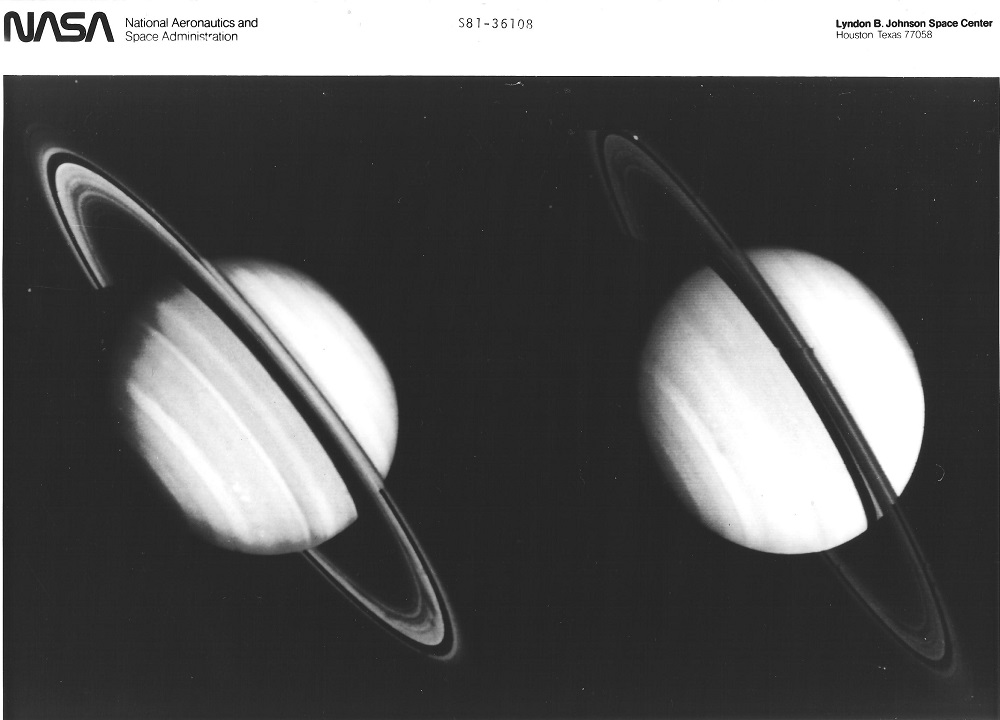
So much is happening in space at the moment that I promised to make the first ‘Space Notes’ of 2024 into an update, and it looks as if we’ll need two. One topic currently making headlines is the re-detection by the Hubble Space Telescope of the mysterious phenomenon known as ‘Saturn’s ring spokes’. See for example Paul Scott Anderson, ‘Hubble Watches Spoke Season in Saturn’s Rings’, EarthSky, online, January 3rd 2024.
Writing about ‘Saturn and Its Rings’ in Beginners’ Astronomy (ON October 24th, 2021), I said, “There certainly are powerful magnetic and electrical forces operating in the rings, and the Voyagers discovered extraordinary radial spokes silhouetted over them, revolving around Saturn with the planet’s magnetic field. The material couldn’t be in orbit and retain that radial form, and photographs of the spokes backlit by the Sun confirmed that they’re composed of dust which is presumably diamagnetic and levitated out of the ring plane by the magnetic field. But that would indicate that they’re metallic, where the rings seem to be composed overwhelmingly of water ice. The Cassini orbiter didn’t see any spokes until after September 2005, because it hadn’t yet viewed the rings from the same perspective as the Voyager approach; when they did appear, surprisingly they could be seen on the shadowed side of the rings (Barry Shanko, ‘Saturn’s Spokes Have Spoken’, Astronomy Now, November 2005).”

The two Voyager spacecraft passed through the Saturn system in November 1980 and August 1981. The Voyager 1 pass was shortly after Saturn’s equinox, when the Sun was in the plane of the rings and they were still relatively dark in the approach pictures, but the rings had opened significantly by the following year (Fig. 1). The features which became known as the ‘spokes’ can be seen at top and bottom of the Voyager 2 image on the left, and are more obvious in the colour photo (Fig. 2). In enhanced contrast they become really obvious (Fig. 3), and film of their revolution around the planet makes clear that they are centred on the planet but not in orbit, instead revolving with the planet’s magnetic field (Fig. 4).


Initially Saturn’s rings were numbered inwards, as ‘A, B and C’ (Fig. 5).
As I was growing up that was all, and amateur astronomers argued with professionals about whether there was an inner ‘D’ ring, which some called ‘The Loch Ness Monster of Saturn’. Still more controversial were reports of an ‘E’ ring on the outside of the known system. Not only did the Pioneer 11 flyby of 1979 confirm the existence of both, but it also discovered a very narrow ‘F’ ring on the outskirts of ring ‘A’. Voyager 1 added the discovery of a ‘G’ ring, (Fig.6.) between the tiny moons Janus and Epimetheus (Fig. 7), and Mimas, the innermost of Saturn’s classically known satellites (Fig. 8). The largest and outermost ring of all is known as the ‘Phoebe ring’ and is thought to emanate from Phoebe, Saturn’s backward-revolving, captured outer moon, but has yet to be honoured with a letter because the original order is now hopelessly confused (Fig. 9).


The spokes appear to be confined to the B-ring, the brightest of them all, but what they are and where they come from are still as mysterious as they were in 1981. There seemed to be a possible explanation when the Cassini mission, which reached Saturn in 2004, discovered that the E-ring was being fed by eruptions from the icy moon Enceladus (Fig. 10).

The Voyager spacecraft had discovered clear evidence of such outbreaks in the past, but unfortunately the opportunity to photograph Enceladus in closeup had been lost when Voyager 2’s camera platform jammed temporarily due to overwork. Could the diamagnetic particles in the spokes be coming from a metallic core of Enceladus, heated by radioactive decay and expelled by volcanic eruptions? The answer was no. As Cassini examined the plumes from Enceladus in ever greater detail, eventually flying through them (Fig. 11), it became clear that they were almost entirely water ice. Cassini detected organic compounds within them, feeding speculation that the subsurface ocean of Enceladus may contain life, but the volcanic eruptions of rock and metal have been thoroughly ruled out. The James Webb Space telescope has now obtained infrared images of the Enceladus plumes (Fig. 12), and what will emerge from those remains to be seen.


Another idea was that the spoke particles might be generated by eruptions from the inner moons Rhea, Tethys and Dione, which showed markings possibly generated by ‘dust geysers’. These proved to be ice cliffs and the like, and the outer layers of those moons to be composed almost entirely of water ice. Searching for ‘dust geysers’ online, I’ve drawn a complete blank, so the notion has sunk without trace.

The Cassini orbiter didn’t see the spokes until 2005 (Fig. 13), when for the first time it viewed the rings from the same perspective as Voyager 2’s. But had they been there all along, or were they a seasonal phenomenon, as Saturn and its rings approached their next equinox in 2009? Sure enough, they were there again in 2010, but there’s been no sign of them since. They appeared both above and below the rings, and curiously, when they were backlit they appeared bright, not dark (Fig. 14), making their composition still more mysterious.

Among its many other commitments, the Hubble Space Telescope now maintains an annual watch on the outer gas giant planets, Hubble Outer Planets Atmospheres Legacy (OPAL, Fig. 15).

The images since 2019 (Fig. 16) show the progressive flattening of the rings with respect to us, and the Sun, as the next equinox draws nearer (Fig. 17). The 2021 images were named the Grand Tour (Fig. 18), commemorating the 1970s outer planet mission which never was, though many of its objectives were covered by the Voyagers. Even in 2021, there was no sign of the spokes, but now in the 2023 images (Fig. 19), there they are, on both sides of the planet, as plain as day. So are they seasonal, or are they there all the time, and only visible at certain low Sun angles? What are they made of, where are they from? The mystery is as deep as ever.


Jupiter and Io
As predicted in the June ‘Sky Above You’, on December 31st NASA’s Juno spacecraft made a close flyby of Io, the innermost of the four large moons discovered by Galileo Galilei and named ‘the Galilean satellites’ in his honour. The flyby distance was to be 1500 miles, but was reduced to 930 miles, and as promised the images were spectacular (Figs. 20 and 21).


There are now reckoned to be 266 active volcanoes on Io, linked by a subsurface magma ocean (Fig. 22), and a dedicated mission called Io Volcanic Observer has been proposed to keep track of them all (Fig. 23), though it will have stiff competition from the many other planetary missions now in flight, taking shape or being proposed.


Juno’s next Io encounter will be at the same distance, on February 2nd 2024. These close approaches are only possible because of the evolution of the spacecraft’s orbit during its extended mission, originally to have ended in 2016 but now continuing till September 2025 at least. Following the latest modifications to Juno’s orbit, there will be seven more Io flybys at greater distances. But with the main mission already over and the extended one running its course, there has to be an end sometime. ESA’s Jupiter Icy Moons Explorer is already on its way, to be followed in October 2024 by NASA’s Europa Clipper mission, to take the study of Jupiter and its major moons in new directions.
Uranus and Neptune
Since the Voyager 2 flybys of Uranus in 1986 and Neptune in 1989, one of the major questions has been why those two giant planets look so different – Uranus in green and Neptune in bright blue. Now a fresh study by a team at the University of Oxford, led by Professor Patrick Irwin, suggests that the colours have been misinterpreted from the outset.
It’s not the first time that NASA’s interpretation of planetary colours has been questioned. Both the artists Ed Buckley and Gavin Roberts were doubtful about the hues of the outer planets when illustrating my New Worlds for Old (1979) and Man and the Planets (1983), and had to be persuaded to go along with something like the prevailing views. There’s an ongoing controversy about the colours on the surface of Mars, going back to the Viking landings in 1976, and that might be worth a further article. There are also questions about what colours you would actually see if you were on planets of different stars. And many of the famous images produced by the Hubble Space Telescope are in false colour, to bring out features which the human eye could never see,

Prof. Irwin and his team maintain that Uranus is a fainter green than the Voyager 2 images show, and that Neptune is much the same colour (Fig. 24), when its images are reprocessed to take account of the high speed of the spacecraft when they were taken. I have to say that on the night when I viewed both planets with one of the restored telescopes at Herstmonceux, the former site of the Royal Observatory, Uranus looked distinctly green to me but Neptune seemed almost colourless, which I attributed to its much smaller disc in the image. The Oxford team say that the problem stems from the blending of monochrome images on different wavelengths to create the Voyager images, and those of the Hubble Space Telescope’s Wide-Field Camera 3, as compared to continuous-spectrum images obtained in recent years by the Hubble Space Telescope’s Space Telescope Imaging Spectrograph (STIS) and the Multi Unit Spectroscopic Explorer (MUSE) on the European Southern Observatory’s Very Large Telescope. In both instruments, each pixel is a continuous spectrum of colours.
Because Uranus rotates ‘on its side’, with its poles almost in the plane of the equator, conditions there vary greatly over the 84 years which the planet takes to orbit the Sun. It’s suggested that varying concentrations of methane in the atmosphere make the atmosphere bluer over the equator in summer, and when the Sun is overhead at the poles, as it is now at the Uranus south, it freezes out to form the polar hood of cloud now being observed by the JWST (see the January ‘Sky Above You’). Neptune’s slightly bluer tinge is due to a thinner haze layer than Uranus’s.
Disappointing though all this may seem, we can console ourselves with the thought that it’s not telling us what we would see if we were actually there, and it may be quite a time yet before anyone finds out.
(Spaceflight news update next week.)
Duncan Lunan’s latest books are available from the publishers or through Amazon, and details are on his website, www.duncanlunan.com.
See also:


Leave a Reply