
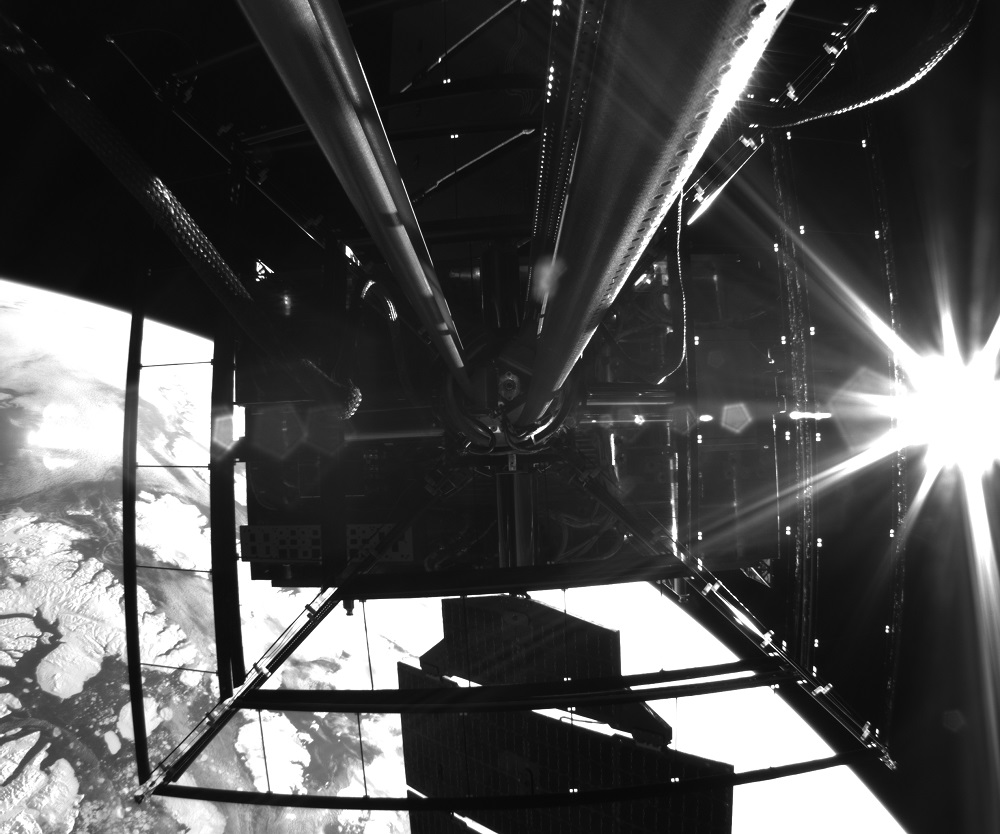
One year ago, Caltech’s Space Solar Power Demonstrator (SSPD-1) launched into space to demonstrate and test three technological innovations that are among those necessary to make space solar power a reality. The spaceborne testbed demonstrated the ability to beam power wirelessly in space.

SSPD-1 was launched on January 3, 2023, aboard a Momentus Vigoride spacecraft as part of the Caltech Space Solar Power Project (SSPP), led by professors Harry Atwater, Ali Hajimiri, and Sergio Pellegrino. It consists of three main experiments, each testing a different technology:
- DOLCE (Deployable on-Orbit ultraLight Composite Experiment): a structure measuring 1.8 meters by 1.8 meters that demonstrates the novel architecture, packaging scheme, and deployment mechanisms of the scalable modular spacecraft that will eventually make up a kilometer-scale constellation to serve as a power station.
- ALBA: a collection of 32 different types of photovoltaic (PV) cells to enable an assessment of the types of cells that can withstand punishing space environments.
- MAPLE (Microwave Array for Power-transfer Low-orbit Experiment): an array of flexible, lightweight microwave-power transmitters based on custom integrated circuits with precise timing control to focus power selectively on two different receivers to demonstrate wireless power transmission at distance in space.
“It’s not that we don’t have solar panels in space already. Solar panels are used to power the International Space Station, for example,” explained Professor Harry Atwater, Otis Booth Leadership Chair of Division of Engineering and Applied Science; Howard Hughes Professor of Applied Physics and Materials Science; director of the Liquid Sunlight Alliance; and one of the principal investigators of SSPP.
“But to launch and deploy large enough arrays to provide meaningful power to Earth, SSPP has to design and create solar power energy transfer systems that are ultra-lightweight, cheap, flexible, and deployable.”
SSPP began after philanthropist Donald Bren, chairman of Irvine Company and a life member of the Caltech community, first learned about the potential for space-based solar energy manufacturing as a young man in an article in Popular Science magazine.
Intrigued by the potential for space solar power, Bren approached Caltech’s then-president Jean-Lou Chameau in 2011 to discuss the creation of a space-based solar power research project. In the years to follow, Bren and his wife, Brigitte Bren, a Caltech trustee, agreed to make a series of donations (yielding a total commitment of over $100 million) through the Donald Bren Foundation to fund the project and to endow a number of Caltech professorships.
In addition to the support received from the Brens, Northrop Grumman Corporation provided Caltech with $12.5 million between 2014 and 2017 through a sponsored research agreement that aided technology development and advanced the project’s science.
With SSPD-1 winding down its mission, the testbed stopped communications with Earth on November 11. The Vigoride-5 vehicle that hosted SSPD-1 will remain in orbit to support continued testing and demonstration of the vehicle’s Microwave Electrothermal Thruster engines that use distilled water as a propellant. It will ultimately deorbit and disintegrate in Earth’s atmosphere.
Meanwhile, the SSPP team continues work in the lab, studying the feedback from SSPD-1 to identify the next set of fundamental research challenges for the project to tackle.




Leave a Reply