
‘Green green, it’s green they say’, was the first line of a hit song for the New Christy Minstrels in January 1963, written by Barry McGuire. But nullius in verba, as they say in the Royal Society – take nobody’s word for anything.

As I reported in ‘Update on the Outer Planets’ (ON, January 7th 2024), a study by a team at the University of Oxford, led by Professor Patrick Irwin, suggests that the colours of Uranus and Neptune have been misinterpreted since the flybys of the two giant worlds by the Voyager 2 spacecraft in 1986 and 1989, respectively. Prof. Irwin and his team maintain that Uranus is a fainter green than the Voyager images show, and that Neptune is much the same colour (Fig. 1), rather than bright blue, when the images are reprocessed to take account of the high speed of the spacecraft when they were taken. My first reaction was that when I viewed them both, with the same telescope at Herstmonceux, the former site of the Royal Observatory, on the same night and in identical observing conditions, Uranus looked distinctly green to me but Neptune seemed almost colourless, which I attributed to its much smaller disc in the image, so Prof. Irwin might be right.


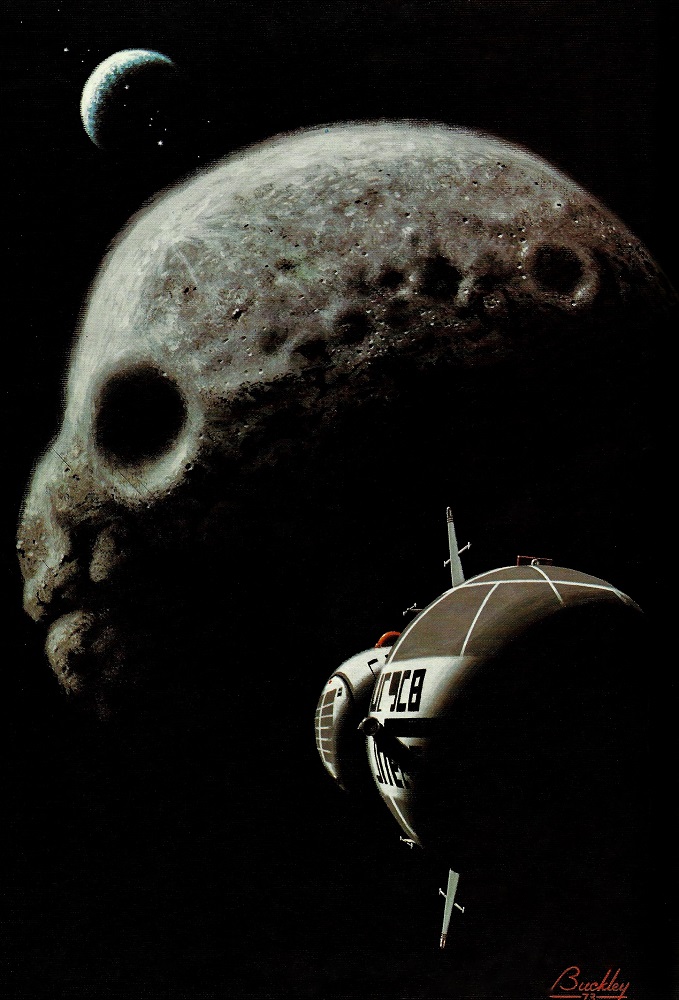
But now I’m having second thoughts. The attribution of those colours to the respective planets goes back long before Voyager: Chesley Bonestell painted Uranus as green and Neptune as bluish for Willy Ley’s The Conquest of Space in 1949, though they appeared in black and white in the book. David A. Hardy painted Uranus as green for an exhibition at the London Planetarium in 1968, and Ed Buckley painted Uranus as green in 1973 and Neptune as blue in 1975 for my books New Worlds for Old and Man & the Planets (Figs. 2 & 3) – all of them drawing on descriptions by experienced observers, long before the Voyager flybys – likewise NASA artists’ impression of the flybys themselves, before the events (Figs. 4 & 5). In 2020 Kevin Gill, a star of the ‘citizen science’ programme processing Juno images of Jupiter, re-examined the Voyager-Neptune images and made them fainter blue (Fig. 6), but still a lot bluer than Prof. Irwin’s version. It’s a little hard to believe that they were all wrong.


In astronomy, there’s often controversy about things that look green. Reports of green meteors arouse scepticism, but in my teens I saw a bright green fireball between two layers of cloud at sunset. The late Heather Couper attributed the birth of her interest in astronomy to to a similar event in her childhood. I’ve often been told that I must have been fooled by contrast with the red clouds above and below, but I’ve seen such effects demonstrated and not been convinced I was wrong in this case. The ‘green flash’ of the last rays of the setting Sun was similarly dismissed for many years, until eventually it was photographed and proved to be real (Fig. 7). I’ve seen it several times, on the upper edges of low cloud as well as on sea horizons, and each time it’s been darker green than the fireball that I saw back in the late 1950s.

Earlier, as I mentioned in the December ‘Sky Above You’, I saw a whole shower of green meteors over Troon one year in my childhood, when I wasn’t of an age to note the date. I thought later that they might have been Geminid meteors, since they were in the northern sky, but I’ve learned since that the Ursid meteor shower, from a radiant near Kochab in Ursa Minor, from about December 17 to 26, peaking around the midwinter solstice, would be a better candidate – particularly as I remember them travelling from left to right in fairly early evening. The Ursids generally produce only 5 to 10 meteors per hour, but outbursts of 100 per hour have been recorded in 1945 and 1986, with a less intense one in 1973 (Don Macholz, ‘The Ursids’ Parent Comet’, in Bruce McClure, Deborah Byrd and Mary Curran, eds., ‘2024 Ursid meteor shower: All you need to know’, EarthSky, online, December 20th, 2023). The showers are typically short, 12 hours or less, so the one I saw in the 1950s may have been little reported. And the fireballs are often green: William Mathe captured one such on December 20, 2019, in Lindon, Colorado. (Fig. 8 – Earthsky Community Photos, reproduced in ‘2024 Ursid meteor shower: All you need to know’).

When it comes to colours of the stars, the issues become still more complicated. Astrophysicists insist that there can be no green stars: the nuclear processes of stars and the way light escapes from them simply don’t allow the green component to be distinguished by the human eye because it’s swamped by radiation in other wavebands. Yet when I learned the constellations from Hector MacPherson’s Guide to the Stars (see ‘Scottish Space Writers’ ON, 12th May 2023), he referred to ‘the distinctive tinge of green which lurks in the light of Sirius’, and that was how I first identified it. Subsequently I found that most reference books said it was blue (and I have to concede that it looks blue to me through a telescope), though some added that as the brightest star in the sky, diffraction during twinkling could make it flash green or red. MacPherson also described the companion star of Antares as green, and Chesley Bonestell painted it that way for Willy Ley’s Beyond the Solar System (Sidgwick & Jackson, 1964).
I remained puzzled, especially when I described Sirius to a schoolfriend as ‘green as a street light’, and he replied indignantly ‘Mercury vapour streetlights are blue’, and on checking I found general agreement on that. At University I took the opportunity to have thorough eye tests, and I am definitely not colour-blind, even for distinguishing green from blue. But when I was three years old, I was allowed to stay up in my high chair for the first lighting of Troon’s mercury vapour lamps, and I remember my grandmother pointing out ‘the pretty green street lights’. It was so thoroughly instilled in me that that particular shade was green, that if you put me on a polygraph and made me say it was blue, the machine would say I was lying. So how can I be sure that the colours you describe are the same as the ones I see?


How people see, and how they interpret what they see, are fascinating subjects in philosophy and science. I took the Logic component of my degree in English & Philosophy under Prof. R.J. Hirst, whose set book The Problems of Perception (Routledge, 1959, Fig. 9) made a fascinating comparison with Eye and Brain, The Psychology of Seeing, by Prof Richard Gregory (Weidenfeld Nicolson,1966, Fig. 10), whom I later met at one of the 1980s IBM Heathrow Conferences. One of the classic problems in the field is, if you see a white horse standing in the shade of a tree on a sunny day, how do you know that it’s white and not grey? Once you start looking, more complicated examples are everywhere. When Rolf Harris did his paintings live on TV, he would ask, “Can you see what it is yet?”, and I would watch to see how soon people did. Some would get them from even fewer visual cues than I did, others could see nothing till they were nearly finished. MacPherson’s book used simple diagrams of the constellations and urged readers to find them in the sky with mental pictures of what they represented, while Patrick Moore’s most frequent comment was ‘Anything that looks less like (a horse, an eagle or whatever) I cannot imagine’, occasionally varied with ‘One of the few constellations that looks like what it’s supposed to represent’. He would direct his readers to draw lines far across the sky from known stars to find others, which didn’t work for me at all. Famously, a frog cannot see a fly as prey unless it’s moving; and people raised in jungles, with no distant perspectives, allegedly can’t recognise perspective drawings or photographs as any kind of image, while many people can make nothing of maps… and so on. On colours in the sky, Sir John Herschel said, “Every man sees his own aurora, as surely as he sees his own rainbow”. (‘Humboldt’s Kosmos’, in Sir John Herschel, Essays from the Edinburgh and Quarterly Reviews, Longman, Brown, Green, Longmans & Roberts, 1857.)
Specifically on colours of the outer planets, in ‘Saturn and Its Moons, Part 1’ (ON, October 31st, 2021), I described the discussions between Ed Buckley and Gavin Roberts in the mid-70s, when they were illustrating my New Worlds for Old and Man and the Planets. We had first learned about the red clouds on Titan from Mars and the Mind of Man by Carl Sagan et al (Harper & Row, 1973), and the question was, what would you see if you were out there? Gavin believed the clouds would cover the moon, but the redness would be almost imperceptible, while Ed thought (wrongly) that the clouds would be sparse, but he conducted experiments that convinced him the colours would be plainly visible. As I pointed out in the January issue of ‘The Sky Above You’, the Sun would still be 250 times brighter than our Full Moon even at the current distance of Halley’s Comet, beyond the orbit of Neptune.


There’s an ongoing controversy about the colours on the surface of Mars, going back to the Viking landings in 1976. When the first images were released, they showed an earthlike blue sky and a landscape which looked almost familiar, with green patches on the rocks (Fig. 11). Images from the early Soviet missions showed that some areas of Mars are actually green, not merely because of contrast, as was alleged of images taken from here. But then it was noticed that the US flag (Fig. 12) and the coloured cables on the lander looked ‘wrong’, and when the images were reprocessed to correct that, the sky turned pink and the landscape much more red (Fig. 13). Twenty years later, the images from Mars Pathfinder were processed similarly. But some maintain that if so much blue light was absorbed in the atmosphere, the power output from the solar panels of the Pathfinder’s Sojourner rover would have been seriously curtailed (the Vikings were powered by nuclear isotopes). Subsequent probes carried colour calibration charts (one by Damien Hirst on the nearly-successful Beagle 2), but objectors say that the result only shows what they and the landscape would look like on Earth. Short of sending people to Mars, the only way to be sure how they should look on Mars would be to illuminate them with white light to calibrate the cameras at night, then see how things appear when the Sun comes up. The issue’s not minor: when the Viking images are retuned, making the sky a deep, streaky blue, the green patches reappear on the rocks and look very much like terrestrial lichen,once thought to be the dominant form of life on Mars. (Ron L. Levin, Gilbert V. Levin, ‘Solving the Color Calibration Problem of Martian Lander Images’, in “Instruments, Methods, and Missions for Astrobiology, SPIE Proceedings 5163”, August 2003.)
When I was researching the mediaeval mystery of the Green Children of Woolpit (ON, June 19th and 26th, 2022), I thought it would be interesting to paint a panel with the ‘leek-green’ colour they were said to have, and illuminate them with different coloured lights to see what would happen. The artist was taken ill and nothing came of the idea, but some time later, Chris O’Kane (then of the Glasgow Science Centre) showed me an exhibit they had, with coloured silhouettes, lit with white light, red and purple. Coincidentally, or perhaps not, the green figure was a girl (Fig. 14). In red light, she looked a darker red (Fig. 15); in purple, she was black to me, but Chris saw her as grey. In purple and white, I saw her as grey (Fig. 16).


When I learned that interior illustrations of Children from the Sky (Mutus Liber, 2012) would have to be in black and white, I dropped that discussion; but not with much regret, because what we were testing was how a green silhouette looked under monochrome light. It’s much harder to predict how colours would look under the full-spectrum light of a red dwarf star, or more plausibly perhaps an orange dwarf (because of the red dwarf flare hazard), as Sydney Jordan painted the imagined colony planet (Fig. 17).

Chesley Bonestell was the first artist I know of to have painted landscapes under other suns, with different colours and contrasting shadows, for Willy Ley’s The Conquest of Space and Beyond the Solar System, above; but again, they all assumed monochrome light. It’s even been suggested that we would be unaware of the colour difference, registering only that the yellow light to which our eyes are most sensitive was brighter or dimmer. (Ken Crosswell, ‘Red, Willing and Able’, New Scientist, 27th January, 2001; Stephen L. Gillett, ‘Retirement Homes of the Gods’, Analog, November 2005.) Significantly, the children didn’t describe any major difference in colours between their twilit world and Earth – quite the reverse, they said that ‘all the inhabitants and all plants that were held in that land/world were dyed with the colour green’, evidently much the same that they saw here. In central Scotland in summer, we don’t lose colours in the landscape until an hour after sunset, probably longer further north, e.g. in Orkney; so that gives an idea of the level of twilight illumination they were used to,
So to sum it all up, when I’m told that Uranus isn’t sea-green, as I’ve long believed – for now at least, I’ll have to take that with a pinch of salt.




Leave a Reply