
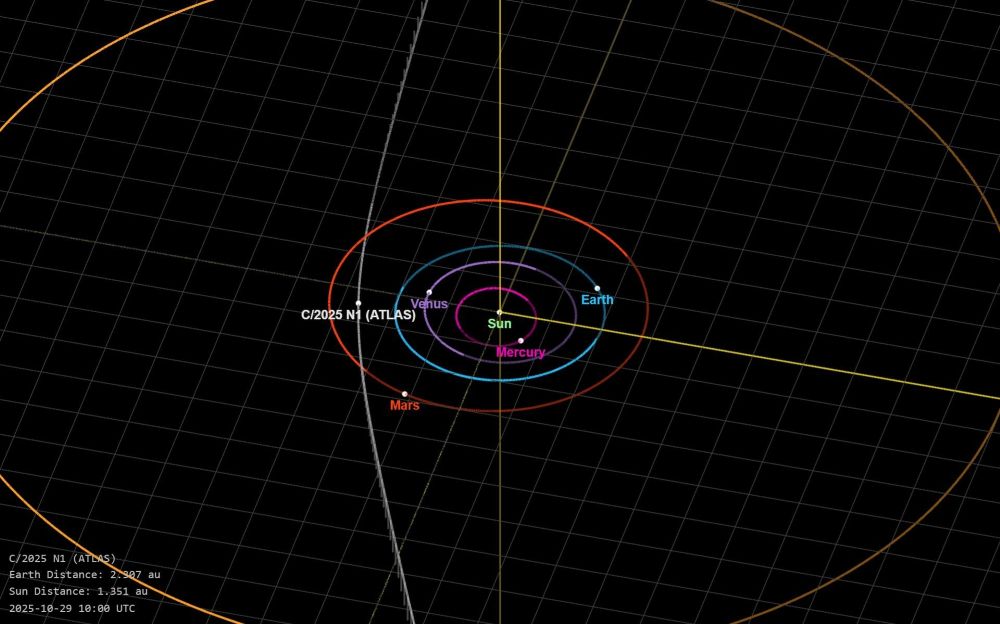
The last month has been eventful for Comet 3I/ATLAS, with its passage of Mars at 18.6 million miles on September 24th, and its perihelion passage of the Sun on October 29th, though neither was particularly close on the scale of the inner Solar System (Figs. 1 & 2).


The flow of misinformation has continued unchecked, with persistent efforts to classify it as a ‘normal’ or ‘typical’ comet at one extreme, and rumours of secret government programmes and deployment of special forces to counter the supposed ‘threat’ to Earth at the other.


Late-appearing images from before last month include the multispectral ones from the Gemini South and Hubble Space Telescopes (Figs. 3 & 4), in which water vapour and iron dust were detected for the first time, along with the first appearance of a tail pointing away from the Sun – supposedly showing that it’s just like any other comet, except that there’s far more carbon dioxide than water vapour, and far more nickel than iron, and the sunward ‘antitail’ which had already been detected is much more prominent than the rearward one, all of which are unusual.

An image from the Psyche spacecraft, on its way to the asteroid of the same name (Fig. 5), confirmed the existence of a gaseous halo. Multiple images in different wavelengths during September indicated that a colour change was taking place (Figs. 6-7), although there was disagreement about what it was, with Prof. Avi Loeb saying it had turned blue, possibly due to metallic dust, and others claiming it was green and coloured by cyanide compounds, found in normal comets.


I found myself wondering if any of this was due to the ambiguity between exact shades of blue and green which I discussed in ‘Green Green, It’s Green They Say’ (ON, 21st January 2024). The PUNCH spacecraft at the Sun-Earth L1 point, a million miles closer, took a time exposure showing Mars passing the object (Fig. 8), but little else.

As I expected, the images taken from spacecraft on and around Mars showed little more. In ‘Space Notes, November 2025’, (ON, 3rd November 2025), I didn’t show the view from Perseverance on the Martian surface, in which the dot of the comet is barely visible (Fig. 9).

A big deal has been made of the non-appearance of images from Mars Reconnaissance Orbiter, due to the US government shutdown. Now they are available (Figs 10-12), and in my view the version without captions shows the comet best, even though they are time exposures, affected by ‘jitter’ of the spacecraft (which wasn’t designed to take such images) and by the comet’s motion, which it couldn’t track with sufficient precision.


The conspiracy theorists, who insisted that the government had them and was concealing them, have already switched tack and now insist that the images ‘must’ be fake. But the observations from MRO will allow the comet’s trajectory to be calculated with much greater accuracy, which will settle the question about whether it’s varying from prediction (see below).


As the comet approached the Sun, it also passed close to it as seen from Earth. Excited predictions that it could be seen by SOHO at the Sun-Earth L1 point were balanced by doubts that SOHO could see it – in the event it did (Figs. 13-14). but the results were not exactly spectacular, and claims that SOHO could analyse the gases in its tail were highly exaggerated, as I said in the November ‘Space Notes’. The GOES-19 weather satellite in geosynchronous orbit actually did better with its Compact Coronagraph (Fig. 15), as shown last time.

As the comet has emerged from behind the Sun considerably brighter than before, it’s now within grasp of a wide range of professional and amateur instruments, and early results are interesting (Figs. 16 and 17), now that we have a better view of the tail.


The structure visible in Fig. 18 led Prof. Loeb to wonder if the comet had fragmented during perihelion, but that has proved not to be the case. Nevertheless it’s obvious that there has been a major outburst of material from the nucleus, which must have been well before perihelion, though we couldn’t see it from that angle.


Prof. Loeb is particularly interested in the radial jets which can now be seen projecting at various angles down-Sun (Figs. 19-21; Avi Loeb, ‘A Complex Jet Structure Emanates from 3I/ATLAS After Perihelion’, Medium, November 8th 2025, ‘The Remarkable Large-Scale Structure of Anti-Tail and Tail Jets from 3I/ATLAS’, November 9th, 2025). These too must have been ejected before perihelion, and with considerable force. “At the current distance of 3I/ATLAS from Earth, 326 million kilometers, these angular extents correspond to spatial sizes of 0.95 million kilometers for the sunward anti-tail jets and 2.85 million kilometers for the tail jet away from the Sun. This enormous spatial scale is three orders of magnitude larger than the scale of the glowing halo around 3I/ATLAS in the Hubble Space Telescope image from July 21, 2025. This multi-jet structure constitutes a remarkable target for future observations with the Hubble and Webb telescopes, as 3I/ATLAS will arrive at closest approach to Earth on December 19, 2025 (Fig. 22). Its minimal distance from Earth will be 269 million kilometers, about a hundred times larger than the extent of the jet structure in today’s images.”

The mass ejected in the antitail and down-Sun jets, seven in all, can be calculated as 50 billion tons per month, which is more than the estimated total mass of the comet, 33 billion tons, assuming that it’s 5 km in diameter or less, as was estimated from the early Hubble images. If the energy required to sublimate that mass from the nucleus came from the Sun, it can be calculated that the nucleus must be 20-30 km in diameter, much larger than thought. The alternative, as Avi Loeb points out (not entirely tongue-in-cheek) is that the jets could be from an active propulsion system, the product of high technology, and might be moving its path closer to Earth .

Fascinating though the suggestion is, I have one problem with it. Multiple jets firing in different directions would tend to cancel one another out. An example is Comet Swift-Tuttle, the Great Comet of 1862 (Fig. 23).


It was seen to have multiple jets (Figs. 24-25), and computer modelling indicated that there were at least seven active areas on the nucleus. In the early 1980s the fear was that they would divert the comet, which is the source of the Perseid meteors (Fig. 26), into a collision course with Earth.

At one point it was thought that the chance of a collision could be as high as 1 in 400. When the comet returned in 1992, its orbital period proved to be 130 years, not 120, and Robert McNaught from Prestwick proved at the Siding Spring Observatory that there was no chance of a collision at the next two passes – provided that the thrust from the jets remains balanced, as it was in 1862 and 1992. If it doesn’t, as Arthur C. Clarke pointed out in The Hammer of God (Gollancz, 1993), there is ‘plenty of time for it to change is mind again’. But for 3I/ATLAS to close the gap of 269 million km, from its present location with only three weeks to go, will take a lot more than that.
Comet Swift-Tuttle is discussed in detail in the opening chapter of Duncan’s Incoming Asteroid! What could we do about it? (Springer, 2013). Like Duncan’s other recent books it is available through Amazon or from bookshops; details are on Duncan’s website, www.duncanlunan.com.




Leave a Reply