
(First published in Interzone # 274, March 2018.)

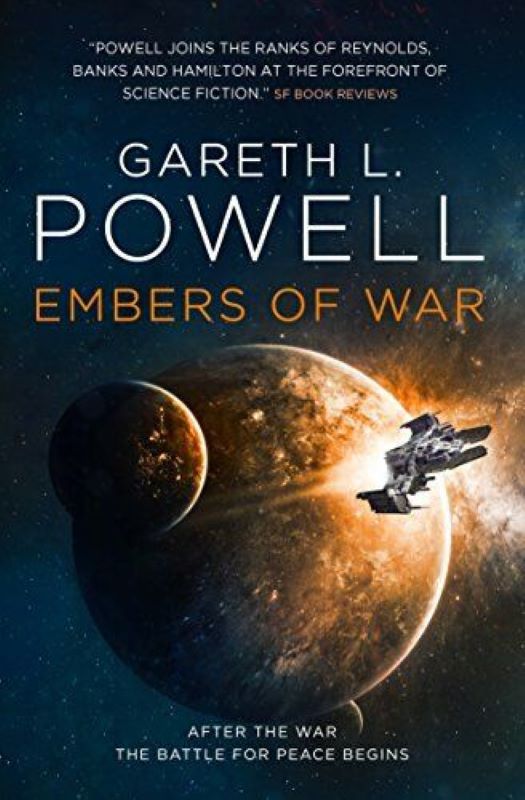
“Embers of War”, by Gareth L. Powell, £7.99 pbk and eBook, Titan Books, 416 pp., 2018.
First of a trilogy, Embers of War is action-adventure, but its darker levels have echoes of World War 2. At a conference of Allied leaders, Churchill remarked that if the enemy knew their whereabouts, the war could be ended at a stroke. In the interstellar war at the beginning of this novel, one side’s leaders are secretly meeting in a sentient forest, the dominant life-form on a heavily defended planet. To be certain of killing them, to end the war and save countless human lives, the entire forest must be destroyed – the dilemma of Hiroshima and Nagasaki, on a planetary scale. In his autobiography Miracles of Life (2008), J.G. Ballard expressed his lifelong certainty that the Bomb had to be used, and although I’m not so sure, I’ve never met a member of the Armed Forces who wouldn’t agree with him.
In the aftermath, Annelida Deal, who passed on the order for the attack, is given a new appearance and a new identity as protection. She’s not outwardly possessed by grief, unlike Leonard Cheshire or as spuriously claimed by Eatherly, unless it comes out through her war poetry, which we don’t get to see but which puts her life at risk. On her way to a reading, the liner she’s in is shot down on a planet which an ancient race has sculpted into the form of a brain. When killer robots descend to massacre the survivors, she realises that she may be the target, but she has no thought of giving herself up. Instead she runs through the convolutions of the Brain (heavy symbolism here) although they provide no overhead cover, until she finds a way into the interior. What she finds will be no surprise to Hitchhiker fans, but to say more would spoil not just this first novel but the two to follow.
A greater burden of guilt is borne by the sentient warship Trouble Dog, which resigned its commission after the forest attack, was stripped of its weapons and joined an interstellar rescue service whose missions are as near-hopeless as our ocean searches for downed submarines and airliners. It sets off to help the liner with the usual crew of misfits, and it’s perhaps unfortunate that this novel comes out so soon after Michael Cobley’s Ancestral Machines, with its homages to Firefly (Review, ON, 24rd March, 2024). The interstellar refuelling depot is amazingly run-down, given the value of what it ships out, and sure enough, the two passengers who are taken aboard there have a secret agenda and one of them tries to take over the ship. But not all the apparent clichés are borne out: the inexperienced young officer who’s the son of an admiral really is the dead loss he appears to be – unlike almost everyone else, he doesn’t even get to narrate chapters in first person.
It’s not giving too much away to say that the admiral, who ordered the forest attack and let Annelida Deal take the blame, is the real baddie, though I had to look back to the Prologue to work out his motivation. His plot which brings all the characters together at the Brain world is worthy of Machiavelli. But it relies a great deal on coincidence: with all the celestial sphere to choose from, the liner, the attacking warship, the rescue ship and its refuelling stop all have to be more or less in a straight line at the outset, and spaced at the right distances along it, for the plan to work out. Either he’s gifted with extraordinary prescience, or the plot has been worked backwards from the planned climax. Also it’s overkill: if the need is only to silence Deal, in her new persona of Ona Sudak, it would be easier, more reliable and certainly less conspicuous to send an assassin, rather than a warship, backed up by a battle fleet on a very feeble excuse. And I do mean feeble: the son who’s been planted aboard the Trouble Dog makes The Navy Lark‘s Sub-Lieutenant Phillips (Fig. 2) look like Hornblower or Jack Aubrey – though there are belated signs that he’ll Turn Out All Right.

At the end, Deal aka Sudak has a tiger by the tail. Although her enemy has been taken down almost too casually, with two more novels to go, whatever she does next is obviously not going to be easy. But from here on, pay attention to Nod, the multi-armed nonhuman engineer whose private musings become increasingly poetic (and we are permitted to see those, unlike Sudak’s reportedly powerful verse). Nod’s species were repairing starships “before humans tamed fire” and they knew the ancient races. “Of course, they could have asked me. But nobody asks the Druff.” Like Trace Gemini, the lassie with the tail in Gene Roddenberry’s Andromeda (Fig. 3), Nod knows a great deal more about what’s really going on than the human characters do.




Leave a Reply