
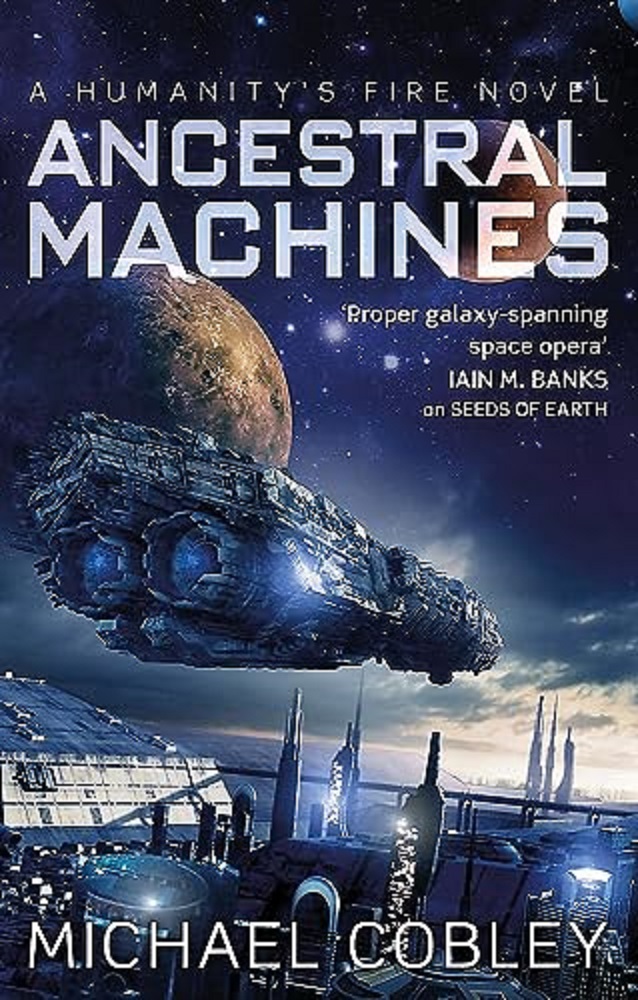
‘First published in Shoreline of Infinity 8, June 15th 2017

Michael Cobley, “Ancestral Machines, A Humanity’s Fire Novel”, £8.99 paperback, 504 pp., Orbit, 2016.
I enjoyed the ‘Humanity’s Fire’ trilogy which preceded this novel, but I was concerned that the opening of the Well into vast sub-layers of alternative realities and ancient technologies would submerge the emphasis on human values which had characterised the early parts of the trilogy. When I found that Ancestral Machines begins down there, I feared that my misgivings would be justified – intriguing though it was to find events in “a cavernous opening half a million miles wide and about three million long, its floor a vast plain littered with the cracked, smashed and split ruins of entire worlds”, like Slartibardfast’s workshop in the film version of Hitchhiker if the antigravity failed. I was also put off by starting with a conversation between two artificial intelligences, of which I have been reading rather a lot in recent SF. However, the action moves from there up to our level of reality, the prime continuum, and though the drone which is dispatched to it has a major part to play towards the end, it’s out of action for much of the novel.
It’s sent to counter the emergence near ‘Earthsphere’ of a truly nasty construct called the Warcage, which was once an artificial solar system called the Great Harbour of Benevolent Harmony. It has long since been taken over by dissidents with a lust for war and conquest, who pit the inhabitants of its planets against one another, breeding ever more savage warriors, and replacing each world as it becomes ruined with a fresh one stolen from elsewhere. Such planet-collecting has featured in SF before, in the BBC’s long-forgotten serial The Big Pull, in a story by the late Lesley Hatch called ‘Asset-strippers’ in the Daily Record‘s ‘Lance McLane strip’, and more recently in Dr. Who. Until recently the general view in astrodynamics was that such collections of habitable worlds were dynamically impossible, and it’s described here as “a massive macro-engineering achievement”, although the late Prof. Archie Roy wasn’t so sure – simulations at Glasgow University had suggested that up to 60 earth like worlds could be added to the inner Solar System without drastic effect. The recent discovery of seven earth like planets tightly clustered around the star TRAPPIST-1 suggests that maybe planetary collection could work without super-technology to hold the system together. In that literal sense, the late Chris Boyce may not have been right when he said, “Interstellar chequers is not a viable mode of existence”.

The TV/film comparisons are appropriate because in his Acknowledgements Michael Cobley makes a second dedication, to the writers and actors of Firefly (Fig. 2). Here the freelance starship captain is called Pyke (try not to think of the Star Trek pilot episode or of Dad’s Army, and when he meets up with a woman officer of Earthspace intelligence called Sam, try not to think of Stargate). We meet him when he’s just been robbed of a cargo and two of his crew have (apparently) been killed. Setting off in pursuit, he rescues another, stranded crew who take over the ship (Fig. 3). To regain it and crew members being held hostage, he must penetrate the Warcage and assassinate a local overlord, to give rebellion against them time to find its feet.

That’s only a partial summary and there are numerous complicating elements, particularly a military leader on the other side who’s haunted by the personalities of his ancestors – at first an irritation but later to prove crucial. It’s all good rollicking stuff, and the few reservations I have concern characterisation and plot. I think Michael relies too much on reader knowledge of Firefly to let us link to his characters. The series is not that well known – it was just a word to me until Serenity was televised, amd not having the background, it meant little to me then. I wouldn’t have seen it ever, but that my wife is a fan of Nathan Fillion in Castle. And while I can see him as ‘Mal’ Reynolds haring off after his missing cargo and revenge, for dramatic reasons within an episode, it’s at least possible (especially at movie length) that he would cut his losses, bide his time, and position himself for a more satisfying retribution. Like the one in Tom Toner’s The Promise of the Child, which I reviewed for Shoreline of Infinity, Vol. 1 No.2, December 2015, the whole assassination plot rests on similar shaky assumptions throughout. In particular, I can’t see Reynolds letting Firefly be taken over by strangers with such laughable ease: all it takes is for the last two crew members aboard Pyke’s ship to be given a false message that they’re wanted at the base of the ramp.
Starting a story in medias res is a powerful device, but it’s not always effective. Pyke loses two of his crew at the outset, more are taken hostage as he loses his ship, and on his way into the Warcage still another has to be left behind at a location which proves crucial later. I regret to say that I began to find this funny rather than sharing Pyke’s anger and grief, let alone the feelings of the other crew members, and when they’re reunited at the end I didn’t rejoice as I should, because I’d never seen them working together as a team in the first place. But now they are all back together and have their ship back, no doubt there will be more fun to come.


Leave a Reply