
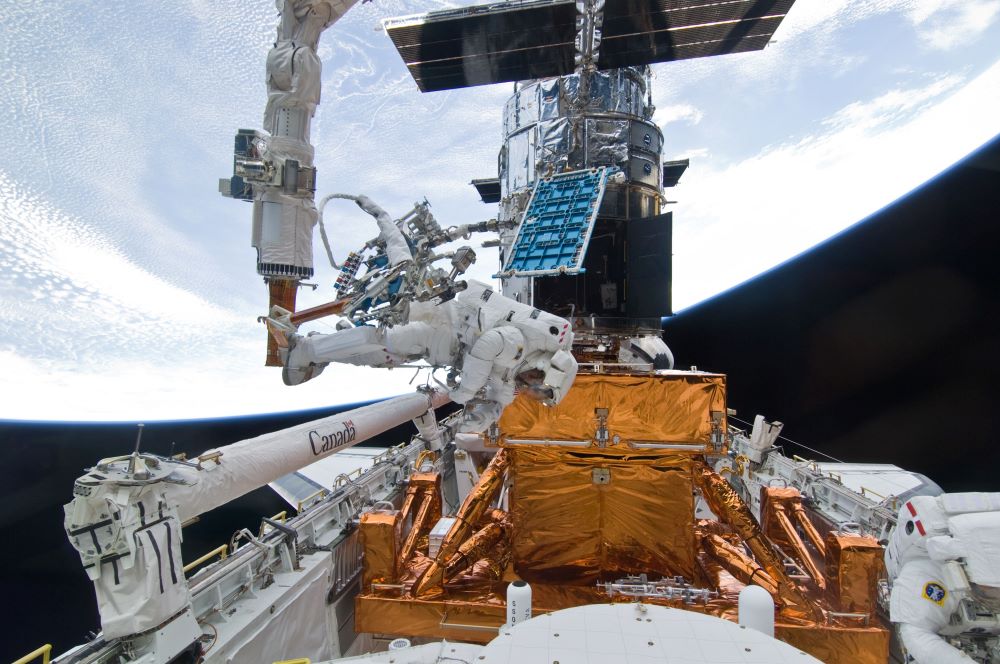
It is 15 years since human hands touched NASA’s Hubble Space Telescope for the last time.

Today, more than three decades after its launch in 1990, Hubble continues to send stunning images back to Earth and conduct groundbreaking science. Much of the credit for the last 15 years belongs to Servicing Mission 4 (SM4), the fifth mission to repair and upgrade the telescope.
“I had high hopes that Hubble would last at least five years more, and maybe even a little more to overlap with Webb,” said astronaut and former associate administrator for NASA’s Science Mission Directorate John Grunsfeld, who participated in three Hubble servicing missions and was lead mission specialist on SM4.
“Here we are at 15 years and Hubble is going strong. The science from Hubble has been phenomenal.”
Servicing Mission 4 was launched on 11 May 2009. It would be the last space shuttle mission to Hubble, with the retirement of the shuttle announced in 2004. In addition to installing two new instruments and replacing and upgrading key components, astronauts would make repairs never envisioned when the telescope was designed.
Megan McArthur, SM4 astronaut and primary operator of the shuttle’s robotic arm during the mission said:
“I looked at one of my crewmates and we both teared up in that moment because it was such a powerful reminder of how important this was, and how meaningful it was for this huge community of engineers and scientists around the world who use that telescope to unlock the mysteries of the universe.”
Hubble was designed and built for servicing in space, with modular, plug-and-play style components that could be easily swapped out. Astronauts had visited it four previous times leading up to SM4. (Servicing Mission 3 was split into two missions (3A and 3B) to get urgent repairs to Hubble quickly.) But during SM4, for the first time, astronauts cracked into two of the instruments to perform surgery in orbit. Using tools specially designed for the task, they opened up the ACS and STIS, swapped out components, rerouted power, and restored the instruments to their full capabilities.
The repairs were so effective that the two instruments have now gone more than twice as long without needing servicing than they achieved in the years prior to Servicing Mission 4.
Astronauts removed two older scientific instruments and added Wide Field Camera 3 (WFC3), a powerful camera that sees some ultraviolet and infrared wavelengths as well as visible light, and the Cosmic Origins Spectrograph (COS), which breaks ultraviolet light from cosmic objects into its component colours for analysis.
They installed a new science computer and insulation. They replaced the telescope’s 19-year-old batteries and all of its gyroscopes, which determine how fast Hubble is turning and in what direction, with improved versions. Three of those gyroscopes have now operated longer than any gyroscopes previously installed on Hubble, and one has now been running continuously for 15 years, completing over 9 trillion revolutions.
At one point, a bolt locking the Wide Field and Planetary Camera 2 into place wouldn’t turn. At another, a stripped screw on one of Hubble’s handrails blocked access to STIS and brought work to a standstill for hours, finally forcing astronaut Michael Massimino to physically wrench the handrail free.
Dr. Jennifer Wiseman, Hubble Space Telescope senior project scientist explained the significance of Hubble and the repairs down 15 years ago.
“There’s no doubt in my mind that the new and repaired instruments on Hubble are enabling scientific productivity like we’ve never seen before. Being able to observe in wavelengths ranging from ultraviolet through the visible and into the near-infrared gives us a toolbox that is enabling new science in powerful ways that we never fully had before. Research by the scientific community is thriving based on Hubble data that have been taken since SM4.”

SM4 Astronaut Megan McArthur said:
“We have these amazing ideas like, let’s build a telescope and put it in orbit around the Earth to unlock the mysteries of the universe ― these very grand visions. And then here I am actually looking at it with my own eyes, this marvel of engineering that does exactly that. It gives me faith in humanity that when we put our minds to it, we can do just about anything, as long as we’re willing to work together.”



Leave a Reply