
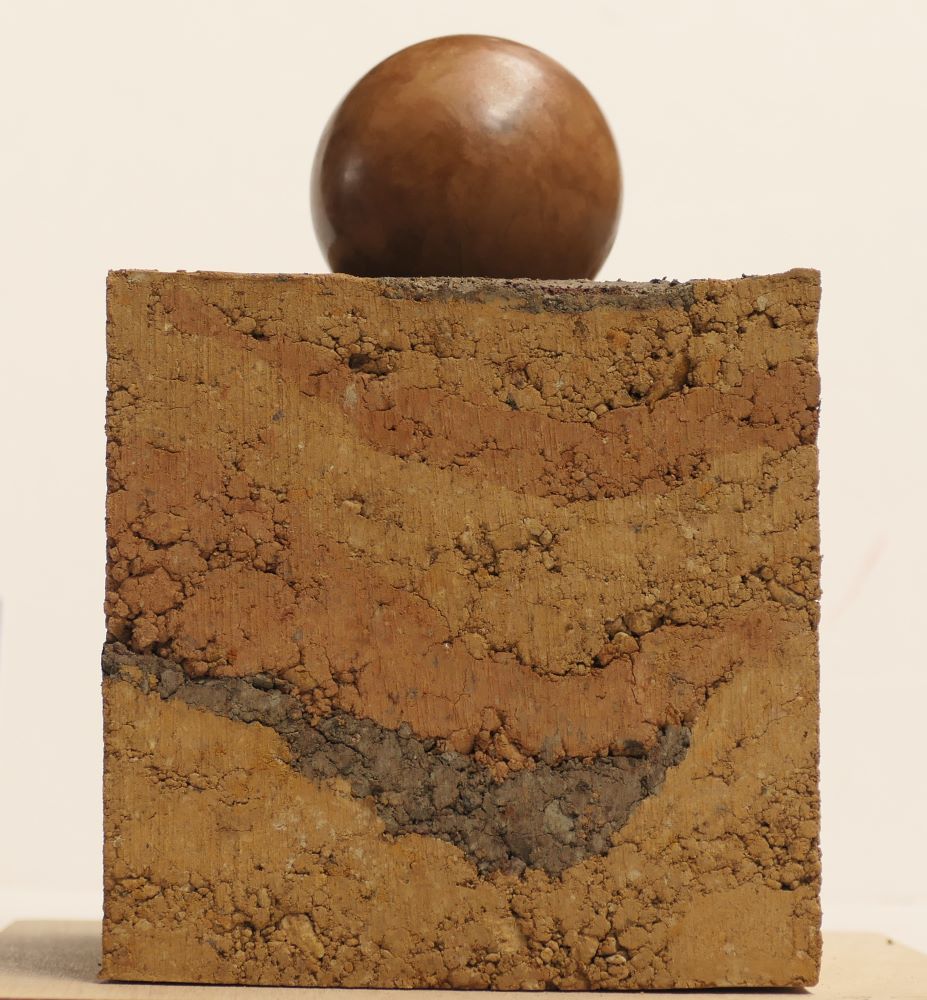
The earth beneath our feet has been at the heart of Orkney’s culture and construction for more than 6,000 years. Tom Morton of Arc Architects and Becky Little of Rebearth, specialists in the heritage of natural materials, have been studying Orkney’s clay subsoils for the last three years, funded by Historic Environment Scotland.
Some of the most mysterious things found in excavations of the first homes on Orkney are small balls of clay, discovered on at least eight sites and around 5,000 years old. Sometimes a single ball, sometimes dozens, some rough and lumpy, others smoothly spherical.

Who made them and why is unclear. While they are unusual in Scotland, similar things have been made around the world in other cultures and times.
The exhibition displays 16 Neolithic clay balls found at three locations on Orkney.
THE EXHIBITION
- Maeshowe Visitor Centre, Stenness 27th June – 31st August 2024
- Ship O’Fools Gallery, Kirkwall 5th – 12th September 2024
What is clear is that a relationship to earth was key to the Neolithic culture in Orkney. Farming relied on knowledge of the fertility and drainage of earth, while pottery required an understanding of the physical chemistry of different clays, their plasticity and response to heat. But earth was also fundamental to Neolithic construction; mortar and cores in stone walls, plasters and pigments, bedding and sealants, and above all beautiful beaten clay floors. It was a tradition of earth construction that lasted in Orkney until the late 19th Century.

This exhibition presents an exploration of the clay earths that were deposited on Orkney during the last Ice Age and were used in traditional craft and construction. From the large deposits of gold and red clay to the smaller amounts of exotic blues, greens, whites and blacks found in special locations.
The exhibition is part of a summer’s programme of events made possible through partnerships with Earth Building UK & Ireland, Orkney Museum, Orkney International Science Festival, Orkney Japan Association, UHI Orkney College, Ness of Brodgar Trust, and Historic Environment Scotland.
Tom Morton, programme director, said
‘‘It’s really exciting to be able to share this work with a wide public audience as well as heritage professionals. The story of how clay earth has been used by people in Orkney has been a quiet mystery and there is such a wealth of earth on the islands to be discovered.’’
The exhibition features clay balls recovered from several Neolithic sites, alongside art works exploring the different character of clay soils across the islands.
‘‘Many people will know that traditional buildings used clay mortar in the walls, but these local natural materials are now enjoying a comeback as sustainable, low carbon construction materials that can contribute to resilient and circular economies of the future, especially for island communities.’’
Gail Williamson, Grants Operations Manager at Historic Environment Scotland, said:
“Orkney plays a vital role in our heritage as home to some of our most iconic sites and over 6,000 years of Scotland’s history. We’re thrilled to be funding the Earth Building UK and Ireland’s Earthbound Orkney project, which will not only raise awareness of and celebrate Orkney’s earth material heritage, but will also provide training to help ensure continued conservation on these important islands.”
The free exhibition runs at Maeshowe Visitor Centre until September when it will move to Kirkwall for the Science Festival, along with a public talk by the team and training workshops, which are open to professionals and members of the public interested in Orkneys heritage.



Leave a Reply