
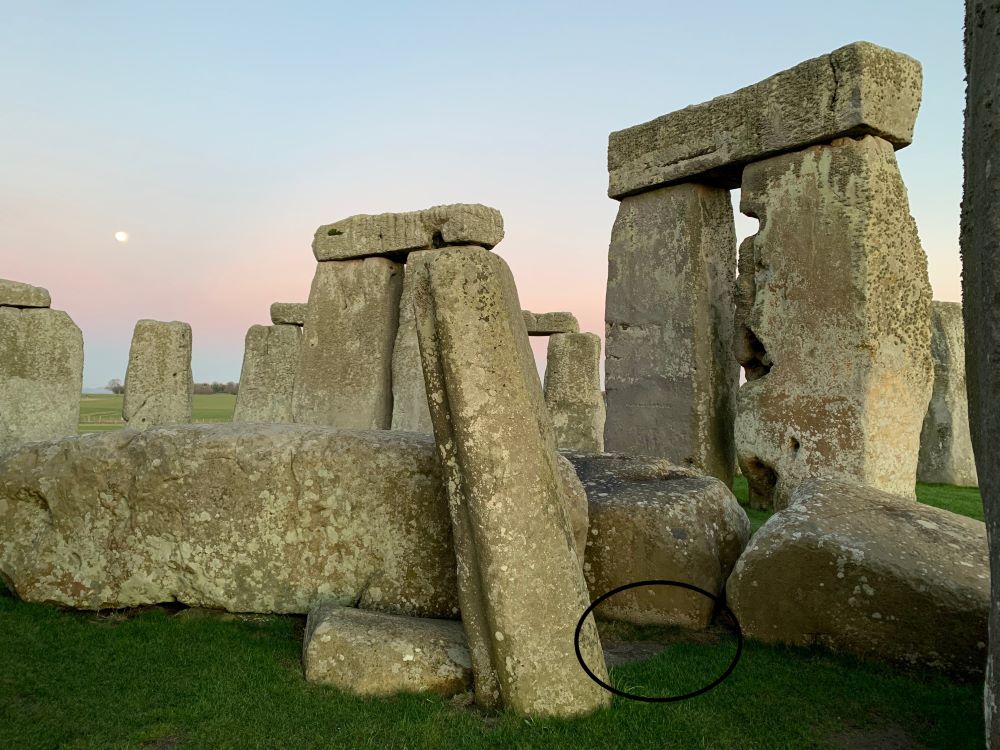
In new research led by researchers at Curtin University, Australia, analysis of the age and chemical composition of minerals within fragments of the Altar Stone at Stonehenge reveals a match with rocks from the Orcadian Basin.

To transport such a stone to Stonehenge would require advanced transport methods and a sophisticated network of communities in existence over 5,000 years ago.
The Altar Stone is a 50cm thick sandstone block measuring 5 x 1 metres, that sits at the centre of Stonehenge’s iconic stone circle in Wiltshire. The researchers studied fragments of the stone.
Lead author PhD student Anthony Clarke from the Timescales of Mineral Systems Group within Curtin’s School of Earth and Planetary Sciences explained:
“Our analysis found specific mineral grains in the Altar Stone are mostly between 1000 to 2000 million years old, while other minerals are around 450 million years old.
“This provides a distinct chemical fingerprint suggesting the stone came from rocks in the Orcadian Basin, Scotland, at least 750 kilometres away from Stonehenge.
“Given its Scottish origins, the findings raise fascinating questions, considering the technological constraints of the Neolithic era, as to how such a massive stone was transported over vast distances around 2600 BC.
“This discovery also holds personal significance for me. I grew up in the Mynydd Preseli, Wales, where some of Stonehenge’s stones came from. I first visited Stonehenge when I was one year old and now at 25, I returned from Australia to help make this scientific discovery – you could say I’ve come full circle at the stone circle.”
Click on this link to access, A Scottish Provenance for the Altar Stone of Stonehenge, published in the journal Nature.

Professor Chris Kirkland, also from the Timescales of Mineral Systems Group at Curtin, said the findings had significant implications for understanding ancient communities, their connections, and their transportation methods.
“Our discovery of the Altar Stone’s origins highlights a significant level of societal coordination during the Neolithic period and helps paint a fascinating picture of prehistoric Britain.
“Transporting such massive cargo overland from Scotland to southern England would have been extremely challenging, indicating a likely marine shipping route along the coast of Britain.
“This implies long-distance trade networks and a higher level of societal organisation than is widely understood to have existed during the Neolithic period in Britain.”
Funded by an Australian Research Council Discovery Project, the research was performed in collaboration with Aberystwyth University, The University of Adelaide and University College London.

Professor Richard Bevins from Aberystwyth University said the findings overturned what had been thought for the past century.
“We have succeeded in working out, if you like, the age and chemical fingerprints of perhaps one of the most famous of stones in the world-renowned ancient monument.
“While we can now say that this iconic rock is Scottish and not Welsh, the hunt will still very much be on to pin down where exactly in the north-east of Scotland the Altar Stone came from.”
Fiona Grahame



Leave a Reply to Matters Geological – The Orkney NewsCancel reply