
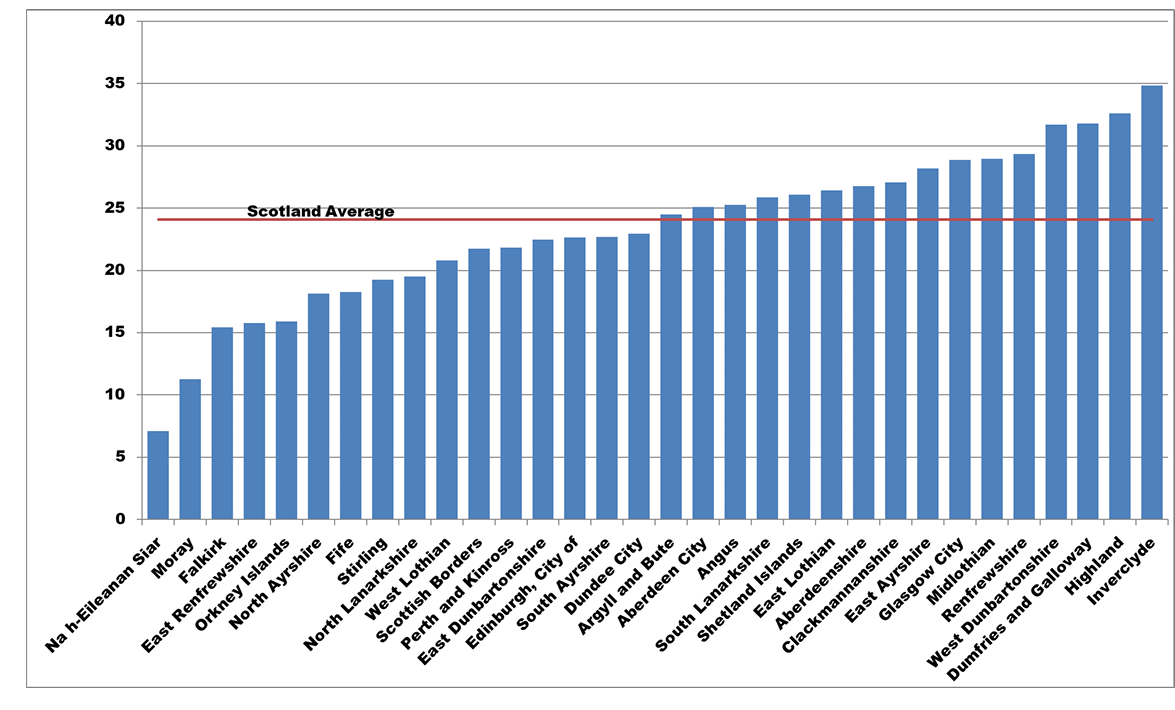
Orkney is well below the average for Scotland in the number of hours per week spent on Mental Health Officer duties.
Across the three islands authorities the range goes from Na h Eileanan Siar at 7.1 hours worked per 10,000 of the population, to Orkney at 15.9 and Shetland at 26.1.

For Scotland as a whole the number of hours spent on mental health officer (MHO) duties in 2023 was the highest since these figures were first reported in 2016, according to a new report published by the Scottish Social Services Council (SSSC).
The Mental Health Officers Report 2023 shows the overall hours estimated to be spent on MHO duties was 13,149, higher than the previous high of 12,752 reported in 2022. This is a 3.1% increase.
MHO hours per week per 10,000 population Scotland 2023

The table below shows the estimated total weekly hours on MHO work for each health board. In the last column that data is converted into the standardised measure of weekly hours on MHO work per 10,000 population.

Not all individuals working as MHOs spend their full time engaged in MHO work. For most MHOs only a small proportion of their working week will involve MHO activity.
There was an increase in the number of active MHO posts to 729, which is 22 more than in 2022. These posts were filled by 697 individuals (headcount) which is up from 670 in 2022.
The table below sets out the numbers of MHOs in each local authority and the number and percentage who are based in their local Health and Social Care Partnership (HSCP). Please note Highland is excluded from the below table as the integration of Highland’s local authority social work services and NHS Highland (32 MHO posts) did not follow the HSCP model, all MHOs are employed within Highland Council). Over 90% (631 of the 697) MHOs employed by 31 local authorities were based in their local HSCP.

Despite these increases the report shows the shortfall in MHO provision reported by local authorities increased by 11.8% from 2,606 to 2,914 hours per week. Twenty-six local authorities reported a shortfall in MHO hours per week ranging from 595 hours in Glasgow City to 28 hours in East Ayrshire and Na h-Eileanan Siar.
Almost three quarters of the workforce is female. And for the MHO workforce as a whole the average age is 50. Importantly there are different types of employment contract. The majority of MHOs are on a permanent contract (83%). The largest of the remaining contract types is casual/relief (8%). There are 57 MHOs with this contract type, in 2022 there were 47.
Between December 2022 and December 2023, a total of 98 MHOs left 100 posts. This is the highest number of vacated posts since records began in 2012, the next highest was 95 in 2021 and 2022. On the plus side 2023-24 saw the most admissions at 71 since records began in 2008. 2015- 16 had the next highest number of admissions with 69 admissions.
SSSC Chief Executive, Maree Allison said:
‘I’m pleased to see the number of active MHO posts and the number of people filling them both increased during 2023. However, we need to balance this against the reported shortfall in MHO duties increasing by 11.8% to 2,914 hours, which is higher than the previous two years.
‘Statistics like these, produced by our Workforce Intelligence Team by analysing data collected directly from local authorities, help workforce planning and succession planning by the Scottish Government, local authorities and others by giving an accurate picture of the MHO workforce.’
Download the Mental Health Officers Report 2023 here.
Summary and Conclusions from the Report
The number of active MHO posts in December 2023 was 729, which is a rise of 22 from the 707 in 2022. A rise was also seen in the number of individuals working as an MHO, from 670 to 697. The estimated hours spent each week on MHO duties also rose by 3.1 % as did the number of active posts.
Despite above noted rise in headcount, post count and hours spent on MHO work, the reported shortfall also rose by 306 hours (11.8%). The number of local authorities reporting an estimated shortfall increased from 24 in 2022 to 26 in 2023.
There was a rise in both the exclusive and cover active MHO posts, and a fall in non exclusive MHO posts.
The aforementioned 3.1% overall rise in both active post and hours worked was not constant across all the MHO types. The number of exclusive MHOs grew by 6.4% (17) yet their total hours worked grew by only 4.3% (357), similarly active cover posts grew by 28.9% (13) and hours by 21.4% (42). Unsurprisingly the average hours worked by the above MHO types decreased by 2% and 7% respectively. We also saw a fall of 8 active non-exclusive posts, but the total hours worked by non exclusives only decreased by 2
The trend for MHOs to be increasingly located in mental health teams (MHTs) rather than non-mental health teams (NMHTs) continues. This is particularly clear when we look at the MHO data from 2005 onwards (SSSC, MHO time series, 2021).
Fiona Grahame

Leave a Reply