
As ‘Polaris Dawns’ was being published in Orkney News this time last week, the spacecraft and its 4-person crew were within hours of return to Earth, at 3.36 Eastern Daylight Time in the USA, 8.36 a.m. British Summer Time. I had hoped to cover the entire mission in one article, if it took place within a week, but it was not to be. As it was, I rejoined the coverage during the re-entry phase, as the Resilience capsule was crossing the USA, and stayed with it through to the crew’s emergence. It was good to do that because I hadn’t been able to watch so much of a Crew Dragon mission in detail before – not like the old days.

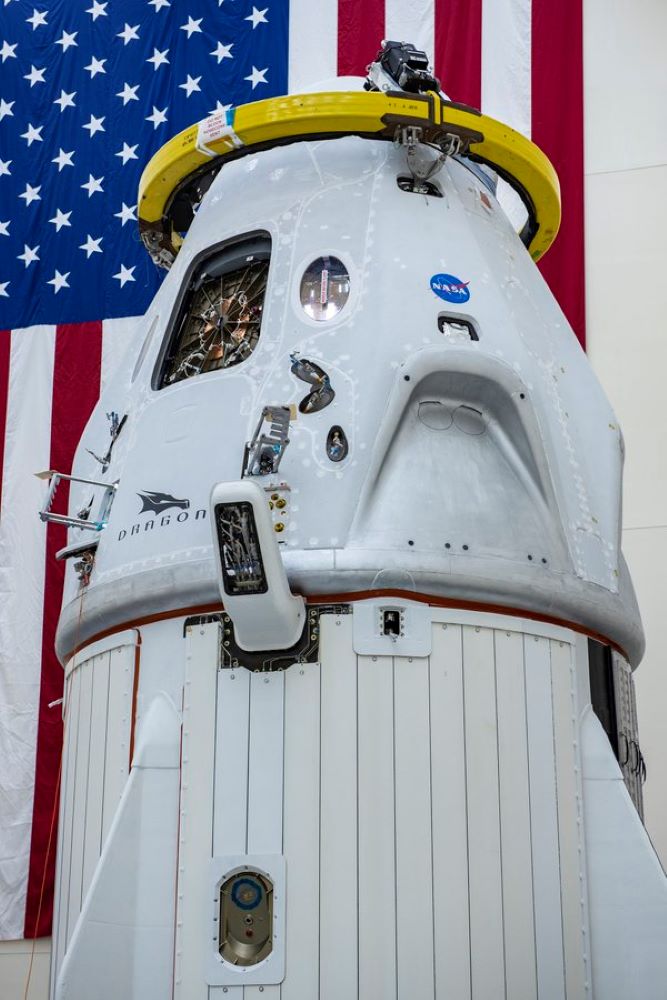
The sequence began one hour and 20 minutes before splashdown with release of ‘The Claw’ (Fig. 1), which holds the Crew Dragon spacecraft to the Trunk, the equivalent of the Service Modules on the Apollo and Orion spacecraft. On the early Soviet Vostok missions the spacecraft were secured by a strap which sometimes failed to separate, causing some nasty scares including on Yuri Gagarin’s re-entry. The problem is re-enacted in Sandra Bullock’s return to Earth in a Chinese capsule in Gravity. Using a mechanical release allows any problem to be identified before retrofire, and alternative measures to be taken. From next year on, Dragon splashdown are to be made on the west coast, so that the Trunks can be brought down safely in the Pacific – though not intended to survive entry, pieces of them have been coming down around the world and causing disquiet. The Trunk was jettisoned five minutes before the de-orbit burn (retrofire), shortly before Fig. 2. A last image was taken of the Skywalker ladder (Fig. 3) immediately before the nose cone was closed over it, and it took approximately 52 minutes from the start of the deorbit burn to deployment of the drogue parachutes, 40 km up at the end of the re-entry sequence.


During the re-entry the capsule was tracked from the ground (Figs. 4 & 5), and by astronaut Don Pettit from the cupola on the International Space Station (Fig. 6).


Pettit said that almost all the large contingent currently on the ISS had crowded into the observation turret with him, and that had helped to stabilise the image as he took it. If you blow up Fig. 6 to the maximum you can actually see the capsule’s fiery trail and its conical shape (just). Although the deployment of the drogue chutes and main chutes’ deployment at lower altitude were in darkness, they were spectacular in infrared due to the high temperature on the outside of the capsule, and somewhat frustratingly I haven’t been able to find any still photos of them in the media coverage, after a considerable search. The views of the four main chutes open on descent were reassuring (Fig. 7), and despite the earlier concerns about weather in the recovery area, the splashdown was into virtually flat calm (Fig. 8), as the precursor Inspiration4’s had been three years earlier.


The first of three recovery boats rapidly converged with it, to attach flotation collars and lifting harness (Fig. 9). In the drone image of Fig. 10, the track of light across the sea to the left is from the nearly full Supermoon – not visible in infrared, of course, but fully seen in Fig. 11 as the recovery ship approached, with its helicopter pad from which the crew would soon be flown ashore.


Unlike the previous practise of Project Mercury, Gemini and Apollo missions, the capsule remained closed with the crew inside while it was lifted to the ship’s stern (Fig. 12), for final checks of the thrusters for propellant leaks (Fig. 13) before being moved forward to an exit deck for the crew’s emergence (Fig. 14).


I first became aware of the Polaris Dawn mission in 2021, when it was announced as the coming successor to Inspiration4, and I’ve been following it and reporting on it in more details since early this year. But all along, something has been bugging me, something that wasn’t right, and it didn’t finally dawn on me (literally) until the mission was over.

Despite some relevant photos from the mission (Fig. 15), Polaris is the one fairly bright star which is located on the Earth’s axis, and therefore can’t have a dawn. It never rises or sets, remaining stationary in the sky while the other stars wheel around it, as seen in a recent ‘star trails’ time exposure, by my friend Dr. Alan Cayless in Bridge of Allan (Fig. 16). Anywhere in the northern hemisphere, its altitude above the north point on the horizon is equal to the observer’s latitude. From the North Pole it would be directly overhead, and at the equator it would sit motionless on the horizon (Fig. 17).


That won’t always be the case. Due to the pulls of the Sun and Moon, the Earth’s axis has a wobble called Precession of the Equinoxes (Fig. 18), taking 26,000 years (Fig. 19), with result that the celestial pole is constantly in motion across the sky.


Polaris is currently the Pole Star only because the axis happens to be pointing at it (and certainly not because it’s the brightest star in the sky – I’ve had some arguments with people about Sirius, in that regard – especially in the Bon Accord bar in Glasgow, where people who want to know where the Pole Star is can’t seem to grasp that the bar is on North Street.) The effect was discovered by Hipparchus, c.129 BC, and verified by Claudius Ptolemy (c.165-c.100 BC – Ptolemy, The Book of Astronomy in Antiquity, A New Introduction by Professor Christian C. Carman, Flame Tree Concise Editions, 2024; review by DL, Concatenation, in press.) 13,000 years ago, the pole star was Vega in the constellation Lyra; in 3000-2500 BC, during the building of Stonehenge 1 and the great Pyramids of Egypt, it was Thuban in the constellation Draco (Fig. 20). And around 2000 BC, I believe there’s strong evidence that the megalith builders discovered and were fascinated by the effect of Precession, particularly on Capella in Auriga (‘Alexander Thom Star Dates’, ON, April 3rd, 2022). As I promised at the time, I intend to publish that idea more widely, but some tact might be needed in pointing it out to Jared Isaacman.

There is another circumstance allowing ‘Polaris dawn’. Although to the naked eye Polaris appears to be a single second-magnitude star (as I said, by no means the brightest in the sky), it is actually triple, with a yellow Cepheid variable supergiant, Polaris A, orbited by a smaller Polaris Ab and an F3 Main Sequence star, Polaris B, which might have a chance of having an earthlike planet (Fig. 21).

(For explanations of those terms see ‘Stars and Nebulae’, ON, January 30th, 2022, and ‘Novae and Supernovae’, ON, 6th February 2022.) From planets orbiting any of the three, the other two might be seen to rise and set. As Polaris B is 30 times the Earth-Sun distance from Polaris A, to maintain a stable orbit a planet might have to be very close to it, close enough to have a trapped rotation and keep the same face always towards the star, in which case the closest component of the system might be stationary in the sky as Polaris is to us, though for different reasons. If it has an atmosphere, there might be too much glare on the sunward side for the other two stars to be visible; but they could be seen to rise and set from the nightside. Again, though, I somehow doubt if Jared Isaacman had those special circumstances in mind, rather than just picking a nice-sounding name for his mission.
Duncan Lunan’s more recent books are available on Amazon; for more details see Duncan’s website, http://www.duncanlunan.com.


Leave a Reply