
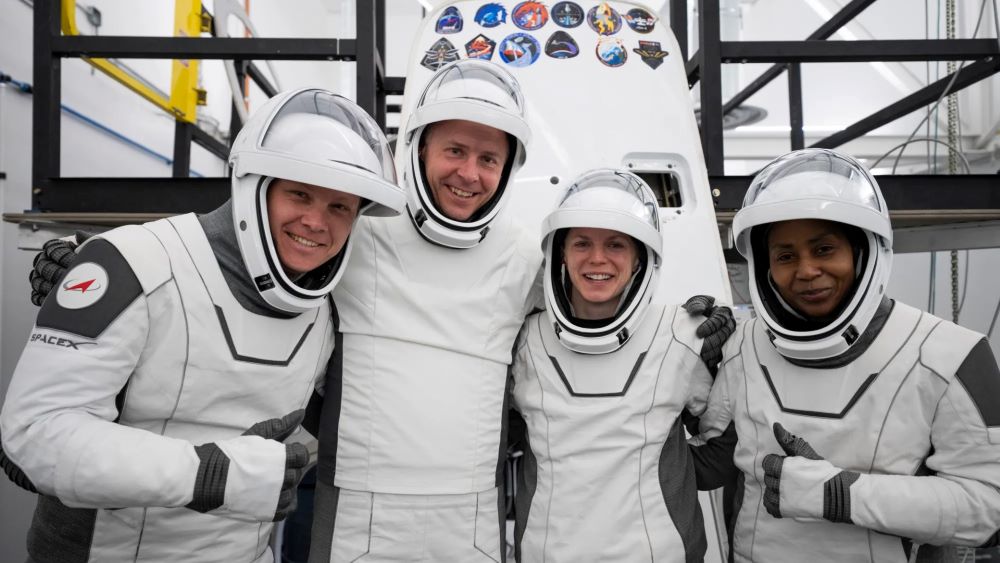
After the successful uncrewed return of the Boeing Starliner capsule, now under intense study to find the sources of its problems, NASA has gone ahead with its plans to absorb Butch Wilmore and Suni Williams into the work schedule of Expedition 71/72 on the International Space Station (Fig. 1), replacing two of the four astronauts scheduled to launch for it in August (Fig. 2).


On 4th September, the seat liners for Wilmore and Williams (which are individually moulded to brace the astronauts against high accelerations) were moved from the Starliner to Crew Dragon 9, on which they will return to Earth in February. The Starliner came back empty on September 8th, the main Expedition 72 came up by Soyuz on the 11th (Fig. 3), and station commander Oleg Kononenko handed over to Sunita Williams on the 22nd, with the formal start of Expedition 72 the following day when the Soyuz crew departed.

In the reallocation of tasks that makes sense, because she was station commander on Expedition 33 in 2012. I haven’t been able to find out who the commander of Expedition 72 was originally supposed to be, but the two US astronauts who didn’t fly are both described as ‘mission specialists’, trained for specific tasks which the others will now have to cover. Zena Cardman, who was in the studio at the Crew-9 launch, talked about being sad to see ‘her’ rocket and ‘her’ crew go without her. Obviously she wasn’t intended to take charge up there, so the intended commander’s feelings don’t seem to be on record – yet.


The remaining Crew-9 astronauts, Nick Hague (commander) and Alexandr Gorbunov of Russia’s Roscosmos (Fig, 4), launched on September 28th (Fig. 5) and arrived at the ISS on Sunday, September 29th (Fig. 6, 7 & 8). After all the fuss about spacesuits, it turns out that there was a SpaceX suit on the ISS which Wilmore could have worn to come back, had that seemed the best option, but there wasn’t one for Williams until Crew-9 delivered it.


The launch was historic in another way. Until now, every SpaceX crewed launch for NASA has been from Kennedy Space Center’s historic Launch Complex 39A, which hosted Apollo and space shuttle launches before leased to SpaceX. Uncrewed SpaceX missions fly from Space Launch Complex-40 pad at Cape Canaveral Space Force Station, further south, formerly used by the U.S. Air Force for Titan rocket launches from 1965 to 2005, including the Viking and Voyager missions. In 1966, it was used to launch a Titan 3C rocket carrying the Manned Orbiting Laboratory military space station mockup and a Gemini capsule, with no crew (see ‘History of Spaceflight’, ON, October 16th, 2022, and ‘Space Stations’, ON, November 13th, 2022), so this was the site’s first crewed launch since Project Gemini in 1965-66.

Shortly before the Crew-9 launch a video was released of the Polaris Dawn one, and for once, at least in my experience, it continued past the separation of the Crew Dragon and its ‘trunk’ service module from the upper stage of the Falcon 9. That revealed that the object silhouetted against the Sun and the Earth was not the booster but the Crew Dragon (Fig, 9), and that was confirmed during live coverage of the Crew Dragon launch, which again lasted for longer. The Sun was further right than in the Polaris Dawn launch, clearly illuminating the Dragon from the side as it drew away. In both sequences the quality and steadiness of the coverage from the Falcon second stage was particularly striking. Nevertheless, apparently an attitude control problem with the Crew-9 booster developed later, when it was, commendably, deorbited to avoid contributing to the space debris problem. (Second stages have bad track records in this regard, especially when the residual propellants mix and explode. The second stages of Ariane 4 and the Delta 2 launchers both made big and unwanted contributions to that problem.) The retrofire of the Crew-9 Dragon second stage was seemingly misdirected, causing it to fall outside the planned drop zone in the Pacific. The Federal Aviation Authority has imposed still another block on Falcon 9 launches while the matter is investigated, putting the launch of Europe’s Hera probe in some doubt (see below).
Tempers are growing short in that context, with the FAA attempting to impose heavy fines on SpaceX for violations of FAA protocols in recent launches, and SpaceX replying that these were operational matters, like substituting one control room for another, and didn’t require major investigation and re-authorisation of the flights concerned. Elon Musk is still more aggrieved about a new FAA evaluation of the Starship/Superheavy combination, prompted by the Environmental Protection Agency and postponing the fifth flight until November at the earliest, although the fifth flight was a complete success. The fifth pair of vehicles have already been stacked for launch (Figs. 10, 11 and 12), and the Starship for the sixth one has already successfully had its static firing (Fig. 13). Elon Musk has pointed out that Ship 6 will probably now be ready before Ship 5 has flown, let alone had its results evaluated; asserting that it’s intolerable for a programme so much in the national interest to be frustrated in this way, he is suing the FAA Director for exceeding his authority.


None of this bodes well for the all-British, private Crew Dragon mission, proposed by Axiom Space for 2026, and for which Tim Peake has been nominated for commander, coming back from retirement as an astronaut to do so. Elon Musk’s disparaging remarks about Britain have already earned him two rebukes from the Prime Minister, and it should be remembered that historically the attitude of Labour governments to crewed spaceflight has not been enthusiastic. Michael Foale’s visit to Tony Blair, trying to get the UK to participate in the International Space Station, did not bring about any change of policy at the time; and before that, when David Atkinson MP (Bournemouth, Con.) tabled a motion congratulating the USA on the first flight of the Space Shuttle, it was passed only after adding a Labour rider calling on the USA now to abandon manned spaceflight, until all problems on Earth had been solved. If the dispute between Keir Starmer and Elon Musk escalates, either could decide to ban British astronauts from Crew Dragon flights.
In ‘The Sky Above You’ last week I mentioned that the ‘Fetch’ rover, proposed to collect samples deposited by the Perseverance rover for return to Earth, has not been abandoned by ESA although NASA now proposes to use a more powerful version of the Ingenuity helicopter. In recent tests at a quarry near London (I don’t think it was the one so much used by Doctor Who and Blake’s Seven), ESA and Airbus demonstrated their latest Mars rover prototype, now called ‘Charlie’ (Fig. 14), as well a Fetch rover, now called ‘Codi’ (Fig. 15 – shouldn’t that be ‘Colli’?) When work on the rover model began at British Aerospace, it was simply called ‘BB’ for ‘breadboard’ – I saw it demonstrated at one of the UK Space Conferences at Charterhouse. But to the French engineers, ‘BB’ had a different meaning and the next model was called ‘Brigid’, as an Anglicisation of ‘Brigitte’. If it gets to Mars, I wonder what it will be called by then?


I also noted that on Mars, Perseverance has a definite target for its somewhat risky steep climb towards the inner rim of Jezero crater. Only weeks ago, as it crossed the Neretva Vallis river floor, Perseverance found an extraordinary bright rock, inaccessible on a steep rocky hillside, which appeared to be volcanic in origin and presumably washed down-river, billions of years ago (Fig. 16), Now another has been found on the climb, ‘Freya Castle’, a remarkable striped rock unlike any previously seen on Mars (Fig. 17). It too is sitting on the surface, as if washed there, or thrown by some distant eruption. The object of the climb is to find rock from deep within the Martian interior, but if this one has rolled downslope, who know what is waiting above?


By now the second test flight of the new Vulcan booster, with its BE-4 first stage engines supplied by Jeff Bezos’s Blue origin and its trusty Centaur upper stage, was to have launched two identical Mars probes called ESCAPADE (see ‘Space Notes’, September 2024). The first Vulcan launch successfully set the Peregrine lander on its way to the Moon, though the probe subsequently failed due to a fuel leak. However two prototype Vulcans were recently destroyed in ground tests, and NASA decided to postpone the ESCAPADE launch till February, causing surprise because there isn’t a launch window to Mars that month. But that applies only to minimum-energy Hohmann transfers, which are normally used for obvious reasons; Vulcan, however, is powerful enough to send small payloads to Mars on faster trajectories, and that’s what’s now planned. Today, October 4th, as I write, the second Vulcan test flight has been a complete success, sending an instrumented dummy payload into orbit around the Sun and proving its capability for interplanetary missions (Figs. 18-20).


On October 7th, Blue Origin is also returning to space tourist flights with a new version of the New Shepard booster and capsule (Fig. 21). The flight will be uncrewed, like the last one on which an anomaly grounded the programme for two years, and in addition to testing out the improvements which have been made, it will be carrying a payload of experiments including a LIDAR landing radar intended for Blue Origin’s future lunar lander.


Europe’s Hera mission to the asteroid Didymos, whose moon Dimorphos was impacted by the DART probe in September 2022 (Fig. 22), has arrived in Florida (Fig. 23) and is preparing to launch on a SpaceX Falcon 9 on October 7th, on the assumption that the FAA’s ban on Falcon launches will be lifted by then. Like DART, Hera will fly along with two cubesats (Figs. 24 & 25), Juventas and Milani, to inspect the impact crater (Fig. 26) and effects on both moons, one or both of which may have been resurfaced by ejecta from the impact. Landings on both will be attempted. The findings will contribute to study of the effect of impactors to change the orbits of asteroids, protecting us from impacts, which was one of Prof. Colin McInnes’s contributions to my book Incoming Asteroid! What Could We Do About It? (Springer, 2013).


Just two days later, if all goes well, a Falcon Heavy booster will launch the long-awaited Europa Clipper mission to the icy moons of Jupiter, particularly Europa, which is covered with an ocean up to 100 miles deep below its surface ice (Fig. 27).

Plumes of water vapour have been detected escaping from Europa, and it’s hoped that Europa Clipper will be able to fly through them as ESA’s Cassini orbiter did with the ones from Saturn’s ice moon Enceladus. If so, Europa Clipper should be able to identity them with more certainty. The mission was originally intended to launch on NASA’s Space Launch System Artemis booster, but that has proved too expensive and the mission will instead fly a longer path after Falcon Heavy launch, taking two years longer to reach the Jupiter system.
Only weeks after contact was successfully renewed with Voyager 1, out in interstellar space beyond the reach of the Solar Wind, an anticipated hard decision has been made with Voyager 2, turning off one of its four remaining experiments to conserve power. Its plasma sampler was chosen for the cut, because its present limited use still involves turning the spacecraft on attitude control thrusters dating back with everything else to 1977. Turning off it now may give Voyager 2 a little more time beyond 2030, but on both spacecraft the radioactive power sources are back to their last gasp (Figs. 28 & 29), and the end is remorselessly approaching.






Leave a Reply