
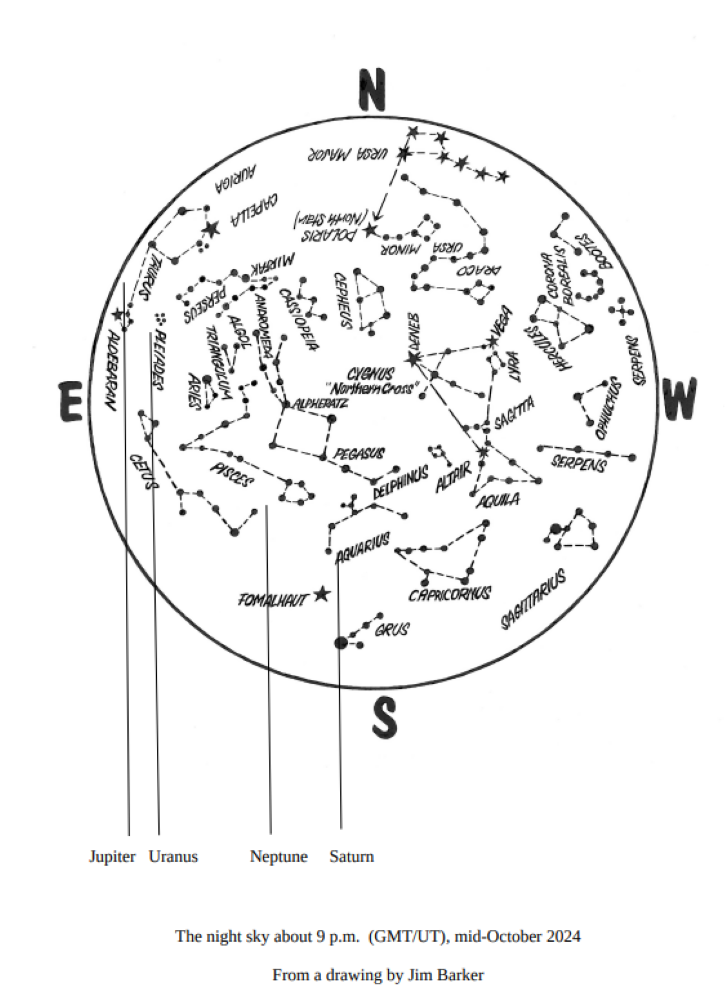

There’s so much happening in astronomy and space these days that it’s impossible for one person to cover it all. I have perforce to concentrate on Solar System news so that it will fit into the astronomy column ‘The Sky Above You’, which I write in basic form mid-month for Troon’s Going Out. I then expand it with updates from the monthly UK magazine Astronomy Now (highly recommended), which comes out on the 16th, and then add relevant news for Arran Sound, adding illustrations for Orkney News, and also covering crewed and uncrewed missions for them in ‘Space Notes’.
For current news my main sources are the online Universe Today, EarthSky and Space.com. EarthSky is in an interesting situation: having recently completed their annual fundraiser, successfully, they have now been offered a further $50,000, if they can raise still another $50,000 to cover it. That total could keep them in business for years to come, and I recommend looking at their site with a view to doing so. My news items this month are drawn mostly from EarthSky’s daily round-up on October 1st, which includes the new funding appeal.
The Moon

The Moon is New on October 2nd, Full on October 17th, another ‘Supermoon’ which is Full at its closest to Earth. On the 2nd there will be an annular eclipse of the Sun, when the Moon is too distant to cover it completely (Fig. 1). It will be visible only from Easter Island and the tip of South America. (The last one visible in Scotland was in May 2003, when I managed to see it from Dornoch, while Sir Patrick Moore and Brian May drew a blank at Deerness on the north coast.) The crescent Moon is close to Venus on October 5th, and near Saturn on the 14th, Jupiter on the 20th and 21st, and Mars, with Castor and Pollux in Gemini, on the 23rd. The Moon passes almost centrally through the Pleiades on 19th October. British Summer Time ends at 2 a.m. on October 27th.
Continuing study of the lunar samples returned by China’s Chang’e-5 lander on December 16th, 2020, has turned up an amazing discovery. Out of more than 3000 glass beads formed by volcanic activity (whose existence was once fiercely denied by researchers who insisted everything on the Moon was formed by impacts), three were found to be very much more recent than expected. Analysis of beads in moonrock brought back by the Apollo missions and Russia’s lunar landers had indicated that volcanic activity on the Moon had ceased about 2 billion years ago, well before life on Earth moved from the sea to the land. But those three beads show that there were still active volcanoes on the Moon, forming and ejecting beads as recently as 123 ± 15 million years ago, (Paul Scott Anderson, ‘Moon’s volcanoes were erupting only 120 million years ago’, EarthSky, September 8th, 2024), during the reign of the dinosaurs on Earth. It looks as if the activity might be due to local hotspots of radioactivity in the Moon’s crust, but if so, there will be a big search to find out where they are. I featured one such area in ‘Curiouser and Curiouser’, ON, 23rd July 2023, but even that one is reckoned to be a billion years old, much older than the beads now found in the Chang’e-5 samples.
On 20th August last the European Space Agency’s JUICE probe (Jupiter Icy Moons Explorer) passed the Moon at only 465 miles in a 30-minute encounter before making an Earth flyby at 37,000 miles, one of several (Venus in August 2025, Earth in September 2026 and January 2029), which will set it on course for the Jupiter system in July 2031. On its way out the spacecraft tested its Jupiter Energetic Neutrals and Ions (JENI) and Jovian Energetic Electrons (JoEE) instruments, built and managed by the Johns Hopkins Applied Physics Laboratory (APL) in Laurel, Maryland, and obtained the most detailed images yet of Earth’s radiation belts (Fig. 2), and what will be learned from that remains to be seen.

Mercury
The planet Mercury is not visible this month, going through superior conjunction beyond the Sun.
Venus
Venus remains low in the evening sky, setting soon after 7 p.m.., close above the crescent Moon on the 5th.
Mars
Mars rises at about 11.00 p.m. in Gemini, in line with Castor and Pollux at the end of October, after all three are passed by the Moon on the 23rd.
On Mars, as previously reported, the Perseverance rover is making a chancy climb out of the river valley it recently crossed, on its way to the crater rim. Its target has been narrowed to a site called ‘Dox Castle’, which appears to be material from deep within Mars, excavated by the impact which formed the crater and lining it as a ‘margin unit’ inside the crater wall proper, which probably consists of more recently formed crustal material. The previous chance to study anything like this was in June 2018, when the Opportunity rover was exploring the rim of Endeavour crater and had found a way down to the floor, named ‘Perseverance Valley’, coincidentally but aptly enough, three years before Perseverance itself touched down (Fig. 3).

Opportunity had been on Mars for 14 years by then, and frustratingly, it had barely begun its descent of the valley (Figs. 4 & 5) when it was cut off by a global dust storm (Fig. 6; see ‘Martian Dust Storms’, ON, 23rd June 2024).


Perseverance is nuclear-powered, and unhindered by a local dust storm currently blocking the view into the crater (Fig. 7). Dox Castle was imaged from the Jezero floor by Perseverance in 2022 (Fig. 8), and one project scientist is quoted as saying that he looked wistfully at it but never imagined they’d find a way up there.


If they do find material from the anticipated depth, it’s not likely to contain the organic traces which are one of Perseverance’s objectives, but may teach us a lot more about the interior and origin of Mars. That will generate some difficult choices: Perseverance has been enthusiastically storing samples on the surface for future collection and return to Earth. It was recently announced that ESA is still working on the ‘Fetch’ rover originally intended to collect them (Tereza Pultarova, ‘Europe’s Mars ‘fetch rover’ nails sample pick-up test in the field’, Space.com, 20th September, 2024), though NASA had dropped the concept in favour of a beefed-up version of the Ingenuity helicopter. But if Perseverance finds really important ‘areological’ samples from deep within the planet, it has only 13 sample tubes left.
Jupiter
Jupiter, between the horns of Taurus (ElNath and Tianguan), rises at 8.30 p.m., and is passed by the Moon on the 20th and 21st, as above. During September Jupiter, Mars and Saturn have been making a spectacular morning display with the stars of Taurus, with Gemini now added, and it will continue in October though the planets are growing further apart. On the 9th Jupiter will be at its stationary point, after which it begins to move westward against the stars as it’s overtaken by the Earth. Opportunities continue to see transits of Jupiter by the larger satellites and their shadows: Io will do so on the morning of October 10th, and the shadow of Ganymede will be prominent on the planet at 12.30 a.m. BST on October 27th, 90 minutes before the end of British Summer Time.
Saturn
Saturn in Aquarius sets at 3.30 a.m., and the Moon will pass just over one lunar diameter below it on the evening of the 14th, occulting the planet as seen from south and east Africa, southeast Asia and China. While Saturn’s equatorial plane and rings are nearly edge-on to us, there will be opportunities to see shadows of its moons on the planet, but the moons themselves will be hard to see due to lack of contrast.
Uranus
Uranus in Taurus rises at 7 p.m., south-west of the Pleiades mid-month, south of the Moon on the 19th.
Neptune
Neptune in Pisces sets at 5 a.m., rising about 9.30 p.m., and is near the Moon on the 15th, occulted by it as seen from parts of Africa, India and Japan.
Orionid Meteors
The Orionid meteors from Halley’s Comet peak on the night of 21st/22nd October, but visibility will be spoiled by moonlight.
Comet Tsuchinshan
Comet Tsuchinshan, aka Comet ATLAS, will be midway between Venus and Arcturus in Boötes on the 13th, when closest to Earth, but was thought unlikely to be seen so close to sunset even if it survived passing the Sun on September 27th – which it has, at more than a third of the Earth-Sun distance. If it does, the October issue of Astronomy Now predicts that it could reach 2nd magnitude and be visible to the naked eye, if not by October 12th then surely by the 15th, in the constellation Serpens on the right of our map. By the end of October it will be in Ophiucus, and still visible in binoculars.

Another new comet has just been discovered on September 27th, A11bP7I (not even named yet), a ‘Sun-grazer’ which, if it survives solar passage on October 28th, may become as bright as the planet Venus and visible in daylight, like the notorious Comet Ikeya-Seki of summer 1965 (Fig. 9). That one delighted southern hemisphere observers, but was lost in the sunset glow as far as Scots were concerned – I well remember the teenage frustration of searching for it, though I do remember a spectacular ‘Sun pillar’ which almost convinced me it was the comet’s tail. This one will be visible in the mornings in the northern hemisphere, if at all – but as Sir Patrick Moore was fond of saying, ‘Comets are like cats. They have tails and do whatever they like’.


Another non-event of the 1960s was the apparent discovery by Peter van der Kamp of two planets orbiting Barnard’s Star, 6 light-years away, the nearest single star to the Sun (Figs. 10 & 11). The Glasgow Herald carried the story and I remember digging it out for the late Prof. Oscar Schwiglhofer, after one of the British Interplanetary Society Scottish Branch’s Green’s Playhouse ‘Discussion Meetings’ (see ‘Colour in Space Art’, ON, 28th July 2024). It was one of the reasons for selecting Barnard’s Star for the BIS’s ‘Project Daedalus’ interstellar probe study (Fig. 12), although the existence of the planets had been challenged on what seemed to me shaky grounds, namely that it had coincided with the removal of the telescope’s lenses for cleaning and refitting.

The Project Daedalus report carried photographs which appeared to show that the observations were nevertheless genuine, but for whatever reason they carried no weight and other observers failed to confirm the finding. Along with the ‘Project Blue’ intensive study of the Alpha and Proxima Centauri systems in connection with Project Starshot, the proposed interstellar lightsail mission, an extension to search for planets of other nearby dwarf stars was created at the European Southern Observatory, called ‘Red Dots’ (Fig. 13), by analogy with Carl Sagan’s ‘Pale Blue Dot’ characterisation of Earth in the Voyager 1 Solar System panorama.

In 2018 it was announced that one or more planets of Barnard Star had been detected, and in 2021 that result was disputed. This one, announced today (October 1st), suggests a planet half the size of Venus, with an orbital period of 3.15 Earth days, but with indications of three more planets further out. Will these results hold up to scrutiny? Once again, we can only wait and see.
You can download a copy of The Sky Map for October here:


Leave a Reply