
Today there are severe penalties for dealing in elephant ivory. In the UK if you break the law under the Ivory Act 2018 you face a maximum fine of £250,000 or 5 years’ imprisonment.
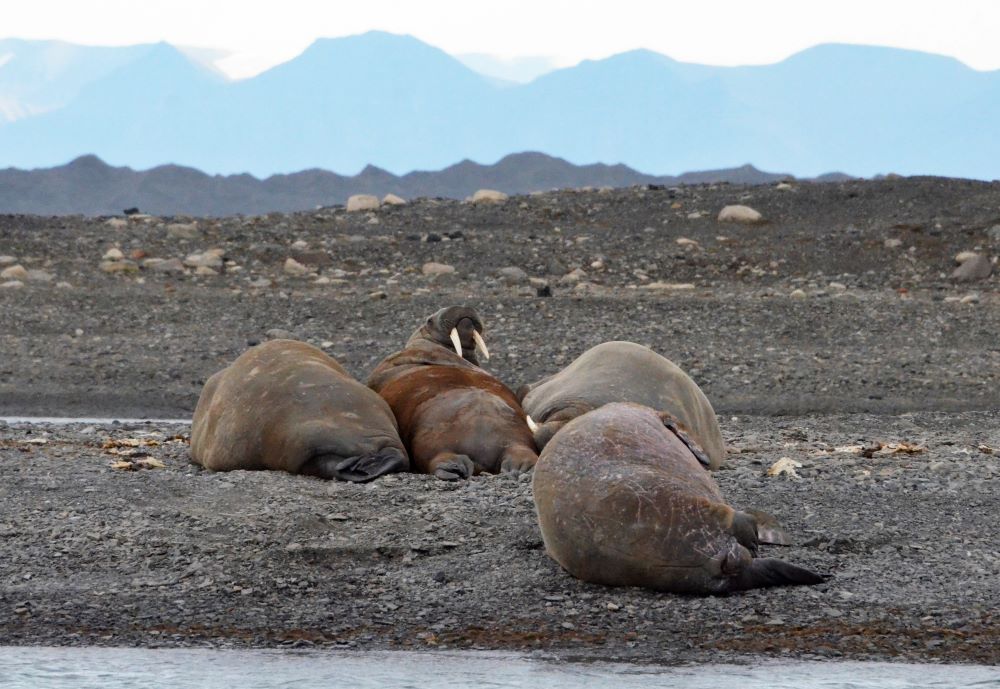
Ivory was traded for many centuries. The onset of the Crusades in the Middle Ages put a temporary halt to the lucrative trade in elephant ivory and so alternatives were sought. The Vikings, great traders that they were in people and furs, turned their attention to ivory which could be got from hunting walrus.

New research from the University of Copenhagen shows that the Vikings were (the first) part of a network that supplied not just Europe and the Middle East, but probably also East Asia with walrus ivory.
Associate Professor Morten Tange Olsen from the Globe Institute at the University of Copenhagen, who is one of the authors of the new study, explained:
“Our study shows that the Vikings regularly travelled the around 6,000 kilometres to Pikialasorsuaq in Northwest Greenland, an area characterised by harsh climatic conditions. And they probably didn’t do it for the thrill of it, but to obtain this precious commodity, which they brought to Northern Europe and other parts of the world.”
The researchers conducted DNA analyses, which show that the Vikings covered a greater distance than previously believed in their search for walruses.
The study is a collaboration between researchers at the University of Copenhagen, the University of Lund in Sweden and the University of Groningen in the Netherlands and international partners from Greenland, Iceland and Canada.
The researchers studied fragments of walrus skulls mainly, obtained from excavations of Viking villages in Europe and settlements in Greenland and Canada.
The study also demonstrates that the Vikings probably had more dealings with indigenous Arctic populations than previously assumed, including the Thule and Dorset cultures.
Morten Tange Olsen said:
“DNA sequences from these fragments provided us with a genetic map of the place of origin of various Arctic walrus populations at the time of the Vikings. This enabled us to show in which part of the Arctic the animals were caught.
“Our research shows that the Vikings were extremely well-travelled and had a well-established network that covered a larger area than previously believed and which in time and place must have overlapped with early Greenlandic and Canadian cultures. “
He believes the cross-disciplinary collaboration between archaeologists, biologists and geneticists is what has made the study a success.
The new study once again shows that the Vikings had a remarkable ability to navigate and survive in harsh climatic conditions, and that they helped create a global trade network that reached beyond the borders of Europe.
“Now, for the first time ever, we have a clear genetic map of Arctic walrus populations, which tells us where the Norsemen went to obtain the precious commodity, ivory.”
Morten Tange Olsen and his colleagues hope the study will open our eyes to the Vikings’ complex and extensive trade network and interaction with other cultures.
Click on this link to access, Greenland Norse walrus exploitation deep into the Arctic, published in Science Advances.
See also: Ivory in the Arctic WWF

Leave a Reply