
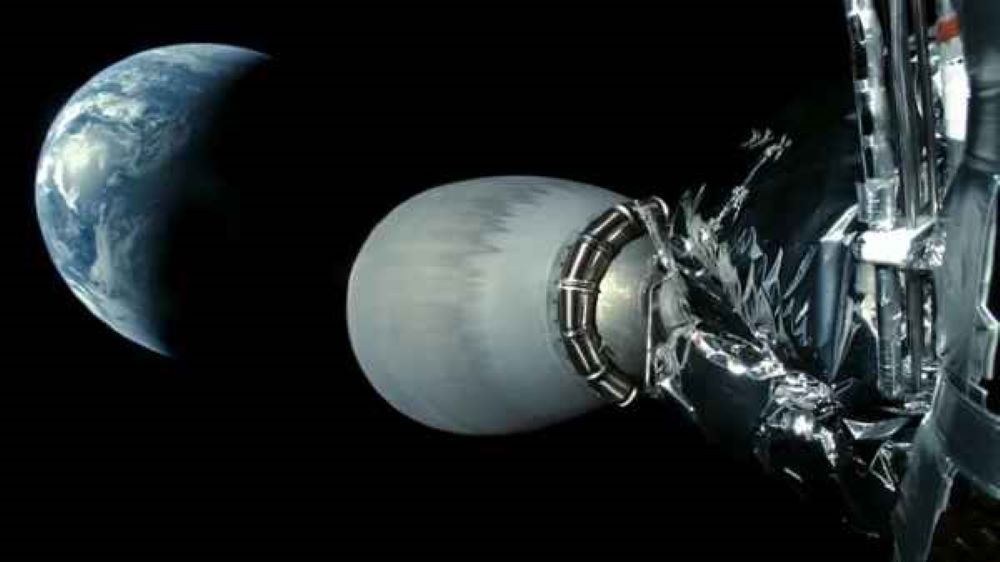

After the successful launch of Europe’s Hera probe to the asteroids Didymos and Dimorphos on October 7th, and the image of the receding Earth taken by the second stage of its SpaceX booster (Fig. 1), on October 10th and 11th the spacecraft itself photographed the Earth and Moon from distances of 900,000 to 1 million miles. Using different instruments in the array, which are all on the same face of Hera (Fig. 2), they were photographed by one of the two Asteroid Framing Cameras (Fig. 3), then in infrared by the Japanese Thermal Infrared Imager (TIRI, Fig. 4), and thirdly in a false-colour image by the HyperScout H multispectral instrument (Fig. 5).


The infrared image has the North Pole at the top with the eastern USA and Atlantic Ocean facing the spacecraft; the multispectral imager will be used to identify the surface composition of the asteroids, and before that of Deimos, the outer moon of Mars. Last week’s image of Hera separating from the booster is the last that Earth will see of it, but Figs. 3-5 are not the last that it will see of Earth, which it will fly past after Mars in 2025 on the final course correction for the asteroid rendezvous.
(Notice how much brighter the Earth is than the Moon in Fig. 3, and vice versa in Fig. 4. It’s because the Earth is covered with reflective clouds and ocean (Fig, 3A), and the Moon reflects only 7% of incident sunlight, but as a result it absorbs much more heat during the day.)


In a double turnaround, just before last week’s article appeared, the US Federal Aviation Authority lifted its ban on the Starship/Superheavy combination, which was not supposed to happen till the end of November at least. SpaceX had been preparing for launch on Sunday 13th despite the embargo, which was lifted on Saturday 12th. The launch immediately went ahead (Figs. 6 & 7) and was a complete success. A video released on YouTube of Flight Tests 2, 3, 4 and 5 in parallel shows that the flight sequences were extraordinarily synchronised, virtually to the second in the boost phases – only Flight Test 1 was exempt because on that one, the stages failed to separate and tumbled before auto-destruct.

It’s a great achievement to have come so far in just five attempts, with both stages returning to Earth on the last two (Fig. 8) and the Superheavy booster captured in mid-air this time (Figs. 9-13),


while the Starship splashed down in the Indian Ocean within sight of the ship sent to observe it (Figs. 14 & 15). There was some burn-through on the Starship fins again, but not nearly as severe as on IFT-4, and the vehicles survived both.


The following day, October 14th, the FAA lifted its embargo on Falcon 9 launches, which followed an errant return of the second stage to the drop zone on the previous flight. Since the Falcon Heavy booster consists of three Falcon 9s side by side (Fig. 16), that cleared the way for the launch of NASA’s Europa Clipper mission, which had been due on October 10th but was postponed due to the approaching storm. After it NASA might have been expecting that clearance, because the two side boosters didn’t have upper stages, and had already flown successfully in the launch of NASA’s Psyche asteroid probe, while the core stage and boosters were not recovered this time, and the second stage will not be coming back, like Hera’s.

To protect the probe from Hurricane Milton it was kept in SpaceX’s hangar within its payload fairing (see ‘Postponements and Disappointments’ last week), which was pressurised with nitrogen, and within it the more sensitive parts of the spacecraft were covered by the same titanium and aluminium shielding which will protect them from Jupiter’s radiation belts (it is hoped). Once again the launch was a complete success (Fig. 17), and now we have to wait for the planetary slingshots and the arrival at Jupiter in six years’ time.

Taking no chances this time, I tuned in to the launch coverage an hour early, and although much of the buildup consisted of material I already knew, a couple of interesting points arose. Although the booster segments would not be recovered, the cameras often concentrated on the closed payload shrouds above them, and it occurred to me to wonder if they would be retrieved from the ocean, as I’d recently learned that Falcon 9’s are. I remembered experiments with that in 2017-2020, using a fast catcher boat called Ms-Tree (Fig. 18), and in discussion of them, I remember one expert questioning whether the cost of such boats made recovery uneconomic, while another thought that if reusing shrouds cut a few more millions off the launch price, it might just make the difference between using SpaceX or one of its competitors. I’d learned that in one of the recent Falcon 9 launches, the shrouds had been reused for the 13th and 17th times, so I checked, and such retrievals have been standard practise since 2020, although the fast recovery boats did indeed prove uneconomic, and the shrouds are now picked up once they’re on the water.

Another studio discussion during the countdown was about the liquid oxygen ‘tank farm’ which SpaceX has now installed near its launch facilities on Cape Canaveral Space Force Base, allowing faster turnaround of Falcon boosters for relaunch. As it happened, in a Zoom meeting the previous day I’d heard a discussion of the much larger such tank farm which SpaceX has installed by the Starship/Superheavy launch towers at Boca Chica in Texas. It raises questions about how fast Elon Musk intends to launch and relaunch the Ships from now on, given that he is committed to putting US astronauts on the Moon with one on the Artemis 3 mission of 2026. He has already shown the world that he has a production line of Superheavys (Fig. 19), which must now be well ahead of the launches that have been announced.

The success of Flight 5 must tempt him to speed up still more, and in the wake of it he announced that on Flight 6 an attempt may be made to catch the Starship as well, presumably using the other one of his two existing launch towers. It’s not entirely clear why he wants to do it that way, given that Starship SN-15 of the previous series achieved a soft landing in May 2021 (Figs. 20 & 21), but it does suggest that he intends to be launching them in rapid sequence once they’re perfected.


Of the delays and disappointments which I described last week, the major one remaining is the return of Crew-8, still on the International Space Station several weeks after their scheduled return. Weather seems to be the only reason for the delay, and no doubt they’ll be back soon. Crew-9 is due back in February, with the two ‘stranded’ Starliner astronauts, and that looks like being a busy month, with the launch of the ESCAPADE Mars probes on Jeff Bezos’s New Glenn booster, and possibly the launch of Dream Chaser on the ULA Vulcan-Centaur, among other things.


Leave a Reply