
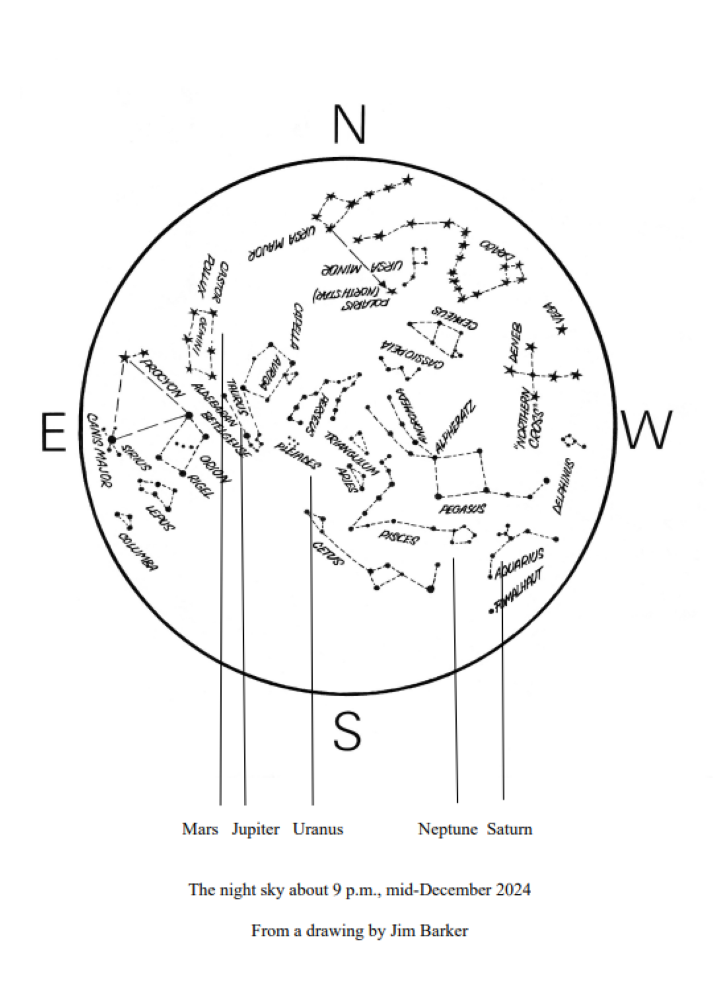

The Moon is New on December 1st and 30th, and Full on December 15th. The crescent Moon is near Venus on the early evening of December 4th and 5th, below the Pleiades on the 13th and above Jupiter on the 14th, and between Mars and Castor and Pollux in Gemini on the 17th. The winter solstice is on December 21st.
The planet Mercury is at inferior conjunction with the Sun on December 6th, after which it becomes visible mid-month, at its greatest separation from the Sun on the 25th, and three days later on the 28th it will be to the left of the morning crescent Moon, with Antares in Scorpius between them.
Venus is now brilliant against a dark sky in early evening, setting at 8 p.m. and near the crescent Moon on the 4th and 5th.
Mars rises in Cancer about 7 p.m., 2 degrees above the cluster Praesepe at the beginning of December, and is passed by the Moon on the night of the 17th/18th, after which it will be occulted by the Moon in daylight. From December 9th Mars will appear to move westward against the stars, doubling in brightness as it’s overtaken by the Earth, to which it will be closest on January 12th, and at opposition, directly opposite to the Sun, on January 16th.
Jupiter is very bright, visible all night long, in Taurus, to the left of the Hyades open cluster and the red giant star Aldebaran, moving back towards them as it’s passed by the Earth. It’s at its closest to us on the 6th, at opposition, due south at midnight, and the Moon passes it on the 14th. The volcanic moon Io and its shadow will cross the face of Jupiter on the 10th, grazing the Great Red Spot at 11.30 p.m..

The Europa Clipper spacecraft, now 13 million miles from Earth, has deployed its magnetometer boom and several of its radar booms (Fig. 1), the first two of its suite of scientific instruments. Seven more will be commissioned during December and January. The thermal imager and radar will be tested during the Mars flyby on March 1st 2025, and the magnetometer will be calibrated during its final Earth flyby in 2026.

Saturn in Aquarius sets at 11.00 p.m., above and left of Venus, passed by the Moon on the 8th, and occulted by it on the 9th, as seen from the Far East.
Uranus, between Aries and Taurus, sets at 5.30 a.m., and is passed by the Moon on the 13th.
Neptune, between Aquarius and Pisces sets at midnight, and is near the Moon on the 9th.
One of the surprises from the Voyager 2 flyby of Uranus in 1986 and Neptune in 1989 was that neither planet had a dipole magnetic field, unlike Earth, Jupiter and Saturn. One of the possible explanations was that Uranus had a huge liquid water ocean under its visible cloud layers, as Jupiter was believed to have (probably frozen) but turned out not to, in the spacecraft flybys of the 1970s. (Byron Preiss, ed., The Planets, Vintage, 1985 – Fig. 3; Pioneering the Space Frontier, The Report of the National Commission on Space, Bantam, 1986 -.Fig. 4). The idea was not widely accepted (see Fig. 5).


Burkhard Militzer, a planetary scientist at the University of California, Berkeley, has spent 10 years experimenting with mixtures of carbon, oxygen, nitrogen and hydrogen, in the proportions found in the early Solar System, and found that in certain conditions of high temperature and pressure, they can form separate layers, with water above, and heavier nitrogen and hydrocarbons below, preventing interior convection and the formation of a dipole magnetic field. So far, these simulations apply only to the interior of Uranus, and more information on the composition of Neptune is needed to test the process there. The resulting model predicts that the gaseous outer layer of Uranus is 3000 miles thick, above a liquid water layer 5000 miles deep, and a similar hydrocarbon layer below that, overlying a rock and metal core the size of Mercury, which was detected in the Voyager 2 flyby. (Conor Feehly, ‘Neptune and Uranus have a magnetic mystery — but the case may finally be cracked’, Space.com, online, 25th November 2024.)

In a water ocean of that depth, water would be compressed into forms unknown on Earth (Fig. 6), and its properties in those conditions are largely unknown, because they can be generated in the laboratory only in minute quantities. It’s possible that these exist within some of the exoplanets which have been discovered, either on ‘super-Earths’ much larger than ours (Figs. 7 to 9), or in ‘water worlds’ whose low density suggests that they are almost entirely composed of it (Fig. 10).


In the huge quantities postulated within Uranus, they could well generate magnetic fields by processes currently unknown or guessed at. A first guess is that they might help to explain why Uranus’s magnetic field is much further displaced from its rotational axis than Earth’s or Jupiter’s, for example (Fig. 11). At the very least, the case for a return mission to Uranus and its moons c.2023 is considerably strengthened (Figs. 12 to 14).


The Geminid meteors peak on the night of 14th/15th December, but will be spoiled by moonlight. Comet C/2024 S1 (ATLAS), aka Comet S1, discovered on September 27th, might have become as bright as the planet Venus and visible in daylight, if it survived solar passage on October 28th – it didn’t, but that’s comets for you.
Duncan Lunan’s recent books are available through Amazon; details are on Duncan’s website, http://www.duncanlunan.com.
A copy of the Sky Map for December 2024 can be downloaded here:


Leave a Reply