
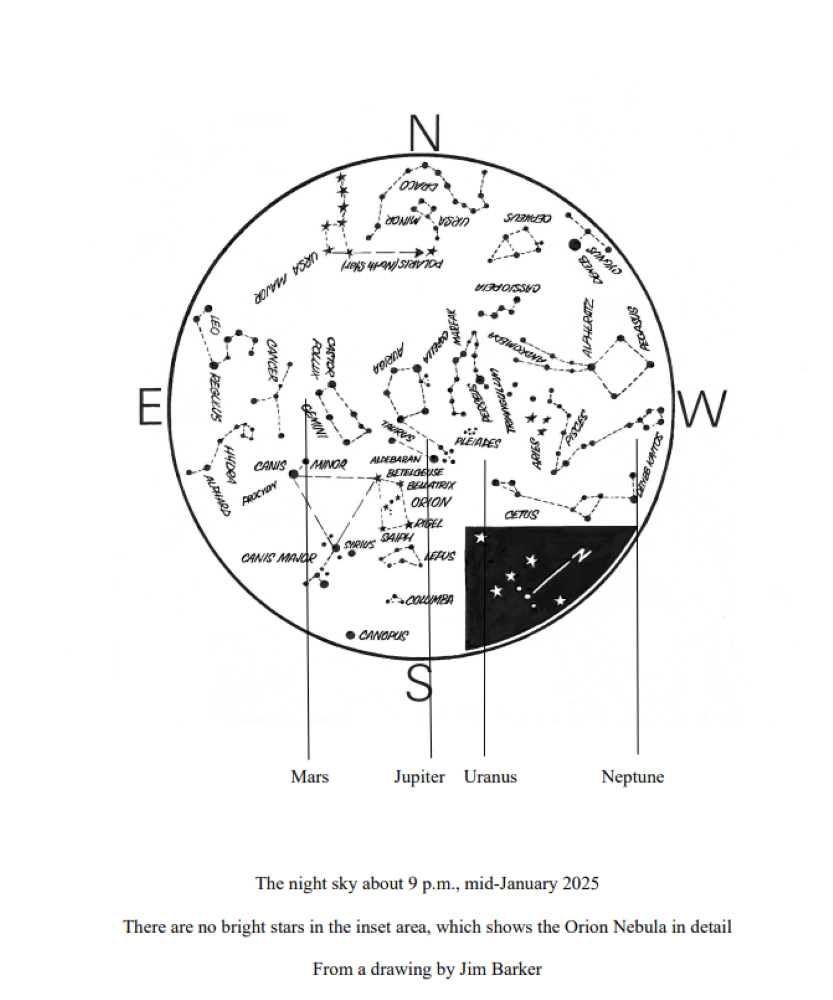

The Moon is Full on January 13th, near Mars the same night, and New on January 29th. The Moon is near both Venus and Neptune on the early evening of the 1st, and occults Saturn on the 4th, passing through the Pleiades and near Jupiter on the 10th.
On December 20th my friend Grahame Gardner, one of those who photographed midsummer sunrise last year from the Sighthill stone circle at its new site, pulled off a double coup by photographing both midwinter sunrise and midwinter sunset on the same day.


Both were closely in line with the marker stones for those events (Figs. 1 & 2), as indicated by their shadows on the central stone and on the far side of the circle (Figs. 3 & 4).


It should be possible to determine just how close when the full set of images become available. Meanwhile, personal circumstances have prevented me so far from organising photography of the Moon at its ‘major standstill’. The most northerly events occurred in September and the extreme southerly ones are in March, but to check the accuracy of the marker stones a year either side would suffice. I’ve missed the first year for personal reasons, and several of the people who had promised help have had to drop out due to health issues, but I have two firm promises so far, and a sustained effort between here and March 2026 might capture all four lunar events. Equinox sunrise and the rising of Rigel have still to be covered, but if we catch them all in the upcoming months then we can have a break till the ‘minor standstill’ in 9.3 years’ time, by when I shall be 90 and still more in need of help.

On Christmas Eve, the Parker Solar Probe made its 22nd and last scheduled close pass around the Sun (Fig. 5), passing 3.8 million miles from the visible surface at 430,000 miles per hour, with its carbon foam heatshield reaching 1,800 degrees Fahrenheit (980 degrees Celsius), although a yard behind it the body of the spacecraft was at room temperature (Fig. 6).

The spacecraft was activated for the flyby on December 20th, and all instruments were working normally when contact ceased until after the encounter. AOS (Acquisition of Signal) occurred on Boxing Day, and the probe has survived the close pass in good shape. After downloading its data in late January the Probe will remain in that orbit and make two more close encounters, bonuses on top of the planned mission, on March 19th and June 22nd, 2025. Meanwhile decisions will be taken about whether its remaining fuel can be put to productive use.
The planet Mercury is very low in the southeast in the first week of January, rising about 6.30 a.m..
Venus is brilliant in early evening, setting at 8.45 p.m. and near the crescent Moon on the 3rd, at its furthest from the Sun on January 10th. Venus passes two degrees from Saturn on the 18th.


A new analysis of data from the huge Deccan Traps, formed by a volcanic plume in India 65 million years ago (Figs. 7 & 8), thought to have contributed to the extinction of the dinosaurs and perhaps been the prime cause of it, has revealed that the eruptions had major climatic effects, but they were over before the Chixculub impact off Yucatan delivered the much more rapid coup de grace. (Robert Schreiber, ‘Massive Eruptions Did Not Trigger Dinosaur Extinction’, Space Daily, online, 20th December 2024). At the same time, as it happens, another study of long-period meteor showers has suggested that they may be traced back to their currently unknown parent comets. As all of them hit the Earth’s atmosphere, so too might their origin comets, like Comet Swift-Tuttle (Fig. 9), the parent of the Perseid meteors, which is already known to be a serious collision hazard. Identifying more may be a first step towards ensuring that we don’t go the way the dinosaurs went. (Heidi Toth, ‘How to Find a Comet Before It Hits Earth’, Space Daily, online, 20th December 2024).

Mars moves back from Cancer into Gemini in mid-January as it’s passed by the Earth, closest to us on January 12th, passed closely by the Moon on the 13th, when it will be occulted as seen from North America, and at opposition, due south at midnight on the 16th, when it will be almost in line with Castor and Pollux.


The Perseverance rover on Mars has reached its most recent objective, Lookout Hill, on the inner rim of Jezero crater (Fig. 10), after months spent climbing steep and slippery slopes, and moved on past Witch Hazel hill on the far side of the rim (Fig. 11). The hope was that it would find very old material from deep within Mars, turned up by the impact which formed the crater billions of years ago, and also more examples of the extraordinary boulders downslope, which might have rolled down from above. I’ve yet to hear whether those hopes were fulfilled, but the panoramic images taken from the crest revealed it wasn’t yet at the highest point. Nevertheless it was able to see over terrain outside the crater for the first time, revealing a volcanic hill in the middle distance, and beyond it two near identical peaks which can be seen from orbit, on either side of a long chasm which is obviously younger than they are, raising hopes of older terrain over there too. So far, I’ve only seen these as a video on YouTube – ‘Mars Guy’, ‘Perseverance Tops Out and Looks Beyond’, December 15th, 2024.
Jupiter is also very bright, back near Aldebaran in Taurus after opposition in December, setting around 5 a.m., at the beginning of the year, 1 a.m. by the end of January. The Moon passes it on the 10th.
New data from the Juno spacecraft flybys of Jupiter’s volcanic moon Io suggest that it may not have an underlying magma ocean after all, though it has been assumed to exist since the Voyagers discovered the volcanism in 1979 (Keith Cooper, ‘What causes volcanic eruptions on Jupiter’s moon Io? Scientists aren’t so sure anymore’, Space.com, online, 12th December 2024). With a moon-wide subsurface ocean, the tidal forces keeping it heated should also produce distortion of the crust which isn’t observed, and the magma may be confined to pockets (Fig. 12). Since it was known even before the Voyager missions that multimegaton lightning bolts jump between Jupiter and Io, I have been suggesting all these years that rather than being spread over the surface, they may be concentrated by subsurface anomalies like the ‘mascons’ under the crust of Earth’s moon, and although I’ve repeatedly been told that I must be wrong, by experts including Garry Hunt and H.L.Gold, I’m wondering if there may be some truth in it after all.

Saturn in Aquarius is above and to the left of Venus on the 18th, much fainter, and sets at 8.00 p.m.. It’s occulted by the Moon on the 4th, between 5.13 and 5.23 p.m., depending on location in the British Isles, emerging between 6.20 and 6.31 p.m., and so is its largest moon Titan about 4 minutes later.
Uranus in Aries sets at 3.30 a.m., and is passed by the Moon on the 13th.
Neptune in Pisces sets at 10 p.m., near the Moon on the 5th.


For ten years now NASA has been maintaining a systematic programme of annually photographing the giant outer planets, in multispectral images with the Hubble Space Telescope (Fig. 13), joined more recently by the James Webb Space Telescope. To do this takes advance planning, because other demands on the telescopes’ time are so great. The 10-year period covers an entire revolution of Jupiter around the Sun (Fig. 14), as well as ongoing seasonal changes on the more distant planets, especially the ongoing changes in presentational attitudes due to the axial tilts of Saturn and Uranus. A decadal overview of the programme was presented at the December meeting of the American Geophysical Union in Washington D.C.. (Josh Dinner, ‘Dramatic changes on Uranus, Neptune, Saturn and Jupiter revealed in 10 years of Hubble Telescope images’, Space.com, online, 12th December 2024.)
The Quadrantid meteors peak on the night of 3rd/4th January, unspoiled by moonlight after moonset at 8.30 p.m.. It’s a recent shower, apparently only 500 years old, and possibly from an asteroid 2003 EH1, which may be also a comet observed by Chinese, Japanese and Korean astronomers in 1491. They gave a major display in 1825, and I saw a very good one in 1986, the last year of Halley’s Comet. They take their name from the constellation Quadrans Muralis, designated by Lalande in 1795 and abolished by the International Astronomical Union in 1922.
One of the major topics which I haven’t yet tackled are the multiple threats to astronomical institutions which have emerged in recent years and grew in number during 2024. Some of the delay is due to personal reasons, and I was discouraged when I urged readers to support the EarthSky website’s annual fundraising appeal, only to discover that their website can’t accept overseas donations, insisting on US postcodes in the mandatory ‘donor address’ column. An email enquiring about it got no response. But the biggest discouragement was that in most of the cases below, the matter appeared to be settled before I got to hear of it. Fortunately, in most cases the news is now better.
One ongoing issue, for the last 30 years at least, is the preservation of Scotland’s last four municipal public observatories, unique in the UK. Calton Hill’s in Edinburgh has been closed for years due to lack of maintenance; Airdrie Observatory was saved by a major campaign in the early 2000s, in which our current king took part in his capacity as the Duke of Rothesay, along with many other celebrities including Sir Arthur C. Clarke and Sir Patrick Moore. The Coats Observatory in Paisley has come under various threats, including being floodlit for a period of years, with no off-switches provided; and the Mills Observatory in Dundee (Fig. 15) seemed certain to close, (Dave Millar, petition, ‘Mills Observatory’, Change.org, online, May 2024) but my colleague Robert Law tells me by Christmas card that the decision has been reversed. A new boss has been appointed who believes in the value of the Observatory and has brought in hundreds of new visitors, causing the Observatory to be reprieved for the next 18 months at least. More vigilance is needed.


The Scottish Dark Sky Observatory above Dalmellington was destroyed by fire in 2021 (Fig. 16), thought to be deliberate, but funding has been arranged to recreate it. Access was a problem at the previous site: when I was asked to take part in filming a Landrover advertisement up there, the film crew managed to ditch two Landrover Discoverys on the icy climb to it, and several people couldn’t manage the ice-covered open staircase to the main dome. The new observatory will be all on one level, and at a more accessible site in the Galloway Forest. Unfortunately nothing can replace the items from my own collection which I had lent for display on the ground floor: an exhibition during which the star charts were to be copied was cancelled during the Covid epidemic, so they’re gone for good. There was nearly as bad a problem at the Siding Spring Observatory in New South Wales in 2013, when it was swept by a bush fire (Fig. 17).

The buildings were saved, and the glass plates of over a century of observations had been moved to Edinburgh, to the Royal Observatory at Blackford Hill, and after digitisation (see ‘The Sky Above You – March 2024’, ON, March 2nd, 2024), the originals are now in the Royal Scottish Museum. But the paper records of those decades of painstaking work did not survive nearly as well. The Mount Wilson Observatory overlooking Los Angeles, which I visited in 1984 when it was under threat of closure, had a similar scare in 2020, during one of the regular summer wildfires, but the flames didn’t actually reach the buildings (Fig. 18).


The telescopes of the ‘other’ Royal Observatory in Greenwich were moved to Herstmonceux Castle in 1948-1957 (Fig. 19), and I once had the opportunity to observe Uranus and Neptune from there (see ‘Green green, it’s green they say’, ON, 21st January 2024), but the lease of the ground from Queen’s University, Ontario, is coming up for termination (Bernie Bell, ‘The Fate of Herstmonceux Observatory’, ON, August 12th, 2024), and I haven’t heard any better news about that or about where the observatory might move to.
And finally (if only it were), there’s the national disgrace of allowing deep access tunnels through virgin World Heritage terrain on either side of Stonehenge. To help the contractors along, they’ve been given permission not to report any finds within 10 metres of the ground surface. The only Neolithic remains deeper than that are flint-mines, in Wales and East Anglia. The situation there is that the proposal has been knocked back on grounds of cost, but planning permission remains in place, and the local authorities have promised to appeal (Fig. 20). The case goes to the Supreme Court some time in the spring, and the Stonehenge Alliance urges us to stand firm in the likelihood that more public protest will be needed (‘Judgment Disappointing, Relief at Labour’s Scrapping of Stonehenge Tunnel Scheme’, The Stonehenge Alliance, online, 16th October 2024).

There’s better news about the Nancy Grace Roman telescope, whose optical array has now been completed and has survived vibration and thermal tests, before being moved to NASA’s Goddard Centre for integration with the main body of the spacecraft. But the threat to the Chandra X-ray space telescope remains unaltered (see ‘The Need to Save Chandra’, ON, 30th June, 2024); the decision on shutting it down has been delayed, but it’s being made clear that if it’s saved, something else in NASA’s science programme has to go. Space affairs are traditionally the responsibility of the Vice-President, but what’s to be done will be a major test for the Trump administration and for Elon Musk as the new NASA administrator. I doubt that Nigel Farage will have had anything helpful to say on the matter in his recent visit.
Duncan Lunan’s recent books are available through Amazon; details are on Duncan’s website, http://www.duncanlunan.com.
Click on this link to download a copy of the Sky Map for January 2025

Leave a Reply