
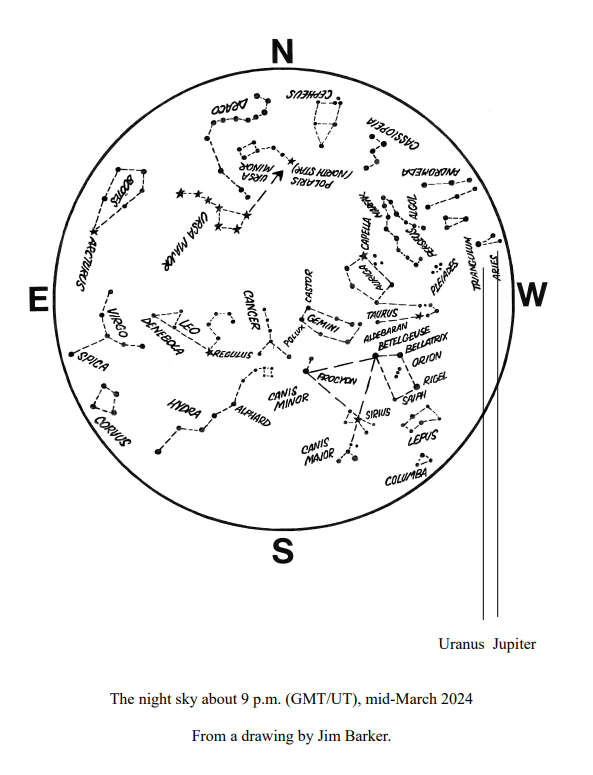

The Moon will be New on March 10th, and Full on March 25th. The Moon passes Jupiter on the 13th, going on to pass Hamal in Aries, then the Pleiades, Aldebaran and ElNath in Taurus by the 16th, when it will be nearly at First Quarter (half-full, waxing). On the morning of the 25th, close to Spica in Virgo, it sets during a faint penumbral eclipse which will be visible in full from North America. British Summer Time resumes on March 31st, eleven days after the spring equinox on March 20th.
The latest attempt at a commercial US Moon landing, IM-1, aka Nova-C and Odysseus (‘Odie’), was launched successfully on February 15th and touched down at the crater Malapert-A, 180 miles from the lunar south pole, on February 22nd. As contact with it was lost, surprisingly the Japanese SLIM lander got back in touch, having unexpectedly survived the lunar night.
In May 2024 China plans to launch its Chang’e-6 mission, to retrieve samples from the Farside of the Moon. The mission is planned to last 53 days and collect up to 4.4 pounds (2 kilograms) of lunar materials, from a site around 43 degrees south latitude and 154 degrees west longitude, in the south of the Apollo basin, part of the huge South Pole-Aitken (SPA) basin (Fig. 1; see ‘The Lunar Farside’, ON, June 4th 2023). For more details and for other stories see ‘Space Notes, March 2024’, ON, March 3rd, 2024.

The planet Mercury came to superior conjunction on the far side of the Sun on February 28th, as did Saturn, and both were imaged by the solar-observing SOHO space telescope at the Earth-Sun L1 point (Fig. 2). Mercury is in the evening sky in March, at best evening visibility this year. Mercury is below and right of the crescent Moon on the 11th, and to the right of Jupiter between 13th and 27th, at maximum elongation from the Sun on the 24th.

Venus is invisible this month, as is Mars, still out of sight beyond the Sun, as all the planets will be by the end of next month.
The jammed screws on the return capsule of the OSIRIS-REx spacecraft were successfully removed, and the full count of returned material (121.6 grams, Fig. 3) is much larger than hoped for (even the overspill was more than that). Among early revelations is that some of the material in the ‘junk pile’ of the asteroid Bennu appears to have come from the icy moons of Saturn, and it looks as if pebbles and dust grains on Bennu have come from all over the Solar System – which is of additional interest because Bennu is in the class of asteroid which could hit Earth, and doubtless did so in the past. Bennu may be older than the Sun, and may have collected its mixed bag of surface material during the processes in which the planets initially took shape,
Jupiter, in Aries, sets at 10.30 p.m.. The shadow of the volcanic moon Io crosses the face of the planet dramatically on March 2nd, and the crescent Moon passes Jupiter on March 13th. Study of the northern hemisphere of Io, in the Juno spacecraft flyby of 15th October last year, has revealed three previously unknown volcanic peaks, near the north pole (Fig. 4), contributing to the 266 active volcanoes now known to exist.


Saturn, in Aquarius, is no longer visible and reached superior conjunction beyond the Sun on February 28th (Fig. 2). One of the new discoveries from the Cassini orbiter mission, which ended by plunging into Saturn in 2017, is that Mimas, the moon which looks so like the ‘Death Star’ in Star Wars (Fig. 5), has an interior ocean 20-30 km below its surface. (See ‘Saturn and Its Moons, Part 2’, ON, November 7th, 2021). Exciting though that is in light of the Bennu samples mentioned above, it’s thought that the Mimas ocean is only 25 million years old, too young to have evolved life or for any of the liquid to have percolated up to the surface. But then, it was only discovered for sure last week – who knows what next week will bring?

Uranus, on the left side of Aries, sets at 11 p.m.. Uranus appears south of the Moon on the 14th.
Neptune too has disappeared from the night sky for now, in conjunction beyond the Sun on March 17th.
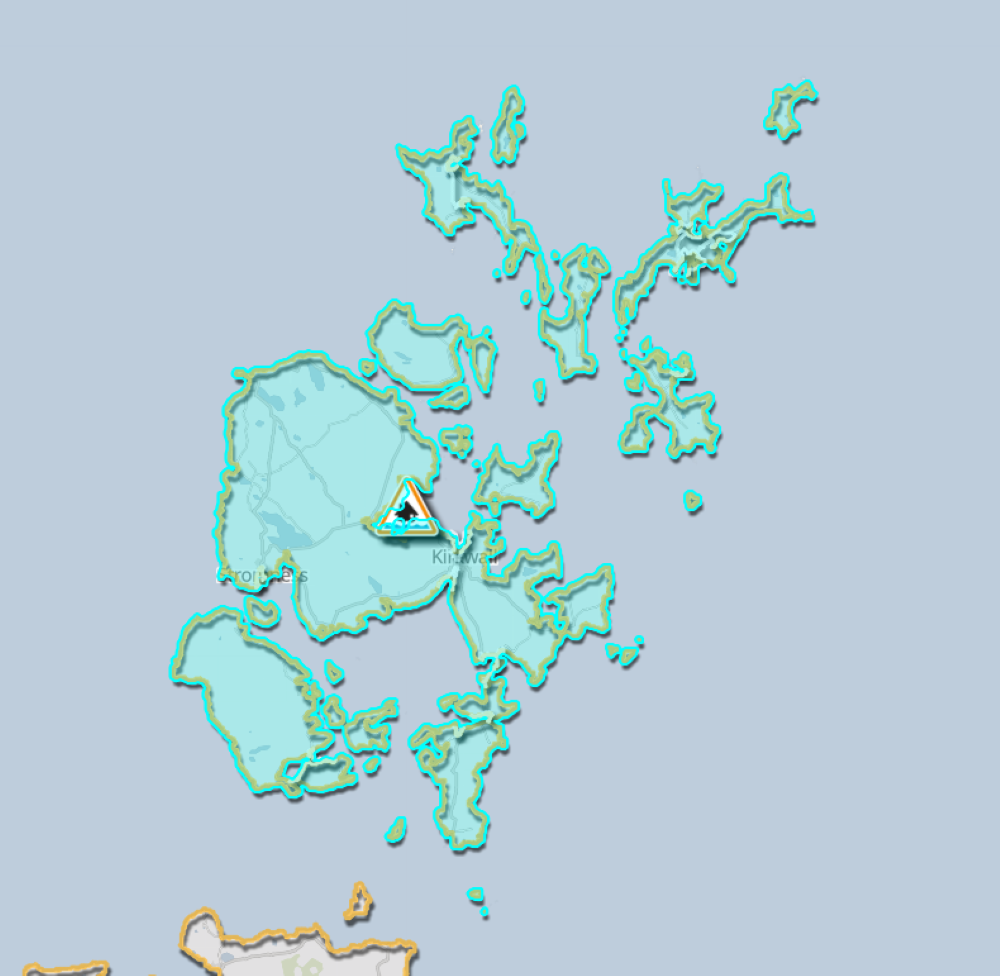
The March 2024 issue of Astronomy Now includes ‘Escape to the Orkneys’ by Callum Potter, an article about his move to a farmhouse on Rousay. To date he’s concentrated on observing the aurora borealis, though he’s also installed a meteor camera, but as he’s about to install his domed observatory and is Director of the British Astronomical Association, we can expect to hear more before long.
There’s a nice photo at the head of the article showing Callum’s house with Orion and the Pleiades above it, and the aurora borealis reflected in the upstairs windows. Years ago, I was in Sutherland for a celebration, during which a lady who found out what I did for a living told me how disappointed she was that she had bought a house there nine years before, in hopes to watch the aurora, but had never seen it yet. As I had seen it recently from Lairg and Rosehall, I asked her to point out her house, and taking a quick bearing on the setting Sun with my wristwatch, I said with some diffidence, “Your house faces south, with a steep hill behind it”. “I know,” she replied, “But does that mean I can’t see the Northern Lights?”
Nigel Henbest’s Stargazing 2024, published by Philip’s and one of this column’s major sources, recommends that through April, after sunset, we scan the western horizon not just for Mercury but for Comet Pons-Brooks, as it tracks from right to left from Andromeda into Aries, to the right of Hamal in Aries and above to the right of Mercury on March 25th, half a degree southeast of Hamal at the end of the month. The comet was discovered in 1812, with an orbital period of 71 years, and was last seen in 1954. It will be at the limit of naked-eye brightness, but has been known to flare up by 4 magnitudes, and did so on 14th November last. If it does so in March, binoculars might no longer be needed to see it.
Comet Olbers (discovered 1815) will be in the sky the same night, to the left of Uranus and above left of Jupiter, moving from Cetus into Taurus during the month, and expected to reach naked-eye magnitude by summer.

In 1979, when Gavin Roberts painted two closely-orbiting objects in the Kuiper Belt beyond the orbit of Neptune (Fig. 6), none were known to exist, and none were discovered till 2008. Pluto and its satellite Charon were thought of as a twin planet, their names an uneasy mix of Latin and Greek. The first Kuiper Belt object to be discovered was given the Inuit name ‘Sedna’, about when the Hallé Orchestra released a recording of Gustav Holst’s The Planets, with a cover by David A. Hardy and a new movement composed by Colin Matthews, called ‘Pluto, the Renewer’ (Fig. 7). In keeping with ‘Mars, the Bringer of War’, ‘Venus, the Bringer of Peace’ and ‘Jupiter, the Bringer of Jollity’, I suggested that another should be ‘Sedna, the Talk of the Steamie’.

The discovery of KBO (Kuiper Belt Object) UB 313 put the cat among the pigeons, because at first it seemed to be larger than Pluto, though it turned out to be 24 km smaller. A motion was pushed through the International Astronomical Union to reclassify Pluto along with Eris and Ceres in the Asteroid Belt as ‘dwarf planets’. The motion was passed after the US delegation had left the IAU Congress and did not go down well, because Pluto had been the only planet to be discovered by a US citizen. UB313 and its satellite had been nicknamed ‘Xena’ and ‘Gabrielle’ by their discoverers, which some of us liked, but of course that wouldn’t do with the IAU and in recognition of the trouble they’d caused, UB313 and its satellite were officially named Eris, after the goddess of discord, and Dysnomia, after her daughter.


Eris and Dysnomia are back in the news, along with the Hawaiian-named Makemake (Fig. 8) and its satellite S/2015 (136472) 1 (Fig. 9), or MK 2 for short, though doubtless not for long. Since the dynamic surfaces of Pluto and Charon were revealed by New Horizons in 2021, there has been considerable discussion about possible activity within and on smaller KBOs.

Initially it was assumed that liquid water would be the main active agent (Fig. 10), but it may not be the only one. Both Eris and Makemake are in mutual trapped rotation with their satellites, despite the latters’ small sizes, and dynamic studies indicate that must be due to formation of internal oceans by tidal heating. Now the James Webb Space Telescope has studied the infrared spectra of methane deposits on their surfaces, and found that the methane has been formed internally by chemical action within such oceans (Fig. 11), then released by geysers. (Paul Scott Anderson, ‘Icy Eris and Makemake Have Warm Hearts’, EarthSky, 21st February 2024.) Similar features were found by the Hubble Space Telescope on the surface of Charon, before the 2015 New Horizons flyby, and will doubtless come in for fresh study now. When I wrote above, ‘who knows what next week will bring?’, I hadn’t expected it to be so literally true.

Duncan Lunan’s recent books are available through Amazon. For more information see Duncan’s website, www.duncanlunan.com.
You can download a copy of the March 2024 Sky Map here:


Leave a Reply