
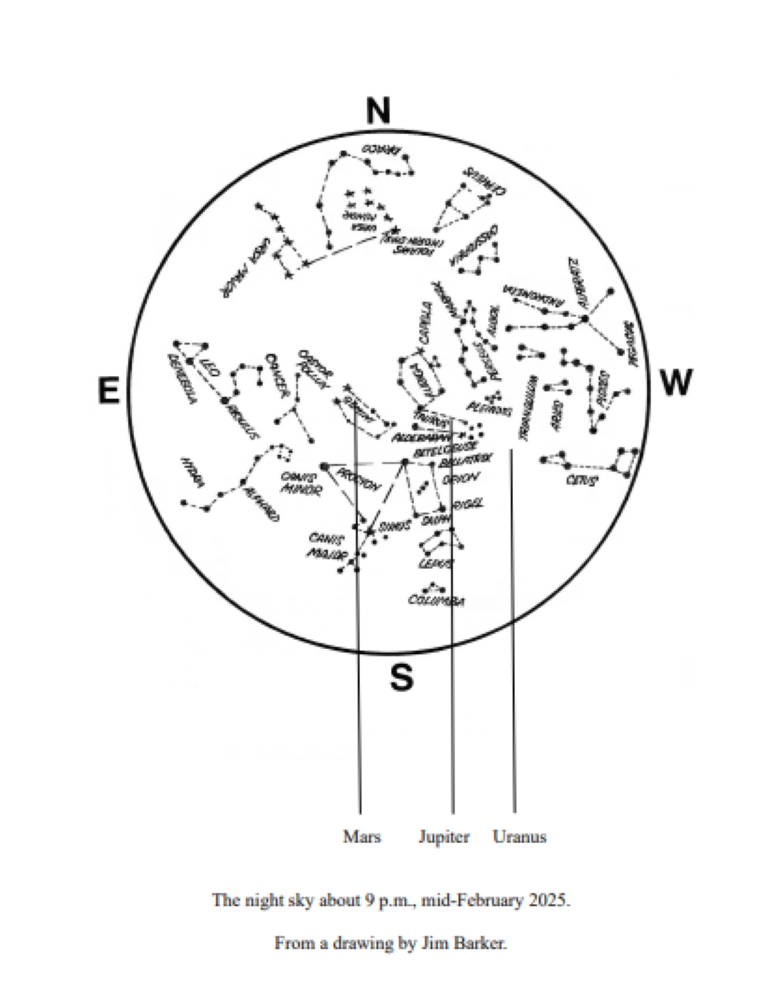

The Moon is Full on February 12th, and New on February 28th. The Moon is near both Venus and Saturn on the early evening of the 1st, as it was last month, passing close by Mars on the 9th and near Jupiter on the 12th.
A stir has been caused by the 10-metre asteroid 2024 PT5, which was discovered in August last year in a South African sky survey (Fig. 1).


A study of its reflectance properties in January by the Lowell Telescope in Arizona, as part of the MANOS (Mission Accessible Near-Earth Object Survey) determined that its composition is similar to moonrock, particularly in its volcanic pyroxene content (Fig. 2) rather than known types of asteroids, and its orbit, very similar to the Earth is consistent with an origin from the Moon. About 16 possible candidates for such lunar ejecta are known, and in my Children from the Sky I suggested that an apparent lunar Farside event witnessed by monks at Canterbury in 1178 might have been responsible for some of them. (Figs. 3 & 4; ‘The Green Children of Woolpit, Part 1 & 2’, ON, June 19th and 26th, 2022; ‘The Lunar Farside’, ON, June 4th 2023.) Asteroid 1991 VG is another very interesting candidate, not least because it may have passed through or left the Earth-Moon system in 1975, and it doesn’t reflect sunlight like moonrock, but as if it has solar panels – and it’s not ‘one of ours’. NASA was to have sent a solar-sail probe to it as one of the payloads on the Artemis 1 mission, but it had to be cancelled because the rocket wasn’t ready in time.


After superior conjunction beyond the Sun on the 9th, the planet Mercury is very low in the southwest late in February, setting about 7.00 p.m., and is near Saturn on the 24th and 25th, as it moves from Aquarius into Pisces. On 8th January Europe’s BepiColombo probe made its sixth and last Mercury flyby, passing 183 miles over the nightside before crossing the north pole (Fig. 5).

Like the aliens in Independence Day 2 (‘They go for the landmarks, don’t they?’) it has re-imaged some of the most striking features previously discovered by the Mariner 10 and Messenger probes. It obtained an oblique image of the northern Borealis Plantitia (Fig. 6), dramatic overhead shots of ice-filled craters near the pole (Fig. 7 & 8), and wide-angle images of Caloris Basin, one of the largest impact features in the Solar System (Fig. 9), and other features further north (Fig. 10). BepiColombo’s trajectory has been slowed by reduced yield from its ion-drive thrusters, but it’s expected to reach the planet in late 2026, and will separate into European and Japanese components (Fig. 11) to study the planet from different orbital inclinations.


Venus remains brilliant in early evening, at its highest and above Mercury on February 7th, setting at 9.00 p.m. and at its greatest brightness on February 19th.
Mars is near Pollux in Gemini in early February, fading now after its closest approach to us in January, after which it reverses its apparent motion on February 24th. It sets around 4 a.m., and is passed closely by the Moon on the 9th, occulted by it as seen from northwest Britain, Russia, China and eastern Canada.
Jupiter is still bright, back near Aldebaran in Taurus as its motion reverses on February 4th, setting around 3 a.m.. The Moon passes it on the 6th.

When I started learning about the planets in the mid-1950s, ‘everybody knew’ that Jupiter’s disc was patterned with bright zones parallel to the equator, separated by dark ‘belts’ (Fig. 12). Generally these were called ‘storm belts’, which would be higher than the bright bands and extremely turbulent, because the zones above them rotated at different speeds. Both methane and ammonia were detected spectroscopically and were assumed to be the major constituents of the atmosphere, (though hydrogen and helium are actually far more abundant).

That was the model of Jupiter which I used in my novella ‘The Galilean Problem’, which was published in Galaxy in September 1971 (Fig. 13), and praised by Jim Bell of the Glasgow Science Fiction Circle for its realism. But after the Pioneer 10 and 11 flybys of 1974 and 1975, it turned out that the model was upside-down, as I had to point out when my Notes on the story were printed with it in The Other Side of the Interface, (Fig. 14, Other Side Books, 2021).

The dark bands were actually the true surface of the gas giant planet, thought to consist of ammonium hydrosulphide, while the bright ‘zones’ above them were higher-altitude cloud, confidently stated to be ammonia ice – but it turns out that was only an assumption. “Astronomers will always assume a simple model unless there is overwhelming evidence that this simple model is flawed,” said Patrick Irwin of the University of Oxford, who verified the findings below. “Since we can see ammonia gas in Jupiter’s atmosphere […], it was just assumed that its main observable clouds were most likely composed of ammonia ice.” (Victoria Corless, ‘An amateur astronomer used an old technique to study Jupiter — and found something strange’, Space.com, online, 9th January 2025.
The amateur in question, Steven Hill, suggested using a technique is called band-depth analysis, developed in the 1970s to estimate the concentration of a specific gas based on how much light is absorbed at wavelengths specific to that gas — in this case methane and ammonia. Hill used the absorption bands of methane (619 nanometres) and ammonia (647 nm), to calculate the abundance of these gases above Jupiter’s cloud tops. Methane’s absorption at 619 nm is a reliable reference point because methane’s abundance is well known and its absorption can be used to determine pressure levels. Comparing this to ammonia’s absorption at 647 nm, Hill was able to calculate and map the distribution of ammonia across Jupiter’s clouds with high accuracy, and it turns out that the bright clouds are at temperature levels too high (i.e. too deep in the atmosphere) for ammonia ice to form. So what they are made of is anyone’s guess – ammonium sulphide, perhaps, plus some kind of smog, presumably highly reflective.
I’m guessing that because they are so bright, the clouds simply reflect the solar spectrum and that’s why their composition can’t be determined, like the noctilucent clouds seen in the north from Scotland in summer. It’s generally assumed that those must be some form of water ice, though it’s not clear how it can float at the altitude of about 60 miles where they form. (An attempt years ago to attribute them to metallic dust from Space Shuttle boosters drew a complete blank – only 2 instances of near-matching dates were found out of 135 Shuttle launches.) When the Pioneer probes found towering white plumes with intense lightning activity in gaps in Jupiter’s clouds, and Ed Buckley painted one in 1975 for my Man and the Planets (Ashgrove Press, 1983, Fig. 15), they too were assumed to be ammonia ice. But in May 2020 they turned out to be water ice (Fig. 16), all the way up into the supposed ammonia ice levels (Fig. 17), and I wonder if that may be at least part of the answer on a much larger scale – perhaps with different types of ice, as SF writers going back to James Blish have suggested that Jupiter’s layers may contain (They Shall Have Stars, 1956).


STOP PRESS NEWS, January 29th: continuing studies of images from Jupiter’s volcanic moon Io by the Juno spacecraft last year have revealed lava flows from multiple vents, covering an area of 40,000 square miles, equivalent to Lake Superior (the largest freshwater lake on Earth, by surface area), and indicating a huge magma ocean below. (Figs. 18 & 19). There will be another opportunity to look at them, though from further away, in the next Io flyby on March 3rd.


Saturn in Aquarius is near the crescent Moon on the 1st, below Venus, much fainter, and sets at 8.00 p.m., disappearing into the twilight by the end of the month. The rings now appear extremely narrow and will disappear briefly from view when Earth passes through the ring plane on March 23rd.

Scientists comparing spacecraft images have found several signs of activity on Saturn’s icy moon Enceladus, where the Cassini orbiter found plumes of water vapour coming from ‘tiger stripe’ features near the south pole (Fig. 20). The James Webb Space Telescope has recently found a larger plume than any seen before, extending into space for more than 20 times the Enceladus diameter (Fig. 21).

The other features are less dramatic, on the order of a kilometre or so across, but they show a reddish-brown spot (not a shadow) visible in 2009 and gradually disappearing over the next three years (Figs. 22 & 23), and a dark streak found in 2010 which mostly disappears by 2015, while nearby features grow brighter (Fig. 24). Neither can be explained by material falling from back from the plumes, or ejected into Saturn’s E-ring and eventually returning to Enceladus, so the hunt is on for more of them.


Uranus, between Aries and Taurus, sets at 1.30 a.m., and is passed by the Moon on the 5th.
Neptune in Pisces sets at 8 p.m., and forms a triangle with Venus and the Moon on the 1st, occulted by it that night as seen from the extreme eastern tip of Russia.
Sad news but not unexpected is that the European Space Agency’s GAIA space telescope, already at twice its expected mission duration, is coming to the end of the attitude control gas used to orient it for observations. Originally GAIA was the acronym for a French name, but when that was changed ‘GAIA’ stuck as the name of the Earth goddess, though still printed in capitals for consistency. Launched 10 years ago to study the positions, motions and compositions of stars in the Milky Way, it has done so for nearly 2 billion, out of an estimated 500 billion, and many other objects as well (Fig. 25), drawing up new maps of the entire Galaxy (Fig. 26), despite having been struck by a meteoroid in April 2024 (Fig. 27) which let sunlight into the spacecraft and took great ingenuity to work around. 5


The data has been released in three ‘GAIA Release’ tranches to date, in 2016, 2018 and 2022, with GR4 due in mid-2026 and the final GR5 not until the late 2020s. Along the way its data has been used for many other purposes, including the discovery of hundreds of asteroids, an inconclusive search for the source of the mysterious object ‘Oumuamua’ (ON, 17th and 24th December 2023), and a search at Jodrell Bank for extraterrestrial civilisations (see ‘The Search for Extraterrestrial Intelligence’, ON, April 17th 2022). Before GAIA, it was thought the origin of new stars in the Milky Way had proceeded at a steady rate of one or two per year over its history. But it turns out from GAIA’s tracking of star streams in the Galaxy (Fig. 28) that the Milky Way as we know it originated in an intense burst of star formation after a collision 13 billion years ago, followed by several more, most recently between 6 billion and 1 billion years ago (see ‘The Milky Way’. ON, February 13th 2022).

The implications of these discoveries will take years to unpack, but scientific observations with GAIA ended on January 15th. Starting around January 20th, the telescope will undergo a 15-day series of tests to gain information for designing future space telescopes, and then it will be moved out of its present orbit around the Sun-Earth L2 point, to keep it from drifting into the way of future space telescope missions or current ones like the James Webb Space Telescope, before switching off at the end of March 2025.
And finally (if only it were) I concluded the January 2025 ‘Sky Above You’ with a shocking list of astronomical facilities, ancient and modern, which are under threat around the UK, as well as examples abroad which have been threatened or damaged by fire, like the total destruction of the Scottish Dark Sky Observatory above Dalmellington. But now Jay Tate of the Spaceguard Observatory in Powys has drawn attention to a worse example yet, which would severely compromise professional astronomy worldwide. I can’t improve on the press release from the European Southern Observatory (‘World’s darkest and clearest skies at risk from industrial megaproject’, 10th January 2025, so these are the key paragraphs explaining the problem.

“Since its inauguration in 1999, Paranal Observatory, built and operated by the European Southern Observatory (ESO) (Fig. 29), has led to significant astronomy breakthroughs, such as the first image of an exoplanet and confirming the accelerated expansion of the Universe. The Nobel Prize in Physics in 2020 was awarded for research on the supermassive black hole at the centre of the Milky Way, in which Paranal telescopes were instrumental. The observatory is a key asset for astronomers worldwide, including those in Chile, which has seen its astronomical community grow substantially in the last decades. Additionally, the nearby Cerro Armazones hosts the construction of ESO’s Extremely Large Telescope (ELT), the world’s biggest telescope of its kind — a revolutionary facility that will dramatically change what we know about our Universe (Figs. 30 & 31).


“On December 24th, AES Andes, a subsidiary of the US power company AES Corporation, submitted a project for a massive industrial complex for environmental impact assessment. This complex threatens the pristine skies above ESO’s Paranal Observatory in Chile’s Atacama Desert, the darkest and clearest of any astronomical observatory in the world (Fig. 32). The industrial megaproject is planned to be located just 5 to 11 kilometres from telescopes at Paranal, which would cause irreparable damage to astronomical observations, in particular due to light pollution emitted throughout the project’s operational life. Relocating the complex would save one of Earth’s last truly pristine dark skies.

“‘The proximity of the AES Andes industrial megaproject to Paranal poses a critical risk to the most pristine night skies on the planet,’ highlighted ESO Director General, Xavier Barcons. ‘Dust emissions during construction, increased atmospheric turbulence, and especially light pollution will irreparably impact the capabilities for astronomical observation, which have thus far attracted multi-billion-Euro investments by the governments of the ESO Member States.’
“The project encompasses an industrial complex of more than 3000 hectares, which is close to the size of a city, or district, such as Valparaiso, Chile or Garching near Munich, Germany. It includes constructing a port, ammonia and hydrogen production plants and thousands of electricity generation units near Paranal.”
The classic problem is that when you open up access to a remote area, housing, tourism and industry quickly move in to develop it. A classic example is ‘Hazeldene’, the house I grew up in on Bentinck Drive in Troon, which was built in the country, in 1901, to enjoy its beautiful views of Arran. Within five years of extending Bentinck Drive out to it, a hotel on the road and a parallel extension of South Beach had completely hidden Arran from the house, unless you stood on the window seat in the upstairs drawing room, from where you could just see the tip of Goat Fell over the houses now blocking the view. Space-related examples have not necessarily had quite such bad consequences: when NASA built a road across Antigua to create a tracking station, it opened up one whole side of the island to tourist access and development; and when NASA upgraded the runway on Easter Island to allow emergency landings by the Space Shuttle, it changed the island from a remote outpost under Chilean military rule to the major tourist destination it is today (see ‘Challenger Liftoff’, ON, August 7th 2022). But it’s hard to see the Paranal development benefiting anyone except the industrialists concerned.
My fear is that when this comes to court, as it almost inevitably will, lawyers for AES Andes may be able to prove that the Observatory has already shot itself in the foot. They will be able to show that the ESO and other observatories worldwide have claimed that the development of the SpaceX Starlink constellation, may make the Observatory unusable and put an end to professional astronomy conducted from the Earth’s surface, and even from the Hubble Space Telescope, which puts the prospect of its refurbishment in doubt. And if the observatories will be no more use anyway, where’s the harm in industrial development next to them? Let the astronomers go to the Moon, indeed to the Farside of the Moon, as they have spoken about doing for so long. Indeed a later version of the Blue Ghost lander, now on its way to the Moon, will be carrying a prototype telescope for just that purpose. It will be difficult for the ESO astronomers to say, “No, we didnae mean it, we can solve the Starlink problem”, and at the very least, it will give them a strong incentive to do so.
(There will be more news about the current Blue Ghost and Resilience lunar missions in ‘Space Notes’ on Sunday, February 2nd.)
Duncan Lunan’s recent books are available through Amazon; details are on Duncan’s website, http://www.duncanlunan.com.
You can download a copy of the February 2025 Sky Map here:

Leave a Reply