
In the good old days, everybody knew what an eclipse was. Like everything else in astronomy back then, they were events visible only from Earth.

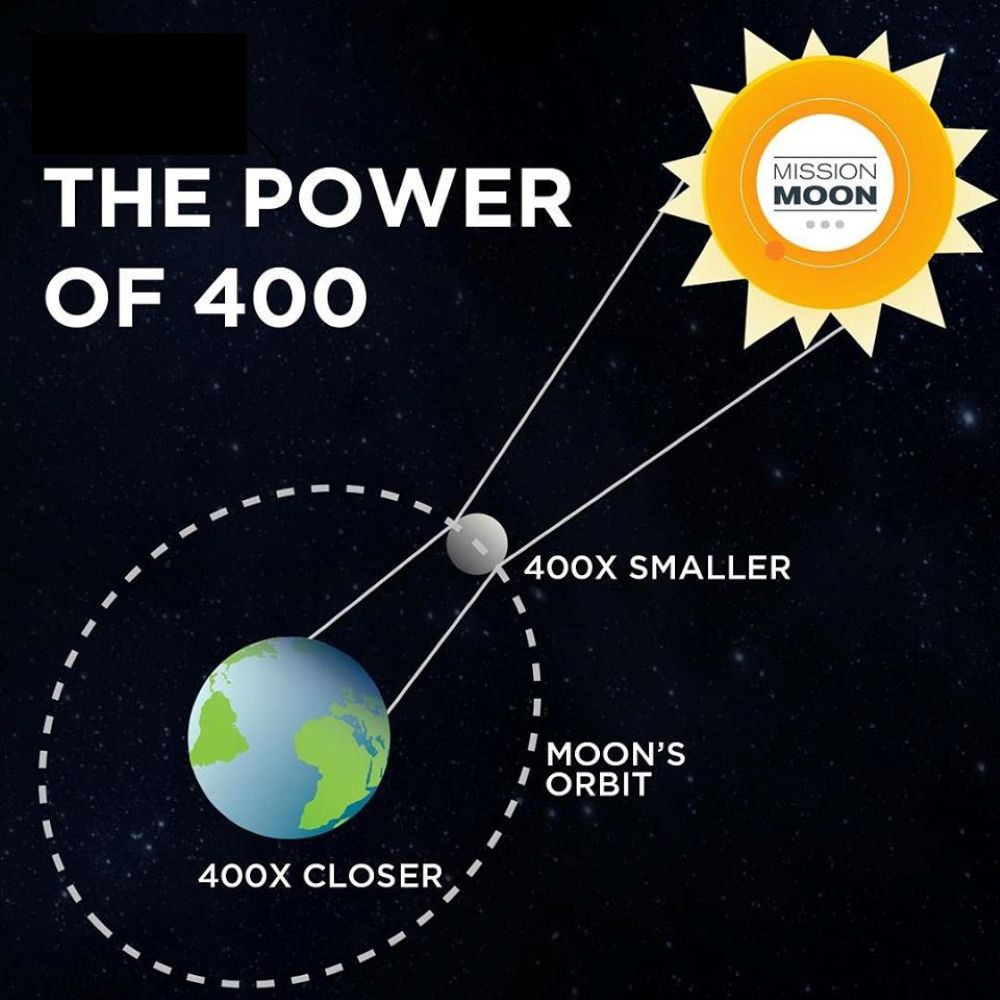
A solar eclipse occurred when the Moon passed between the Sun and the Earth (Fig. 1), and a lunar eclipse when the Earth passed between the Sun and the Moon (Fig. 2).

As it happens, the Sun is at 400 times the Moon’s distance and is 400 times the size, so the Moon’s disc is the same size as the Sun and covers the Sun’s almost exactly (Fig. 3).

Because the Sun is not a point source, in both cases it casts a two-part shadow, with divergent outer rays forming a penumbra and convergent inner ones forming a darker umbra. In either case, eclipses are total only within the umbra. Looking back on my ‘Beginner’s Astronomy’, I’m embarrassed to see that I covered only lunar eclipses, because there was one coming up (‘Lunar Eclipses’, ON, May 2nd, 2021).

But with the space age came opportunities to see eclipses from other viewpoints (Fig. 4 from Forbidden Planet is an extreme example, from orbit around Altair, the brightest star in Aquila). Firefly Aerospace’s Blue Ghost spacecraft landed in Mare Crisium on March 2nd, shortly after sunrise (Fig. 5), so the Moon was then a waxing crescent, seen from Earth. It returned an image of the Sun on the lunar horizon (Fig. 6), followed by one of the Earth above the probe’s shadow (Fig. 7).


Note that the Sun was behind the spacecraft and the Earth, high in the western sky, was almost Full. Twelve days later, it would return images of a lunar eclipse on March 14th. Journalists can be forgiven for having to use familiar terminology in an unfamiliar context, but it has to be said that much of what followed was wrong, starting with an image of the Sun, completely unobscured, but supposedly at the midpoint of the eclipse, actually at its onset (Fig. 8). It was a relief to see a later video sequence which showed the Sun being hidden, as a ring formed around the black disc of the Earth (Fig. 9).


It was repeatedly said that this had never been seen before, and that is simply not true. It has been predicted for a long time – probably ever since the ancient Greeks recognised that an eclipse of the Moon is due to the shadow of the Earth, whereby they knew that the Earth was round. If you were on the Moon at the time of a lunar eclipse, you would see the Sun eclipsed by the Earth – much more so, because the Earth would be four times the diameter of the Moon seen from here.

Probably the first piece of coloured space art was James Nasmyth’s painting of such an event in The Moon: Considered as a Planet, A World and a Satellite (with James Carpenter, Murray, 1874 – Fig. 10), and similar paintings were produced since by artists including Lucien Rudaux, Chesley Bonestell and David Hardy, all of them predicting correctly that despite its greater size, the Earth would be surrounded by a ring of refracted light which would be red, due to the absorption and scattering of blue light which gives the sky its blue colour and makes the eclipsed Moon red. The first images of it were obtained by Surveyor III during a lunar eclipse of April 24th 1967. The view of the eclipsing Earth is more blurry than Blue Ghost’s because as it moved, it was photographed through several filters in succession (Fig. 11) and processed to produce a coloured image (Figs. 12 & 13).


Comparison with weather reports worldwide established that the gaps in the ring corresponded to cloud formations on the rim of the planet. That graphic was published in Surveyor Program Results (NASA SP-184, US Government Printing Office, 1969), but I found it in a library copy, commercial photocopying wasn’t available back then, and I haven’t located it online.


The search has turned up a minor anomaly. I found Fig. 10 in a file of Surveyor III images online. There was only one camera on each Surveyor (Fig. 14), and yet the colour filter in Fig. 10 is definitely not the one in Fig. 15, which was brought back by the Apollo 12 astronauts and later presented to Edgar M. Cortwright, director of Langley Research Center in Hampton, Virginia, from 1968 to 1975. It remains in the hands of his family, who intend to donate it to a museum in due course. The only explanation seems to be that different colour wheels were flown on different Surveyor missions, but I haven’t been able to verify that either.
The media managed to confuse solar and lunar eclipses thoroughly in covering the Blue Ghost event. Among other things, several articles confused the red ring round the Earth due to its atmosphere, in a lunar eclipse, with the solar corona and embedded prominences which are seen round the Moon in a solar one – even to the extent of calling it ‘the ring of fire’, which the solar one is sometimes called, also applied to the auroral ring round the Earth’s magnetic poles, and most appropriately to the volcanic ring which surrounds the Pacific Rim, due to crustal spreading within it. In a solar eclipse, the last glimpse of the Sun through the mountains on the rim of the Moon generates an effect called ‘the Diamond Ring’, and that was also applied to the last glimpse of the Sun through Earth’s atmosphere in the Blue Ghost event, though the cause was quite different. A more imaginative caption called Blue Ghost’s ring around the Earth ‘everybody’s sunsets at once’, which is not bad until you think that the other half of the ring would be ‘everybody’s sunrise at once’…

A solar eclipse, as seen from the Moon, was portrayed by R.A. Smith for Arthur C. Clarke’s Exploration of the Moon (Muller, 1954 – Fig. 16). Nobody’s seen it from there yet because the few probes which have survived a night on the Moon didn’t have enough power to do anything with it. But solar eclipses have been photographed from space by Russian, Chinese and International space stations, as well as by many satellites. So it will be seen some day, but not with stars around it as some artists have depicted, because the Earth will be at Full when it happens, and earthlight is bright enough to read by.

Despite misrepresentations in the media, Blue Ghost’s mission has been a complete success, with all 10 NASA experiments performed and successfully completed, including communications and navigation tests, the ‘Lunar Planetvac’ dust collector (Fig. 17), and perhaps most importantly, a successful test of an electrostatic system to repel lunar dust, preventing it from clogging spacecraft systems and human lungs.


On March 16th, with the end of the lunar day at hand, Blue Ghost obtained dramatic views of the lunar sunset (Figs. 18 & 19), overexposing the Earth and capturing Venus between Earth and Sun, in hopes to see levitation of lunar dust due to electrostatic forces. The effect had been seen by Surveyors 5, 6 and 7 (Fig. 20), and also sketched from orbit by the crew of Apollo 17 (Fig. 21), but there’s been no more data on it since.


After a scrub due to an air bubble in the hydraulic system of the transporter-erector’s strongback arm, which retracts in the last minutes before launch, a Falcon 9 rocket successfully put the Crew 10 Dragon capsule into orbit on March 14th. Although I had tried to watch the previous attempt, I hadn’t seen any new date other than ‘no earlier than Friday’ so I didn’t see it live, but the BBC has a useful compilation of the launch, climbout, staging and separation from the second stage in Pallab Ghosh, ‘SpaceX rocket launches as stranded astronauts prepare return’, BBC News, Science & Environment, 14th March 2025. Following the handover of the ISS by Crew 9, they returned to Earth on March 18th in the Dragon capsule they could have used at any time (Fig. 22), bringing back Butch Wilmore and Sunni Williams from their supposed stranding (Fig. 23).


The return attracted major interest from a small pod of dolphins, who remained in attendance until the capsule was brought aboard the recovery ship (Figs. 24 and 25).


SpaceX swiftly followed it with a mission of their own, Fram 2 (after Amundsen’s polar exploring vessel), which took an international crew over the poles of the Earth for the first time. 22 experiments were performed, including the first human x-rays in space and a study of mushroom growth in zero-g, before a safe return to Earth on April 4th, landing off the Pacific coast, also for the first time, to make sure discarded parts of the capsule during entry don’t land within the continental U.S..
None of the Fram 2 crew had been in space before, and another ‘rookie’ flight is expected when Katy Perry commands Blue Origin’s next New Shepard space tourism launch. Due to her touring commitments, the flight is expected before April 23rd. The media have been billing this as another space first, with an all-woman crew, but I have seen one article which correctly pointed out that the first such was Valentina Tereshkova’s solo flight on Vostok 6 in June 1963 (Fig. 26).

As that was one of a series of ‘spectaculars’ ordered by Nikita Khrushchev, it was to be a long time before either Russia (first again) or the USA put another woman into space, although there have been many more since including the Shuttle missions STS-93 and STS-114 commanded by Eileen Collins.

Europe’s Exomars rover has had a bumpy ride, without leaving the ground. Its British prototype was originally known as ‘BB’, for Breadboard model, but to the French participants that meant Bardot, so the prototype became ‘Bridget’ (Fig. 27) and eventually was formally named Rosalind Franklin, after the pioneer of crystallography, whose early death robbed her of the Nobel Prize she might have shared for her part in discovering the structure of DNA.


The withdrawal of US participation was a significant setback, criticised on both sides of the Atlantic (Figs. 28 & 29), and seemed to have been solved with agreement to launch it on a Russian Proton booster, with a Russian carrier for the Mars landing, before the invasion of Ukraine in 2022 put paid to the collaboration. A deal has now been reached for NASA to launch it, booster still to be decided, and Airbus have been contracted to build the new lander (Fig. 30).


The Rocket Lab Photon, the first private probe to Venus (Figs. 31 & 32), is now to be launched in summer 2026 on the company’s Neutron booster, instead of its existing Electron vehicle. In a 330-second science phase after atmosphere entry, it will use autofluorescence and backscattered polarized radiation to detect the presence of organic molecules in the clouds between 97 and 72 miles’ altitude (Fig. 33).

It’s the first of the Morningstar Missions to Venus, a series of probes to look for life in the clouds, headed by Prof. Sara Seager of MIT. Its woven Heatshield for Extreme Entry Environment Technology (HEEET) was invented at the NASA Ames Research Center (Fig. 34), and is designed to protect the spacecraft from temperatures up to 4,500 degrees Fahrenheit (2482 degrees Celsius).

When the Photon probe failed to materialise last year, there was scepticism that it would happen, and the same applied to the various proposals for a private space station to follow the ISS.
None of them has dropped out yet, however, and Vast Space feels sufficiently confident to have released a timetable for deploying and occupying its first Haven module in orbit (Figs. 35-36), to be followed two years later by the first Haven-2 module and outgrowth to 4 modules and then 8 (Figs. 37-39).


Vast Space Haven-1 Timeline
| Milestone | Description | Target Date |
|---|---|---|
| Flight Primary Structure | Complete manufacturing and testing of the flight primary structure | July 2025 |
| Integration | Vehicle integration and checkout, including subsystem manufacturing and testing | July 2025 – December 2025 |
| Integrated Vehicle Testing | Environmental test campaign (acoustics, vibration, EMI, TVAC) | Jan 2026 – March 2026 |
| Launch Campaign Start | Pre-launch operations at the launch site | April 2026 – May 2026 |
| Launch | Haven-1 launch | NET May 2026 |
| Automated-Orbit Operations | System commissioning in orbit | May – June 2026 |
| First Crewed Mission | First crewed mission | NET End of June 2026 |
No date has been set for the next launch of SpaceX’s Starship/Superheavy combination, but it’s been announced that it will be the first reuse of a refurbished Superheavy, an essential part of Elon Musk’s long-term plans. The booster from Flight Test 7, which was successfully recaptured by the launch tower at the end of its flight, has undergone a static firing for FT-9 (Fig. 40), reusing 29 of its 33 Raptor engines. Not to be outdone, NASA has now issued a mission patch design for Artemis II, which is intended to carry the first crewed flight of the Orion lunar spacecraft (Fig. 41). The article I saw said that wouldn’t be ‘later than April 2026’, but in view of the difficulties with it which have still to be solved, I think that was meant to be read ‘earlier’.


Casting the Space Notes wider than usual, as predicted the Gaia spacecraft was powered down for good on March 27th, before its attitude control gas finally ran out, and after insertion into an orbit which will take it away from the Sun-Earth L2 zone, currently occupied by the James Webb Space Telescope and targeted for future missions. Gaia has lasted for ten years, twice its planned lifetime, and has stacked up a huge backlog of data on the composition of the Milky Way. Its fourth tranche of data will be released next year, and analysis will continue for many years to come.
Gaia data is used extensively in the search for exoplanets and possible life-bearing ones around other stars. In my archive folder on exoplanets I have a final section for far-out possibilities such as ‘Tabby’s Star’, possibly but not probably orbited by a huge artificial structure. But one of those possibilities has suddenly taken a leap into the limelight. White dwarf stars are the remains of stars like the Sun (Fig. 42), or more massive, but not enough to go supernova.


At the end of a red giant phase and formation of a planetary nebula, they are stripped down to condensed matter, stripped of its electrons, and reach a size not much larger than the Earth (Fig. 43). The first of them to be discovered was ‘The Pup’, orbiting Sirius the Dog Star, and Innes, who first calculated its density, refused to believe it and died without knowing he was right.
You might think that a less likely place to find life-bearing planets would be hard to find, but once white dwarfs in the Hyades cluster were found to have rings of asteroids, formed by the breakup of planets due to tidal forces as the stars collapsed (Fig. 44). it began to seem possible that small rocky planets could reform in the debris discs (Fig. 45), maybe even reaching Earth-size and lying within the new, very tight habitable zone around the white dwarfs (Fig. 46).


But how ‘habitable’ would it be, and how long would it last? Researchers at the Florida Institute of Technology have come up with the surprising answer that there would be enough stellar energy to support photosynthesis and UV-induced abiogenesis, the generation of life from non-living matter via ultraviolet radiation – furthermore, these conditions could last as long as 7 billion years, where the Earth is only 4.6 billion years old now, and according to some estimates, won’t be habitable for more than another billion years or so. So life could start on a white dwarf planet, after the period of the star’s ‘stable’ existence on the Main Sequence when you might have thought that any life there would be extinguished (see ‘Stars and Nebulae’, ON, January 30th, 2022), and then it might have a longer run than we may have. Unless of course we do something about it.


Leave a Reply to Space Notes – Inflows and Outflows – The Orkney NewsCancel reply