
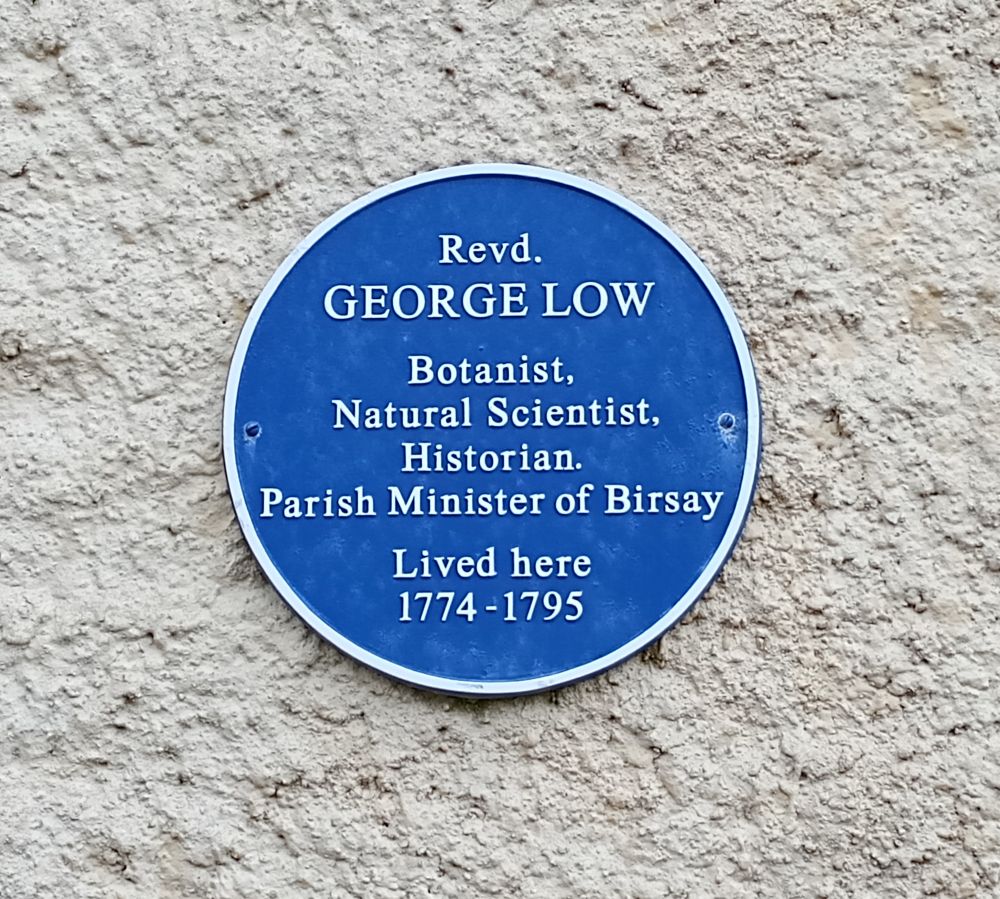
“The Language of these Islands was a dialect of the Norwegian, the same as is used in Iceland to this day. It was called here Norn…but is now so much worn out, that I believe there is scarce a single man in the Country who can express himself on the most ordinary occasion in this language.” Rev. George Low.
The heritage of a community can soon disappear if it is not valued or given scant regard. Huge changes are taking place across Orkney as the thirst for the islands’ renewable energy is exported south. Other developments would see a large deep water facility constructed in Scapa involving significant works on land.
It is often the mundane everyday things around us that no one bothers to record because they have always been there ( at least within living memory.)

Orkney owes a great deal to the antiquarians of the past who meticulously noted down the everyday happenings of the communities they lived in. But they were also immensely curious about those who had lived there before them. The people who had set up great monumental stones, and left tombs of the dead to be explored.
One such antiquarian, botanist and Kirk Minister, was Rev George Low, who in the 18th century recorded much about Orkney which today has disappeared.
George Low arrived in Orkney in 1768 as a tutor to the sons of Robert Graham of Stromness and eventually he became the Minister in Birsay. Low sketched and recorded a mass of information about Orkney: flora and fauna, archaeological features, and the daily lives of the islanders. In 1770 he began work on a ‘History of the Orkneys,’ in which he contemplated embodying accounts of the history and antiquities, as well as of the natural history and topography of the islands, and for this purpose translated Torfæus’s ‘History of Orkney.’
He undertook an arduous tour of the islands at a time when roads were poor and transport involved mostly walking or sailing in small vessels, in all weathers. His health was affected by the arduousness of the tasks he set himself. Tragedy also befell his personal life when his young wife died in childbirth. He himself was to suffer from eye problems and became almost completely blind in 1793. He died on 13 March 1795, and was buried beneath the pulpit in Birsay Church. In his twenty years of ministry in Birsay he had become well loved by his parishioners.
During his lifetime George Low recorded much about Orkney which is now gone, or significantly changed.
In 1774 George Low sketched and described the Medieval church of St Mary’s, Skaill, Sandside Bay, Deerness with its distinctive two round towers at its west end capped with small cupolas. He described it as ‘the most remarkable country kirk in these isles’. Low was able to explore inside the Church climbing its twin towers. His description published in ‘Tour Through Orkney and Schetland’ is a hugely important record of this building. The roof of the church was blown off in the late 18th century and the building became very ruinous, despite still being used by its congregation.
He described the bustling markets which used to take place in Kirkwall and which by Low’s time were already gone, except for one at Martinmass.
They had two weekly markets, on Tuesday and Friday, but these are discontinued: and three fairs in the year, one at Palm Sunday, another at Lambmass, and the third at Martinmass
He wrote about the remains of the Earl’s Palace in Birsay where he says of the interior walls, ” It was said to be painted with Scripture Stories, with the texts they referred to, but these are all defaced together with the moto “Sic fuit est et erit” , said to have been placed above the arms, and not so much as a bit of plaister on the walls.”
And he adds, “This structure is now going fast to ruin.”

In his descriptions of the islands he includes his reflections of the inhabitants which are not always favourable. He suggests the need for a lighthouse in North Ronaldsay because of the number of wrecks which take place on its rocky shores: “the greatest part of these wrecks are Swedes and Danes who all choose rather the passage between this Island and the Fair Isle, than those narrow sounds which lead thro the Orkneys. “
“The whole island is the property of one Gentleman and tho’ small is valuable, the rents are paid as in other parts of Orkney in kind, as malt, meal, butter, oil, feathers etc., the tenants here too as is too much the case thro’ Orkney have no leases, but all removeable at pleasure.”

Low found that the ancient language, Norn, had mostly gone from the islands, even from the songs, which only 50 years before had been “the prevailing tongue of two parishes in the Mainland.”
“…their old language will wear out entirely and will not in these parts be understood at all.”
Even the way the islanders dressed was different from the ordinary people of Scotland. Their clothes consisted of:
- very coarse undyed cloth
- finer colourful coat for ‘best’ wear
- very coarse linen
- knitted stockings
- leather shoes
All of these they make themselves. It was different for ‘The Gentry’ who did not wear ‘homespun’, ” but love to go very fine, and indeed here broadcloths, silks, velvets, cambricks, laces, and other fineries are much more used than even the richest shires in Scotland.”
Many of George Low’s writings and sketches were lost, and in his time he had great disappointment when publishers let him down and others used his work without credit given. A series of lectures in 1924 to the Orkney Antiquarian Society given by Hugh Marwick, and reported in The Orkney Herald, means that we have an account of some of his unpublished work. Hugh Marwick was able to inform the Society that some of Low’s missing manuscripts had been discovered in the Advocates Library, the Library of the National Museum of Antiquities, and the University Library – all in Edinburgh. Hugh Marwick had transcribed Low’s manuscripts held by the University and he says:
“The whole is written in a fine clear hand on quarto sheets which are sewed together in twenty-five bunches or fasciles.”
It was thanks to the endeavours of Hugh Marwick that Orcadians, in the first quarter of the 20th century, were able to listen to and read these invaluable accounts made by George Low in the 18th century about a way of life which was now long gone.

Fiona Grahame
Leave a Reply