
In October 1967 I set up a ‘discussion project’ within ASTRA, then Scotland’s national spaceflight society, to discuss ‘The First Phase of Interstellar Colonisation, Out to 12 Light-years’, with the backing of the late Ed Buckley as artist, later joined in that capacity by Gavin Roberts. The aim was to produce a book which eventually became Man and the Stars (Souvenir Press, 1974). Along the way, we found it necessary to abandon the ‘foreseeable mission’, achievable with existing or imaginable technology, in favour of the ‘acceptable’ mission, using faster-than-light spaceships to maintain links with Earth; and finding that publishers weren’t interested in ‘a set of unconcluded speculations’, we went on to Part 2 on direct Contact with Other Intelligence. At each of those evolutionary stages we lost participants who felt that it had become too speculative, too much like science fiction; their objections were summed up in a review for the Glasgow Herald by Dr. John Lenihan of Glasgow University, who wrote that “whenever Mr. Lunan encounters a difficulty, he simply wishes it away”. To that the late John Braithwaite replied, “that is to say that you can’t discuss the ethics of the voyage unless you have a blueprint for the engines”, but his letter went unpublished.
One early drop-out was the late Prof. Archie Roy, of the G.U. Astronomy Department (later Physics and Astronomy), who had opened the first discussion and what became the first chapter with ‘Will There Be Suitable Planets?’ Although he had founded the Scottish Society for Psychical Research and published both supernatural and science fiction thrillers, he felt that the topic of exoplanets was too speculative to allow his name to be used, and didn’t relent till years later. My last two ON articles, ‘Pale Red Dots’ and ‘Beyond the Pale Red Dots’ have turned out to be a full update on that first chapter. The speaker at the second meeting, ‘Will There Be Suitable Ships?’, was the late Prof. Terence Nonweiler (see ‘Waverider, Parts 1 & 2’, ON, November 27th and December 4th, 2022), who had no such reservations. I’d headed Chapter 1 with a quote from Paradise Lost (‘… and every star perhaps a world of destined habitation’), and for contrast, Chapter 2 began with a folk-song verse in praise of the Balaena, described by the Traditional Music Library as ‘right around the time (1890s) of cutting edge tech., fast steamers and the harpoon cannon’.
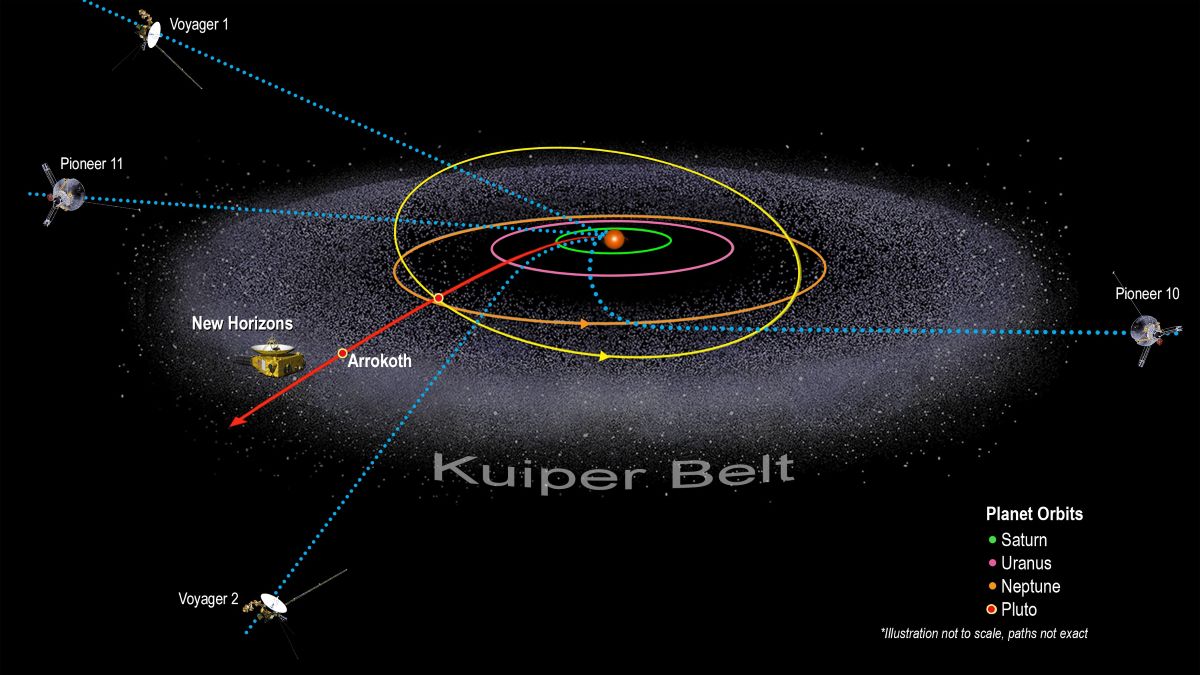
Prof. Nonweiler’s start point was that the problem of interstellar travel was the opposite of interplanetary flight’s. As the late Robert A. Heinlein said, ‘If you can get into Earth orbit [at five miles per second] you are half-way to anywhere’. 6.9 mps will get you to the Moon, 7 mps will get you on your way to the planets, and 9 mps will get you across the Moon’s orbit in only 10 hours. Escape from the Solar System takes only 20 mps, and by the book’s publication, Pioneer 10 had achieved first one speed and then the other, with the help of a Jupiter flyby in December 1973. But Pioneer 10 will pass the distance of Ross 248, by then the nearest star to us, in 33,800 years, and Aldebaran in Taurus, between us and the Hyades cluster and 65 light-years away, 2 million years from now, and it will be the first to pass anything significant. Pioneer 11, Voyagers 1 & 2, and New Horizons, are all heading out of the Solar System (Fig. 1), but none of them will pass anything meantime.

Nuclear propulsion is no help. As Prof. Krafft Ehricke pointed out in 1968 (see end Notes), NASA’s fission-powered Project NERVA (Fig. 2), for crewed missions to Mars in the 1980s, had no growth potential beyond expeditions to Mars and Venus, whereas the aim should be ‘the strategic approach to the Solar System’, assessing and using all of its resources for the benefit of mankind.

With Prof. Ehricke’s permission, the terminology and reasoning of his paper ‘A Strategic Approach to Interplanetary Flight’ was used throughout ASTRA’s follow-on Interplanetary Project, which generated the books New Worlds for Old (1979) and particularly Man and the Planets (1983), subtitled ‘The Resources of the Solar System’. There have been studies of nuclear-powered missions to the Oort cloud of comets and on into interstellar space, but even the gas-core fission Discovery of 2001, A Space Odyssey would take centuries to reach even the nearest star. Alan Bond, later of Daedalus and HOTOL fame, considered that a fusion-powered ship could reach ten light-years in 60-150 years, but only by mastering controlled fusion and building the ship in the vicinity of Jupiter, with very advanced techniques including using solid hydrogen as a construction material. (I liked the bit about how I ‘wished difficulties away’ in the Herald review!)
The records of the Astronomical Society of the Pacific show that interstellar travel was discussed at their meetings in the late 1940s by Jack Parsons, the chemist who devised most of the solid rocket fuels in use today, when he wasn’t practising black magic or hob-nobbing with Aleister Crowley and L. Ron Hubbard. (Russell Miller, Bare-Faced Messiah, Michael Joseph, 1987). The first formal paper on the subject was given by L.R. Shepherd at the first postwar International Astronautical Congress, in London, 1951. (Science fiction writers had been describing it, along with inhabited exoplanets, since The Skylark of Space by E.E. Smith in 1928.) The paper was printed in the Journal of the British Interplanetary Society in 1952, (see end Notes and ‘Pale Red Dots’, ON, 4th May 2025.)
The only form of interstellar travel then on the drawing board was the nuclear-electric ion drive, and Shepherd believed that with advances in technology, it might be capable of reaching 0.01c, one percent of the speed of light. Acceleration and deceleration would be very slow, taking perhaps 50 years each, giving a transit time to the nearest stars on the order of 400 years. In March 1954 Authentic Science Fiction Monthly began ‘From the Earth to the Stars’, a series of articles by John Richards depicting such a mission, launched from Neptune’s large moon Triton (Figs. 3 & 4).


How the crew and their descendants were to occupy their time wasn’t fully explained, but Shepherd had made the point that the engines would need a lot of maintenance and the cover of the June issue showed them making external repairs in deep space. Average journeys within 10-12 light-years could take 1000 years, 30 generations, and Shepherd described it as like setting out under King Canute and finishing under President Truman (later citations updated that to Eisenhower). Although he only hinted at the possibility, comparing the ship to ‘a large planetoid’, the idea took hold of doing it within a hollowed-out asteroid. Charles Chilton used it in the third of his 1950s Journey into Space radio serials, and a dramatic illustration appeared in Rocket, the News of the World‘s space and SF comic (Fig. 5). which in 1956 was just a year too early to catch the excitement of the space race.

Early ion-drive spacecraft used heavy metals such as cadmium as reaction mass, and the small tankage required was a big weight-saver in their design. The comparatively large tankage of Ed Buckley’s ion-drive space probe (Fig. 6) shows that it’s destined for interstellar space.


The painting is unsigned and undated because Ed was working in oils, and he never went back to finish the shadowy figures tending the probe after he shifted to acrylics to illustrate Man and the Stars, simply painting them out (Fig. 7). Ion-drive was considered for the US mission to Halley’s


Comet (Fig. 8), as an alternative to solar sails (Figs. 9 & 10), but both were still almost untried and rejected as too uncertain. I was visiting the Public Affairs Office at the Jet Propulsion Laboratory in Pasadena in 1979 when news came through of the cancellation, and a wave of disappointment swept though the complex.
Krafft Ehricke evaluated ion-drive in his 1968 paper, under the heading CLAT (Continuous Low Acceleration Transfer), but considered them unsuitable for human operations. A warning note was sounded by the European Space Agency’s SMART-1 probe in 2003, which used xenon gas as reaction mass in what is now known as a ‘Hall thruster’ : it proved more effective than anticipated, and the probe reached the Moon two months early. That was very well, but if the thrust on an interplanetary transfer was less than needed, the spacecraft would miss the target planet and have to orbit the Sun several times before it was recovered (if ever). NASA is facing that situation right now with a loss of thrust on its Psyche probe, on the way to the asteroid of the same name. If the situation can’t be remedied, a decision to switch to a backup system has to be taken within weeks, and may lead to a loss of capability later in the mission.
Although the dangers posed by high-energy cosmic rays weren’t appreciated in 1968 (that came out in the later Apollo missions), Ehricke quite rightly argued that if humans were to be moved between planets, the need was for BAT (Brief Acceleration Transfers) taking weeks, at most, rather than months or years. His chosen answer was pulsed nuclear fusion, which had been studied by Prof. Freeman Dyson in Project Orion. Orion would be propelled by small thermonuclear devices (i.e. hydrogen bombs) exploded against a pusher plate on the rear of the vehicle. As Robert Shaw remarked in the ASTRA discussions, it does at least give you a very good reason for heading off in the opposite direction. Dyson’s original idea was for a giant vehicle launched from the Earth’s surface (fallout wasn’t then considered a problem), taking a large expeditionary force to the moons of Saturn (Fig. 11).


The cover of Gary Gibson’s novel Nova War (Tor, 2009) shows the destructive effect of landing such a vehicle on a planet (Fig. 12). In 1968, Ehricke was writing with the assumption that the Saturn V booster would be the workhorse of the space programme for the rest of the century, and although the efficiency of a Saturn-launched Orion would be reduced by the maximum diameter of the pusher plate, he considered it would be adequate for the early stage of his Strategic Approach (Figs. 13 & 14).


Meanwhile, Dyson himself had turned to the implications for interstellar flight (Fig. 15). A 175,000 ton vehicle could send a 1000-ton payload 10 light-years in 150 years. In a later article, Alan Bond reckoned that at the theoretical limit of mass ratio (total vehicle mass to payload), a 25,750,000 ton ship could send the same payload to the same distance in ‘only’ 80 years, which begins to sound feasible but is a poor return on investment. To maintain constant acceleration, the stroke length of the shock absorbers on the interstellar version would be 75 metres, with a frequency of three seconds, leading the discussion group to imagine it pulsing out into the Solar System like a jack-in-the-box, or more accurately a maddened Slinky – as Archie Roy said, quoting Morecambe and Wise, “not a pretty sight”.
At the other end of the scale from ion-drive, L.R. Shepherd had considered the possibility of a photon drive, powered by matter-antimatter annihilation and with an exhaust of pure electromagnetic radiation, able to accelerate the ship to a high fraction of lightspeed. He thought that its operating temperature might be on the order of 100,000 degrees, and by the time of the Interstellar Project, much higher figures were being quoted, up to trillions (British billions) of degrees. Even at 100,000 degrees, it was suggested that the engines might be built (built, mark you), out of magnetically contained uranium or hydrogen plasma, when we can’t even contain a stable ring of plasma in a fusion reactor at present. For some reason, most artists portray photon drive ships as elongated and spidery (Fig. 16), but if even a tiny fraction of the operating temperature got into the structure, to disperse it would need a huge radiator disc, much larger even than the one of Fig. 17. At high fractions of lightspeed, even the finely dispersed material of interstellar space would be a major threat to it, as Shepherd and the late Prof. Michael Ovenden of Glasgow had pointed out – like flying into the beam of one of the more extreme ‘plasma weapons’ considered for Ronald Reagan’s Space Defence Initiative.


Instead of facing that, R.W. Bussard suggested making use of it. With a sufficiently large and powerful collecting scoop, that incoming matter (almost entirely hydrogen) could be channelled into a fusion engine (how easily those words trip off the keyboard!) to provide power and thrust , at any speed above 0.02c (Fig. 18).

A close flyby of the Sun would be enough to get it started, and from then on the faster it went, the more efficient it would be. The collecting electrostatic or electromagnetic field would be very large – a quarter the diameter of Jupiter, in Bond’s calculations for a ‘quite modest’ 100,000 ton starship – so it’s often called the Bussard ramscoop.
Among the many engineering difficulties, Bond noted that the ‘bursting forces’ of the super-powerful magnetic fields could pull the ship’s structure apart, with increasingly resilient materials needed for more distant targets, going from aluminium to carbon fibres to diamond, while resisting the disruptive forces would increasingly dominate design, e.g. in the ‘Ringship’ of Fig. 19. Bussard suggested the problem might be overcome by shaped magnetic fields channelling the plasma round the outside of the ship, which the ship drove back with a ‘travelling wave’, and Ed Buckley illustrated that with two paintings for Man and the Stars (Fig. 20).


In theory, ramscoops could reach high fractions of the speed of light, and relativistic time dilation. would speed up the journeys for the occupants. Alan Bond calculated that his 100,000 ton starship could reach epsilon Eridani in 11.8 years, as measured on Earth, but only 4.8 years on board ship. Either photon drives or ramscoops will require very precise navigation, if only to know when to start slowing down. At 0.3c, the Sun astern will no longer be visible, due to Doppler effect, and the stars around and ahead will be clustering towards the line of flight due to aberration, starting to form a ‘star barrel’ with colours ranging from blue near the centre to red on the periphery. At 0.36c the destination star will have shifted out of visible light into the ultraviolet, at 0.67c the hemisphere astern will be in darkness, and at 0.74c all the stars still visible will merge into a rainbow-coloured ‘starbow’ ahead. Dead reckoning will then be critical because at only 1g acceleration, equivalent to Earth-surface gravity, the starship can go anywhere in the Universe in a year (Fig. 21), regardless of the elapsed time on Earth.

Only orange and red giant stars within the vertex of the starbow would still be detectable, shifted from the ultraviolet into x-rays and gamma rays; it’s particularly interesting that on a voyage from tau Ceti to the Sun, epsilon Boötis would be the prime navigational reference, undergoing a significant change in brightness. (James R. Wertz, ‘Interstellar Navigation’, Spaceflight, January 1972). Overrunning the target could have drastic results: as James Strong pointed out, if the starbow becomes lopsided then it indicates that the starship has left the Galaxy.

In Poul Anderson’s novel Tau Zero (Fig. 22), a runaway ramscoop goes all the way to the collapse of the oscillating Universe before making landfall in its next incarnation. That might seem impossible, but Prof. John Wheeler and Sir Roger Penrose have both suggested that it might happen, and according to Penrose, there are objects so extraordinary that they just might have fallen through from a previous Universe. (Corey S. Powell, ‘Cosmic “Hotspots” May Be Relics of a Universe that Existed Before Ours’, NBC News Mach, September 14th, 2018.)


Gavin Roberts painted the star barrel twice, for the interior of Man and the Stars (Fig. 23) and for the cover (Fig. 24), but the art editors were worried that the dots would run together. I said that if so, we’d get a starbow cover, but they insisted on cropping both paintings so that the red stars are lost, robbing the pictures of their 3-D effect. Worse was to happen when Sydney Jordan’s Daily Record strip Lance McLane went into colour: he had previously drawn the starbow in black-and-white and asked me for a story which would show it in full glory. I obliged with ‘The Nest of the Phoenix’ and ‘I Talk to the Trees’, 1983-84, but Sydney was still drawing his film noir images in black-and-white and the colours were added at the paper. Mostly they did a great job, but in this case they misread the instructions and portrayed the star barrel in monochrome brown, both outbound and inbound (Fig. 25).

T.A. Heppenheimer’s 1978 analysis indicated that above 4% of lightspeed, the ramscoop field would act as a brake and no further acceleration would be possible. It’s not clear whether the ‘travelling wave’ design would be similarly affected, but as the Ram Augmented Interstellar Rocket (see below) would improve the performance, according to Wikipedia, possibly the two together would get round the problem. Even if not, a brake is very useful in space missions, saving up to three-quarters of the propellant needed at launch, and Mars missions routinely use aerocapture or aerobraking in the planet’s atmosphere for that reason. The magnetic solar sail (see below) has similar potential for interstellar missions, and with the RAIR tether and ramscoop braking, might allow either a Daedalus probe or a Starshot fleet to slow down or even stop, allowing much more time to gather data instead of going in ‘bald-headed’ and passing through in mere hours, on missions lasting decades.
‘Going in bald-headed’ was a phrase that puzzled me when I first encountered it in the ‘Simon Black’ space novels of Ivan Southall, following on from his World War 2 ones about an Australian pilot. The reference is to the Marquess of Granby, who lost his wig during a cavalry charge at the Battle of Warburg in 1760, catching the public imagination to the extent that many pubs are still named after him.
In a series of articles beginning in 1968, R.D. Enzmann developed the concept of ‘slowboats’, far larger than the Empire State Building, which would be either exploration vessels returning from the nearer stars in 100-300 years, or one-way missions in advance of multi-generation colony ‘world ships’. Initially they were to be propelled by pulsed fusion of deuterium capsules, later by deuterium-helium3 pellets like the BIS Daedalus below. The concept was introduced to Analog readers in an October 1973 article by rocket engineer G. Harry Stine (see ‘Shuttle Trainer’, ON, August 14th, 2022), with a cover by Rick Sternbach (Fig. 26), and was later illustrated by David A. Hardy (Fig. 27).


It’s still alive today and there’s a detailed article on it in the current ‘Red Cover’ (interstellar studies) Journal of the British Interplanetary Society (Kelvin F. Long, ‘Mission Architecture Calculations for the Enzmann Interstellar Spacecraft Concept’, JBIS, October 2024). Publication of the Project Daedalus report itself, at the end of its 5-year BIS research project, was a game-changer for the whole topic of interstellar travel. I’ve discussed aspects of it in previous articles (see end Notes), so to avoid repeating the artwork I’ll simply attach Adrian Mann’s comparison of the 50,000 tonne Barnard’s Star probe with the Saturn V booster (Fig. 28).

One refinement not often discussed since is the Ram Augmented Interstellar Rocket (RAIR), which would fly ahead of the Daedalus probe, deploying a tether which would be propelled by recoverable metal slugs hitting a base plate. Electrostatically or magnetically charged, the tether would attract interstellar gas and feed it to the probe as additional reaction mass. (Alan Bond, ‘An Analysis of the Potential Performance of the Ram Augmented Interstellar Rocket’, JBIS, July 1974.) Daedalus wasn’t intended to be ‘human-rated’, but with Darrell Gillett (see ‘Waverider, Part 2’, ON, December 4th 2022), in the 1980s I designed a version for a mission to an imagined target 1 light-year out. As well as much improved radiation shielding, it included scoops to capture RAIR input (‘L’ in Fig. 29), and it carried shuttles based on Alan Bond’s HOTOL which was then in the news.

(The name Fraser was not a misspelling of Sir James Frazer, the author of The Golden Bough, but a tribute to Mr. Tom Fraser of Troon, whose slogan was ‘You are always welcome in a bookshop’, and was a great help to aspiring writers and artists there in the early 1960s.)
In 1977, my friend Ian Ridpath drew my attention to an article under ‘Astronomical Anecdotes, Curiosities and Quotations’, published by the Griffith Observer at the Observatory in Los Angeles. It concerned a number of strange obscurations of the Sun over the previous thousand years, not coinciding with eclipses or other known phenomena. In my article ‘A Dust Cloud Orbiting the Sun?’ (Griffith Observer, August 1977), I attempted to derive an orbit for one and suggested it might pass Earth on the outside in December. As it would need a centripetal attractor to hold it together, I suggested it might be the discarded tether of a RAIR probe, but that was too strong for the Griffith Observer, who left it out. Nothing was seen on the predicted date, but 10 years later H.P. Arnold, Kodak’s expert on space photography, observed a similar glowing object crossing the sky. Probably nothing to it – but still…
The most important spin-off from the Daedalus study was that in 1975, Prof. Gregory Matloff proposed to use the Island One space habitats proposed by Prof. Gerard K. O’Neill, as space arks, for self-supporting communities to cross interstellar space. The 50,000 tons of propellant of the Daedalus probe would accelerate an O’Neill habitat to 1% of light speed, giving a 430-year voyage to Alpha Centauri or 600 years to Barnard’s Star. The resources of Jupiter would be required; but a mobile habitat, fully shielded as it must be against galactic cosmic rays, could enter Jupiter’s radiation belts with impunity to ‘mine’ Daedalus propellants from the planet while in close orbit – more efficiently than the Callisto based operation which the the Daedalus team proposed. Again I’ve written this up before (see end Notes), with illustrations; Fig. 30 by Gavin Roberts was for a BBC interview with the late Chris Boyce in 1979.

For interstellar probes, the magnetic solar sail which I mentioned in ”Oumuamua, Part 2′ (ON, 24th December 2023, Fig. 31), is under serious consideration for a probe to the Sun’s ‘gravitational lens’ point, at 547 Astronomical Units (50,871,000,000 miles). NASA’s alternative electrostatically charged design (Fig. 32) has some features in common with the heliogyro of Fig. 10.


Passive laser propulsion for launch from Earth was strongly advocated back in the 1980s by Dr. Arthur Kantrowitz, and Dr. Robert L. Forward suggested using the same technique to launch microlight ‘Starwisp’ probes from orbit to the nearer stars (Fig. 33). But he also suggested a gigantic system for crewed multistage starship sails (Fig. 34), with the lasers close to the Sun for terawatt power and a Fresnel lens the size of the Sun to focus the beams on the ship en route.


His reference mission was to epsilon Eridani (Fig. 35), but he also described one to Barnard’s Star in his novel The Flight of the Dragonfly (aka Rocheworld). His idea of a fleet of lightsail probes has been taken up by Breakthrough Starshot for their mission to Alpha Centauri, with the option of a gravitational slingshot to Proxima Centauri (Figs. 36 & 37) which would take the mission time up to 141 years.


In the ASTRA Interstellar Project, our third meeting was addressed by the late John W. Macvey of Saltcoats, head of the British Astronomical Association’s Variable Star Section, and author of relevant books such as Journey to Alpha Centauri and Alone in the Universe?, followed later by Interstellar Travel and Where Will We Go When the Sun Dies? (Fig. 38).

His topic was ‘Life, As We Know It’, later recapitulated as a chapter in his Whispers from Space, and he convinced us that integrating a terrestrial colony into the ecology of an earthlike planet would be well-nigh impossible, at least with the resources a ‘foreseeable’ mission could carry. Ed Buckley illustrated the conclusion in a painting showing two astronauts, in biological hazard suits, in an apparently peaceful scene where every living thing, large, small or microscopic, could be lethally dangerous (Fig. 39).

John Bell, of the Glasgow SF Circle, made the case against the mission (‘Is Your Journey Really Necessary?’; and the late Andy Nimmo, speaking from a political viewpoint, outlined what the ‘acceptable’ mission would require (‘Who Will Go to the Stars, and Why’), starting with faster-than-light travel. Prof. Miguel Alcubierre has put the Star Trek ‘warp drive’ on a plausible theoretical basis (Fig. 40), and NASA has taken it seriously enough to run a ‘100-Year Starship’ project (Fig. 41) – that’s time to realisation, not journey time! It would be funny if we turned out to have been right all along.


Notes
The paper ‘Interstellar Travel’ by L.R. Shepherd was printed in the Journal of the British Interplanetary Society in 1952, by L.J. Carter in Realities of Space Travel, (McGraw-Hill, 1957), by the BIS in Space Chronicle, 2003, and again in K.F. Long and P.R. Galea, eds, Project Daedalus: Demonstrating the Engineering Feasibility of Interstellar Travel, BIS, 2015.
Prof. Krafft Ehricke’s paper ‘A Strategic Approach to Interplanetary Flight’ was published in Roadman, Strughold and Mitchell, eds., Fourth International Symposium on Bioastronautics and the Exploration of Space, Aerospace Medical Division (AFSC), Brooks Air Force Base, Texas, 1968. While researching New Worlds for Old and Man and the Planets, I accessed a copy held by Strathclyde University Library.
For previous discussion of Daedalus probes and O’Neill habitats, see ‘The Politics of Survival, Part 3’, ON, 2nd March 2025, ‘Project Starseed’, ON, November 20th 2022, and ‘Waverider, Part 2’, ON, December 4th, 2022.
Duncan Lunan’s recent books are available through Amazon; details are on his website, www.duncanlunan.com.



Leave a Reply to Dust around the Solar System – The Orkney NewsCancel reply