
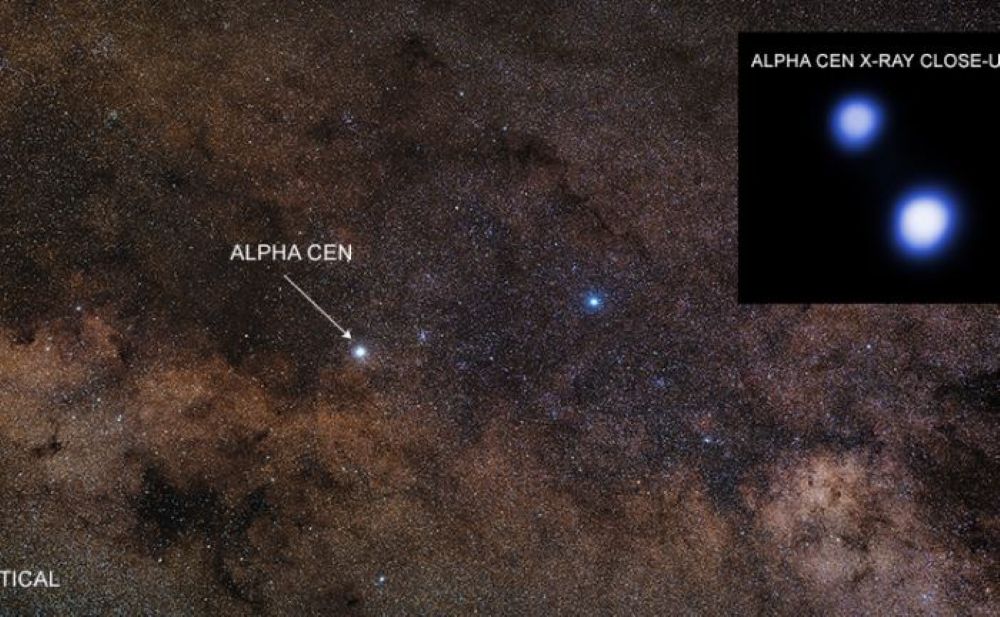
Just when you thought it was safe… 51 years exactly since the publication of my book Man and the Stars in May 1974, I finally updated the first two chapters, ‘Will There Be Suitable Planets?’ (for interstellar colonisation) and ‘Will There Be Suitable Ships?’ Over the last four weeks I’ve written ‘Pale Red Dots’ (ON, 4th May 2025), on planets of the nearer stars, Proxima Centauri, Alpha and Beta Centauri, and Barnard’s Star; ‘Beyond the Pale Red Dots‘ (11th May), on the stars out to 12 light-years, and a few beyond; ‘Connecting the Dots’, (18th May), on ways of getting there; and Dr. Nordley’s fictional but carefully thought-out way of doing that, in my review of his Around Alien Stars (25th May). Job done, I thought – but within minutes of the last one’s acceptance, came news that Alpha Centauri may have at least one planet after all.
A very helpful article, (Matthew Williams, ‘Astronomers Conduct a Preliminary Survey for Planets around Alpha Centauri’, Universe Today Guide to Space, online, May 23rd, 2025), explains what the issues are. Searching for Alpha Centauri planets is particularly difficult because the two stars A and B are closely bound, separated on average by about the distance between the Sun and Uranus (Fig. 1).


The superposition of their orbits as seen from here (Fig. 2), means that light from one star is constantly flooding the region around the other, and unlike regularly ‘eclipsing binary’ stars like Algol in Perseus (Fig. 3), the Alpha A and Alpha B may appear close, as they did c.1990 (Fig. 4), but can hardly ever eclipse. A coronagraph can cut out one star with an occulting disc, as the LASCO instrument on the SOHO observatory does for objects near the Sun (Fig. 5), but not both.


Similarly the gravitational pull of one star on the other obscures any wobble caused by the pull of a planet; and because the Alpha Centauri stars are 5 billion years old, older than the Sun, any gas giant planets will probably be cooler than ours and harder to detect in infrared. The search task is immense and has involved collaboration between researchers at the NASA Exoplanet Science Institute (NExScI), the French-Chilean Laboratory for Astronomy, the Laboratory for Instrumentation and Research in Astrophysics (LIRA), the Steward Observatory, the National Radio Astronomy Observatory (NRAO), the Max-Planck-Institute for Astronomy (MPIA), the Space Telescope Science Institute (STScI), NASA’s Ames Research Center, and NASA’s Jet Propulsion Laboratory, led by Aniket Sanghi, a graduate student and NSF Graduate Research Fellow at the Cahill Center for Astronomy and Astrophysics at the California Institute of Technology (Caltech). What they have done is to take scans of Alpha Centauri A and its surroundings and subtract the corresponding readings from epsilon Muscae, a red giant star located about 330 light-years from Earth in the constellation Musca, the Fly (Fig. 6), that is 1,700 times the luminosity of the Sun. There might seem to be no comparison, but giant stars which have left the main sequence can have the same surface temperatures and therefore similar spectra to much smaller stars which are still on it (Fig. 7).


And what was left was a faint signal which might – might! – indicate the presence of a giant planet, the size of Jupiter, orbiting at 1.5 Astronomical Units, 1.5 times Earth’s distance from the Sun. Back in the 1960s, Prof. Archie Roy had established that a planet could have a distance from Alpha Centauri A out to about the distance of Mars from the Sun, so it would be within that limit. And encouragingly, despite the age of the star, it evidently has a bright disc of surrounding dust. In the Solar System, such dust comes from collisions between asteroids, and subsequent mergers between fragments can form ‘contact binaries’ which prolong the age of the Belt. (See ‘Space Notes, May 2025’.) If all this is verified, it will make Alpha Centauri an attractive target for future interstellar ‘world ships’, which will be looking for the resources of gas giant planets (Fig. 8) and asteroid belts (Fig. 9) rather than earthlike planets to settle. (See ‘The Fermi Paradox, Part 2′, ON, May 1st, 2022 – a reference I forgot to add to the Notes at the end of ‘Connecting the Dots’.)


After renewed flight clearance from the Federal Aviation Authority, with the failure of Flight Test 8 accounted for (Jan Otte, ‘Why Starship 8 Exploded Mid-Flight And What SpaceX Is Changing for the Next Launch’, Discoverwildscience, online, May 30th 2025), Elon Musk’s SpaceX lost little time in setting up FT-9 for their Starship-Superheavy combination. The static firing for the booster had been held on April 3rd, as had three firings of the Starship in May. The vehicles were quickly rolled out and stacked, and air and sea lanes were cleared for three 30-minute launch windows in May 27th-29th. The launch took place on the 27th (Texas time), 30 minutes past midnight on the 28th (BST).

The launch was flawless (Fig. 10) with just two brief holds in the last 40 seconds of the countdown, both problems solved within minutes. A new development was that on separation the booster was oriented for its return trajectory, achieving a significant fuel saving. This was a reflight of the FT-7 booster, the first such for the Superheavy, and instead of capture by the launch tower, it was sent into the Gulf on a steeper path, again saving fuel but adding heavily to the dynamic stresses. Nevertheless it made it down to the landing burn before breaking up at re-ignition: it had been planned to cut one engine during splashdown, simulating a failure, to see if the launch tower would be able to handle one, but that was asking too much.
Meanwhile the Starship continued smoothly on injection to its suborbital trajectory to the Indian Ocean, equivalent to actually going into orbit. There was no repeat of the fuel line failures and explosions of the last two flights, but as the engines shut down a plume of blue vapour could be seen jetting from the side of the Starship and swirling around the tail. The next scheduled event was opening the cargo bay and deploying four simulated Starlink satellites, but when the view switched into the cargo bay a lot of white dots, apparently ice crystals, were swirling inside it. An attempt was made to open the door, but it jammed and had to be closed again – possibly due to internal pressure, because it was announced that an oxygen leak had developed inside the vehicle and was forcing it into a spin. A restart in space of one of the Raptor engines had to be abandoned, and as the ship crossed the Equator and headed towards Africa it was clear that the spin was accelerating (as happened to Neil Armstrong and Dave Scott on Gemini 8, due to a jammed thruster, with near-fatal results). With attitude control lost the Starship was tumbling violently and entered atmosphere ahead of schedule (Fig. 11), though still within the cleared drop zone. Nevertheless, as a final safety measure all remaining propellants were dumped from it before the end. The last picture from the onboard Starlink cameras showed one of the tailfins burning through and breaking up.

SpaceX personnel giving the commentary were understandably downcast, and found it hard to regain their enthusiasm for the success of the early phases, but they gamely stuck to Elon Musk’s previous plan for 25 flights this year and over 100 next year, one of which, late in 2026, is intended to be the first Starship to Mars, carrying a ‘Texsla Optimus’ humanoid robot (Fig. 12) like the Tesla Roadster which he launched on the first Falcon Heavy (Fig. 13).


If that is successful, in theory he could send people to Mars in 2029, though commentators are saying that 2031 is more likely. That’s when Musk currrently plans to send 100 people, with 500 to follow in 2033 (Mike Wall, ‘Elon Musk says SpaceX will launch its biggest Starship yet this year, but Mars in 2026 is “50/50″‘, MSN, online, 30th May 2025). That will be with the Starship 3 variant, 142 metres high on top of its booster, intended to fly for the first time late this year.

At a special event hosted by Musk on May 29th, he announced even more ambitious plans to raise the Starship construction frequency to 1000 per year, then 5000, with the Mars programme only part of the total, though getting up to over 3500 per year as it develops (Fig. 14). What he intends to do with the other 1500 ships (minimum payload 300,000 tons) remains unstated, but as I’ve previous remarked, it’s enough to build solar-electric powersats of 60,000 tons each. 500 0f those would be enough to meet the entire energy needs of 21st century civilisation, according to 1970s estimates. (J. Peter Vajk, Doomsday Has Been Cancelled, 1978, Fig. 15.)

500 powersats of 60,000 tons would have a total mass of 30 million tons, which just happens to be the annual cargo capacity of 1500 Starships launching every three days and carrying 200 tons each. As I said when I first pointed this out (Space Notes, December 2024, ON, 30th November 2024), you read it here first, and these new revised figures still come to the same total.


Europa Clipper was to have been launched by the Space Launch System (SLS), which has proved to be too expensive. In an event which somehow missed the news, Europa Clipper made a Mars flyby on March 1st (Fig. 16), and obtained an infrared image of Mars (Fig. 17) in a successful test of the imager to be used at Jupiter’s moons. It has to be said that it’s not a great picture, but then, the atmosphere of Mars isn’t generally transparent to infrared due to airborne dust. That can be seen in an image of Deimos, the outer moon, taken from the surface by the Perseverance rover on the same day, as it happens (Fig. 18).

It also shows the stars Regulus and Algieba in Leo, the first time stars have been photographed from the surface, and I’m quite pleased that I recognised the Sickle of Leo without being told. But unless the halo round Deimos is a photographic artefact, it’s either high-altitude ice crystals or dust, and looks more like the latter in the rest of the sky
SLS is now scheduled for cancellation after the Artemis II mission, taking US astronauts around the Moon for the first time since Apollo 13, and Artemis III which will take them to the surface for the first time since 1972. The plan is for them to go out on an Orion capsule launched by SLS, transferring to Starship for the descent, but I can see potentially major operational difficulties. The transfer was to have taken place at the Lunar Gateway space station, components for which have already reached NASA, but that too is to be cancelled, as Orion and SLS are to be after the mission.

Without the Gateway, Orion and Starship will have to dock nose-to-nose (Fig. 19), and instead of being docked to the station, powered down and possibly human-tended, the Orion will have to be left unoccupied in orbit. Admittedly that has already been done with Artemis I, but the philosophy of using two spacecraft was that one could act as a lifeboat for the other if need be, as the Lunar Module had to do for Apollo 13. If the first lunar Starship is in enough trouble to make that necessary, docking with an unoccupied Orion may not be as easy as planned. Both the Apollo programme and its intended Soviet equivalent kept one astronaut in orbit in the Earth return vehicle, to help the lander get back to it.
Meanwhile, Japan’s Resilience spacecraft is quietly getting ready to complete the tasks it was launched to do. Resilience was launched on January 15th by a Falcon 9 along with the Firefly Aerospace Blue Ghost, the first completely successful moonprobe in recent years apart from India’s Chandrayaan-3. Blue Ghost went straight to the Moon, but Resilience went into a high Earth orbit, reaching out past the Moon’s distance, and waited for the Moon to rendezvous with it, achieving lunar orbit on May 7th. After 30 days in orbit, taking photographs (Fig. 20), Resilience will attempt a landing in Mare Frigoris on 6th June.


If successful the Hakuto-2 carrier will release Europe’s Tenacious rover (Fig. 21), which will work its way out from the lander in a spiral, and on its front bumper will be ‘The Moonhouse’ sculpture by Mikael Grenberg (Fig. 22), a version of which was previously carried by Swedish astronaut Christer Fugelsang on the STS-128 Space Shuttle mission (Fig. 23). It will be the second sculpture on the Moon, after the ‘Fallen Astronaut’ one left by the Apollo 15 astronauts at Hadley Rille (Fig. 24).


On 10th June 2021 China launched NEO-1 (Figs. 25-26), a satellite to search for space debris and Near Earth Objects, among them NEO 2016 HO3 Kamo’oalewa, in a resonant orbit with the Earth and similar in composition to the Moon (Figs. 27 & 28), so it may be a piece blasted off.


The follow-on mission was first named Zheng He, after the admiral who led seven great exploration fleets from China between 1405 and 1433, and may even have circumnavigated the world. (Gavin Menzies, 1421: The Year China Discovered the World, Bantam, 2002.)

The spacecraft was later renamed Tianwen-2 as part of China’s planetary exploration programme (Fig. 29). Tianwen-2 launched on May 28th, 2025, on a Long March 3B (Figs. 30 & 31), to rendezvous with the asteroid using solar-electric propulsion (Fig. 32).


Three techniques will be used to try to collect samples: the first is hover- sampling, collecting fragments with a remote arm while moving in synch with the asteroid’s rotation, and TAG (Touch and Go) will try to do the same with a rotating brush. Anchored Sampling will attempt an actual touchdown, anchoring the probe to the surface (Fig. 33), which failed with ESA’s Philae lander on Comet 67-P in 2015.

Returning in 2027 (Fig. 34) the samples will be landed by parachute and Tianwen-2 will go on to the Main Belt object 311P/PANSTARRS, also known as P/2013 P5, classed as an asteroid though sometimes showing a tail like a comet (six tails in 2013, Fig. 35), arriving in 2035.


The news is less good for Japan’s Hyabusa-2 asteroid mission. After its successful sample return to Earth from the asteroid Ryugu in 2020, the probe was redirected for a fly-by of 98943 Torifune in July 2026 and a rendezvous with 1998 KY26 in July 2031, continuing to use the solar-electric xenon thrusters for propulsion. The extended mission is ‘Hyabusa-2#’ (‘2-Sharp’ in musical parlance). On March 21st, however, the spacecraft went into ‘safe mode’ due to an undiagnosed problem, and there seem to be no updates since, though it’s still in contact with Earth. Whether it can make the Torifune flyby will depend on whether it was under continuous propulsion at the time of the problem.

Psyche, NASA’s probe to the metallic asteroid of the same name (Fig. 36), has encountered a possibly similar problem and bitten the bullet as regards dealing with it. Psyche is on a Continuous Low Acceleration Flight path, using xenon solar-electric propulsion like Hyabusa-2# (Fig. 37). and on April 1st that had to be shot down because of a pressure drop in the xenon fuel line.

There was the option of switching to a backup line, but if the problem couldn’t be solved, that decision had to be taken by mid-June 2025 at the latest, if the rendezvous with the asteroid was to be achieved in 2029, after a Mars flyby in May 2026. On 29th May it was taken and the switch was made. Psyche is intended to orbit until 2029, and I haven’t heard of any plans for it to go elsewhere, as the Dawn probe went to Ceres after orbiting Vesta. But catching up with this unplanned coast may mean that there’s not enough fuel for a redirection in any case.
Beyond the heliopause, the Solar System’s boundary with interstellar space (though not the boundary of the Sun’s gravitational pull), NASA engineers have pulled off another remote repair to the Voyager 1 spacecraft, still operating 58 years after its launch in 1977. (Victoria Corless, ‘NASA resurrects Voyager 1 interstellar spacecraft’s thrusters after 20 years: “These thrusters were considered dead”‘, Space.com, online, 15th May 2025.) It’s only recently that a key chip in the data transmission programme became corrupted, and engineers managed to rewrite the programme to work around that.
But in 2004, in a milestone at the time, Voyager 1’s primary roll thrusters ceased working and the spacecraft was switched to their backup system. Other thrusters were briefly revived in 2018 and 2019, and are still available, but can’t perform the roll manoeuvres needed to maintain contact with Earth. In 2019 Voyager 2 developed similar problems and switched its trajectory control thrusters back on, for the first time since the Neptune flyby in 1989. But this time, with the backup roll thrusters beginning to clog due to continual use, there was no option but to go back to the primary system and try to turn it back on, heating it up using techniques which have been developed meantime. The risk was that the spacecraft’s navigational sensors might lose their lock on the guide star, during the 23-hour exchange of signals with Earth. But it worked, and on March 20th the primary roll thrusters were once more in operation. Nevertheless, the Voyagers are on borrowed time, with their instruments gradually being turned off for lack of power as their radioactive generators run down. Commentators are already asking if it’s not time to call it a day, freeing up money and time on the Deep Space Network of trackers for other purposes, and in the current climate of cuts to the NASA science budget, the omens do not look good.
Duncan Lunan’s recent books are available through Amazon; details are on Duncan’s website, http://www.duncanlunan.com.


Leave a Reply