
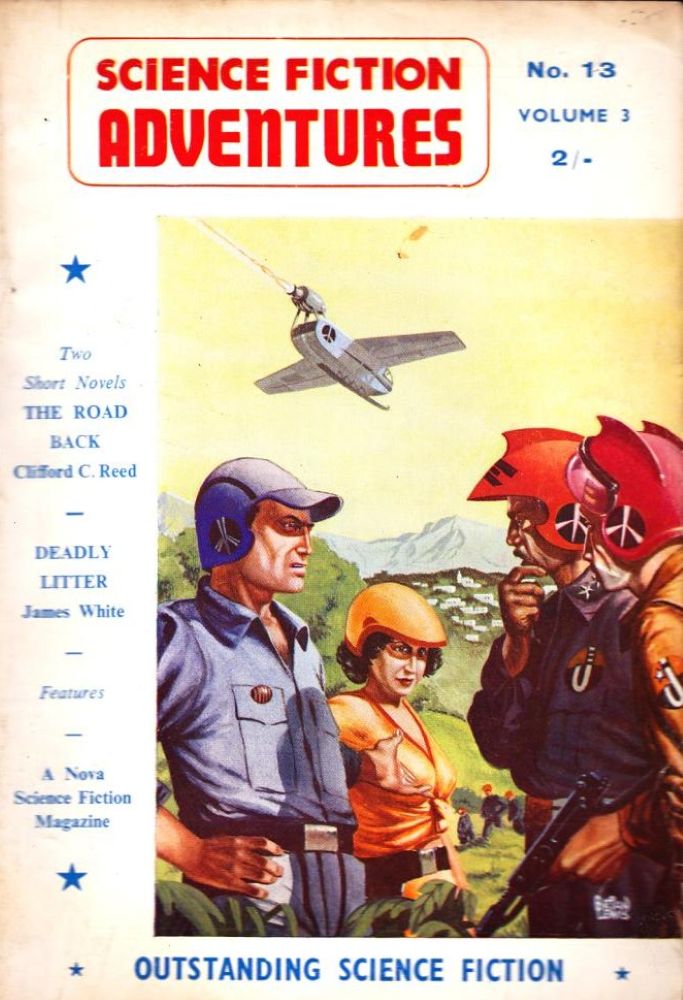
The topic of space debris, suggested for this column by reader Mark Pezzati, isn’t new by any means. One of the first fictional references to it must have been the story ‘Deadly Litter’, by the Belfast SF author James White, published in SF Adventures # 13 (February 1960, Fig. 1), which was the title story of his 1964 collection, though I didn’t come across it till the 1968 Corgi edition (Fig. 2).


My first acquaintance with the concept was probably in 1965, when the late Prof. Archie Roy, a world expert on astrodynamics, introduced ‘Astronautics’ as a new section of his first-year Astronomy course at Glasgow University. Considering the simplest possible case, the explosion of a satellite at high altitude in circular orbit, he demonstrated that unless they were acted on by other forces, the fragments would converge again one orbital revolution later.

That provided an explanation for Arthur C. Clarke’s story ‘Jupiter Five’ (Worlds of If, 1963, Fig. 3), in which somebody launched towards Jupiter from Amalthea (as it was afterwards named) comes back one revolution later. Well afterwards there was a story on the same theme in Analog, in which a misguided attempt to dispose of nuclear waste in space had it launched towards Earth, on a path which would bring it back to hit the spacecraft which launched it. The danger was recognised by a historian considering the path as a Ptolemaic epicycle (see ‘Ptolemy, The Book of Astronomy in Antiquity’, ON, 5th January 2025), but I had got the point much sooner.


By the time of Archie Roy’s lecture a more complicated instance had already taken place. In 1960 NASA launched a passive reflector communications relay in the form of a large aluminised balloon called Echo 1, following it with Echo 2 on 25th January 1964 (Fig. 4). For launch the balloons were packed into spheres which split in two on release (Fig. 5); a very small amount of gas served to inflate them, and a film of one taken from the booster showed extraordinary convolutions of the balloon as it did so, painted at the time for Life magazine (Fig. 6). Two-thirds of an orbit later, one of the end caps came back and collided with the balloon, creating a big dent and ending up inside.

Echo 1 and 2 were both about 2000 miles up, high enough for sunlight pressure to affect their orbits, and came low enough to fall out of orbit in the early 1980s. Meanwhile, with much less publicity another giant balloon had been orbited in 1966 under the name PAGEOS (PAssive Geodetic Earth Orbiting Satellite, Figs. 7 & 8).


I well remember a night in 1967 when a group of friends came over to Troon for coffee after the weekly meeting of the Irvine Folk Song Club, and asked to see various things through the telescope I had recently acquired from the late John Braithwaite. I asked the late Charlie Muir for help to follow a bright satellite which had just risen. and as the telescope had an equatorial mount, we suddenly realised that we were tracking it in near-polar orbit. We waited for both Echo 1 and 2 to pass, to make sure it wasn’t either, and eventually saw the mystery satellite rise again, still in polar orbit but now much further west, due to the rotation of the Earth (its orbital period was three hours). Word of it spread gradually among amateur astronomers over the next three years, but in those pre-internet days none of us knew what it was. Supposedly it was a geodetic project to study the shape of the Earth, and it was used for that purpose with limited success, but a balloon subject to sunlight pressure is the last thing you’d want for that purpose. When a true geodetic satellite was launched (LAGEOS, 1976 – see ‘Launch Vehicle Costs’, ON, November 12th 2023), it was in a much higher orbit, and as small and as heavy as possible to minimise atmospheric drag (Fig. 9).

But the key thing about PAGEOS was that in its near-polar orbit, it was passing several times daily over the USSR. It carried no cameras or surveillance equipment, but anyone on the ground with a tight-beam antenna could bounce a signal off it to Langley, Virginia, say, with much less chance of detection than the transmitters used by the Special Operations Executive in occupied Europe during World War 2.
Having worked that out, I was walking along the Promenade on Troon beach in twilight on a summer’s evening in 1971 or ’72 when I spotted a satellite rising in the west on the typical inclination used by Soviet spacecraft. To be so bright in twilight it had to be something substantial (again, no internet to check what it was on Heavens-Above.com), so I was watching it with interest when PAGEOS came over my shoulder from behind me in the north. It was obvious that their paths would converge, and for a heart-stopping moment I thought, have the Soviets finally decided to get that out of their sky? To quote an old joke, I decided to risk one eye and watch what happened. (On hearing that later, John Braithwaite said that he would have been taking cover behind a sand dune.) But the speeds of the two objects were different, and although they passed within a degree as seen from Troon, they were clearly separated by hundreds of miles in altitude. Although that was a false alarm, it was a precursor of worse things to come.
I had a similar moment of alarm in 1973, again from Troon shore and just after the first Skylab crew returned to Earth, when I was startled to observe at least three ‘unknown’ objects apparently in the same orbit as the space station. An investigation by the late A.T. Lawton of the British Interplanetary Society established that these were the shrouds that had enclosed Skylab during launch, and the upper stages of the Saturn V and the Saturn I which had put up the first crew. None of them posed a hazard to the station and the shrouds, tumbling when I first saw them, quickly underwent orbital decay and fell back into the atmosphere. The stages stayed up for several years, causing some media alarm when they fell.
Although they were no more than rumours at the time, the Soviet Union did indeed test anti-satellite weapons in 1964 and 1968, exploding warheads beside several of their own satellites, destroying one called Kosmos 248, deploying an operational system in 1979 and cancelling it in 1983. Meanwhile, the late George Hay had been editing a Penguin series of anthologies called Pulsar, in which SF stories were matched with relevant articles. He asked me for an article called ‘The Politics of Near Space’, and accepted it, but Penguin truncated the series with Pulsar 2, which contained only fiction. I published it in Bob Low. ed., The High Frontier (Third Eye Centre, Glasgow, 1979), and George then commissioned an expanded version for a series of articles by SF writers which he was editing for a US magazine called The World and I. I noticed some curious biases when I received my copy in October 1987; my own article was mostly unchanged, but where I had described the Soviet ASAT tests as ‘alleged’ they became definite fact, while the US Air Force’s tests of a weapon launched from a modified F-15, which everyone knew about (Fig. 10), became ‘rumoured’.


In the only successful interception, on 13th September 1985, an F-15 took off from Edwards Air Force Base, climbed to 38,100 feet and launched an ASM-135 missile at Solwind P78-1, a US gamma ray spectroscopy satellite orbiting at 345 miles, launched in 1979 (Fig. 11). The last piece of debris finally came down from orbit on 9th May 2004. The test caused an international outcry, not just because of the addition to the space debris problem, but also because Solwind was still operational and scientists who were using it simply found themselves out of a job. The programme was cancelled in 1988, but not in time to stop Soviet claims that the new Space Shuttle runway on Easter Island was actually for an F-15 ASAT base.
In the early 1950s, in the symposia designing the wheel-type space station (Cornelius Ryan, ed., Across the Space Frontier, Sidgwick & Jackson 1952), the astronomer F.L. Whipple developed the concept of the ‘meteor bumper’, when meteors were thought to be the major threat to space travel. A very thin sheet of aluminium, wrapped around the station, would vaporise small incoming meteors and the resulting plasma would not penetrate the inner hull. Repeated impacts would anneal the outer skin rather than shredding it. ‘Whipple shields’ have been used on numerous spacecraft: the Skylab space station was to have had one in 1973, but it was ripped off by the slipstream during launch, and it was noted that even by the second Apollo crew’s visit to it, the hull had sustained considerable damage from small particles, natural or man-made (Fig. 12). The Hubble Space Telescope has one, still bright and shiny at the time of the fifth repair mission (Fig. 13), and while the complex shape of the International Space Station prevents a wrap-around shield, there are over 100 of them protecting sensitive part of the structure.


In August 1982 the late Prof. Oscar Schwiglhofer, the founder of the Scottish spaceflight society ASTRA, attended the United Nations Unispace 82 conference in Vienna (a story worth telling at another time) and spoke on Space Debris. He brought back photographs of the 3rd and 4th Space Shuttle missions, after the latter of which the crew was met by President Reagan, who amazed them and NASA by announcing that the Shuttle was now fully operational, when they considered it to be still a dangerous prototype, and prompting the rebirth of the Soviet ASAT programme two years later. The Shuttle’s crushable tiles made it relatively impervious to small space debris, but that didn’t apply to the cockpit windows. Continuing experience with the Shuttle (on the first crewed US missions since 1975) indicated that paint flakes from other spacecraft were now a significant risk, striking windows with the force of bullets and cratering them despite their hardening and coatings (Fig. 14). The Cupola turret on the ISS has sustained similar damage (Fig. 15). Such small particles are well below the threshold of detection by radar, and will remain an issue to be dealt with even if ‘near space’ can be cleared of larger objects.


After the events above, both Russia and the USA have refrained from further destructive tests in space. The one partial exception was that in 2008, an MS-3 missile fired from a warship (Fig. 16) destroyed a reconnaissance satellite called USA-193, which was descending uncontrolled and contained a tank of hydrazine propellant, frozen by that time, which would pose a serious health hazard in a populated area. The firing was successful and the witnessed explosion was thought to indicate the dispersion of the threat.

China, alas, has shown no such compunction. In an almost unbelievable act, suggesting a military decision without scientific advice, on 11th January 2007 a Chinese missile destroyed one of their weather satellites, Fengyun-1C, in polar orbit at an altitude of 537 miles, the fourth satellite in the Fengyun series, launched in 1999 (Fig. 17). The head-on collision generated more than 40,000 pieces of debris more than one centimetre across, possibly as many as 90,000, and could hardly have been calculated to have a worse effect. Reporting on it for Jeff Hawke’s Cosmos and circulating the piece in ASTRA produced an extraordinary result, with an advocate of space militarisation accusing me of fabricating the data I had used to analyse the danger. By his way of it, all the fragments crossing the orbits of the ISS and the Hubble telescope had descended into the atmosphere in a couple of weeks, so there was no further problem. This was complete nonsense: obviously if pieces had been thrown 400-odd miles towards the Earth, striking the atmosphere, then there must be many more of the 40,000 still up there, steadily descending due to drag.

(Compare Fig. 18, showing the altitude distribution of debris from a Long March 4 upper stage explosion in 2000.) In fact many of them were ranging up to 2375 miles, and would take up to a century or more to come down. As many of them would meanwhile be crossing the orbits of large satellite constellations like GPS, Globalstar and Iridium, the chances of a runaway series of collisions making Middle and Low Earth Orbits unusable, was greatly increased. This was “a fantasy drawn from sensational papers like The Sun“, supposedly, but actually it came from four scientific papers, one by Prof. Colin McInnes, an Honorary Member of the society, published in ESA Journal. [R. Jehn, ‘Dispersion of Debris Clouds from In-Orbit Fragmentation Events’, 15, 1, 63-77 (1991); H. Klinkrad, R. Jehn, ‘The Space-Debris Environment of the Earth’, 16, 1, 1-12 (1992); A. Rossi, P. Farinella, ‘Collision Rates and Impact Velocities for Bodies in Low Earth Orbit’, 16, 3, 339-348 (1992); C.R. McInnes, ‘An Analytical Model for the Catastrophic Production of Orbital Debris’, 17, 4, 293-305 (1993).] Contrary to what my critic said, the British space establishment regards this as a very serious issue and the committee devoted to it, which also has a watching brief concerning asteroid and cometary impacts, regards the debris issue as much more important.
Despite my critic’s claim that it was no different from the previous US and Soviet ASAT tests, Nicholas Johnson, NASA’s chief scientist for orbital debris, said “This is by far the worst satellite fragmentation in the history of the space age, in the past 50 years.” (Aviation Week & Space Technology, February 11th 2007.) What made it so bad was the altitude at which the break-up occurred, and the orbital inclination of the debris. Debris from the previous Soviet and US ASAT tests decayed into the atmosphere fairly rapidly because they were at low altitude, and had a comparatively low inclination to the equator, so it formed a ring around the Earth at corresponding low latitudes (Fig. 19).

Fengyun 1C was in near-polar orbit, so its debris ring soon covered a range of longitudes – and over the next year, that range broadened until it enveloped the Earth (Figs. 20 & 21). It would then be able to hit any satellite within its altitude range, and as AW & ST said, pieces from the Chinese test “threaten all spacecraft flying below about 1,243 miles”.


Archie Roy’s simple example of space debris clustering very quickly goes out of date in real life. The fragments of the disrupted satellite are quickly dispersed by outgassing, atmospheric drag and sunlight pressure, further complicated by the uneven shape and density of the Earth below. It can be shown mathematically that above a certain number of objects in orbit, mutual collisions will increase the numbers in a ‘cascade effect’ until every satellite is destroyed and the sphere of debris englobing the Earth prevents all further space missions until it clears. The trouble is that we don’t know how large or small that critical number is; but in the ESA Journal papers cited above, one of the more worrying estimates was that just six objects the size of the proposed Space Station Alpha (forerunner of the ISS) would inevitably generate a cascade, due to pieces chipped off, objects accidentally released, etc.. Some minor debris such as protective caps and thermal blankets were accidentally released during assembly of the first two ISS segments in 1998 (Fig. 22), and there have been attempts to claim these were giant alien spaceships (Fig. 23), but Fig. 24 is the true explanation.


(See ‘Epsilon Boötis, Clyde Tombaugh, Black Knight and STS-88’, ON, June 12th, 2022.) The occasional toolkit and similar items were lost since (Fig. 25), and could be tracked on Heavens-Above until they fell, but even with two stations on-orbit, US and Chinese, they haven’t proved to be major sources of space debris.

(In the film Gravity, the Hubble Telescope, the ISS and the Chinese Tiangong station are all shown in the same orbit. Objects released from any of them would then have been no hazard, colliding gently if at all. Getting from one to another would actually be very difficult: pointing at them and firing thrusters, as Sandra Bullock does in the film, would only take you into a higher or lower orbit. As the late John Brunner said in The Shockwave Rider, of similar mistakes: “See you later, accelerator. Much later.”)


Nevertheless as the numbers for space debris continued to rise (Figs. 26-28), concern grew everywhere, except for military and commercial interests. Booster manufacturers did take steps to minimise the explosions of residual propellants in discarded upper stages (Delta 2 and Ariane 4 came in for some hard words in that respect), but those measures weren’t enough to stop the rise, much less providing any solution to the amount of debris already up there. The prospect of a cataclysmic cascade, destroying everything in Low and Middle Earth Orbit, came to be termed ‘Kessler Syndrome’, after Donald J. Kessler, NASA’s major expert on the subject (Fig. 29).

In 2001, he and P.D. Anz-Meador published an analysis of the situation in 1999, finding ‘the region between 600 km and 1000 km to be well above the unstable threshold and the region between 800 km and 970 km to be above the runaway threshold’, while ‘the region between 1300 km and 1420 km was above the runaway threshold and the entire region between 1000 km and 1500 km was above the unstable threshold’ (Figs. 30 & 31).


I’m grateful to Mark Pezzati for sending me Kessler’s new paper with Hugh G. Lewis, of the University of Southampton, giving their assessment when taking the huge new satellite constellations into account. (‘Critical Number of Spacecraft in Low Earth Orbit: a New Assessment of the Stability of the Orbital Debris Environment’, Proc. 9th European Conference on Space Debris, Bonn, Germany, 1–4 April 2025, published by the ESA Space Debris Office.)
One thing that immediately struck me was that Kessler avoided the use of his own name in relation to the runaway situation. Arthur C. Clarke has a similar problem when people wanted to name geosynchronous orbit ‘Clarke Orbit’, which he disliked because Isaac Newton and Konstantin Tsiolkovsky, among others, had pointed out the possibility of a 24-hour orbit, and he had only thought up a particular use for it.

(Fig. 32 – ACC, Ascent to Orbit, A Scientific Autobiography, Wiley-Interscience, 1984.) Rather than talk about ‘Kessler Syndrome;, they drew a distinction between ‘collision’, between two or more objects, and ‘catastrophe’, where everything collides with everything else. Apart from the military tests, to date there has been only one significant ‘collision’, in 2009, when Iridium-33 hit or was hit by Kosmos-2251 (Fig. 33), adding 800 more pieces to the debris count.

In the detailed analysis which follows, Kessler and Lewis find that the situation is now worse and will continue to get worse in terms of numbers, though in qualitative terms, not that much worse because it was already out of hand in 1999. I have seen elsewhere a low-key statement that the advanced GPS of the Starlink constellation would prevent collisions – with one another, perhaps, but even in conjunction with the global Space Surveillance Network (Fig. 34), could they avoid everything?

Kessler and Lewis think not. ‘Despite the mitigation potential arising from collision avoidance manoeuvres, the rate of increase in collision fragments will increase substantially… these conditions mean that after some period of time – perhaps shorter than previously anticipated – the intact population would be difficult to maintain because the fragment population would become too hazardous to continue space operations in low Earth orbit… Whilst these conclusions are not too different from those of previous studies and point to instabilities that are likely anticipated in the context of a possible 1 million satellites, they serve to emphasise the importance and timeliness of limiting future breakups in space and of identifying management tools that address the environmental conditions leading to instability.’
In the words often wrongly attributed to Edward VIII, ‘something must be done’. Borrowing the subtitle of my Incoming Asteroid! while we’re at it, the question for next time is ‘What could we do?’
(To be continued)
Duncan Lunan’s recent books including Incoming Asteroid! are available on Amazon; details are on Duncan’s website, http://www.duncanlunan.com





Leave a Reply