

Last week’s Part 1 was mostly concerned with space objects in Low or Middle Earth Orbit (Fig. 1), where most applications satellites are to be found, except for communications and electronic surveillance ones, and World Weather Watch ones, in geosynchronous orbit, much higher up.


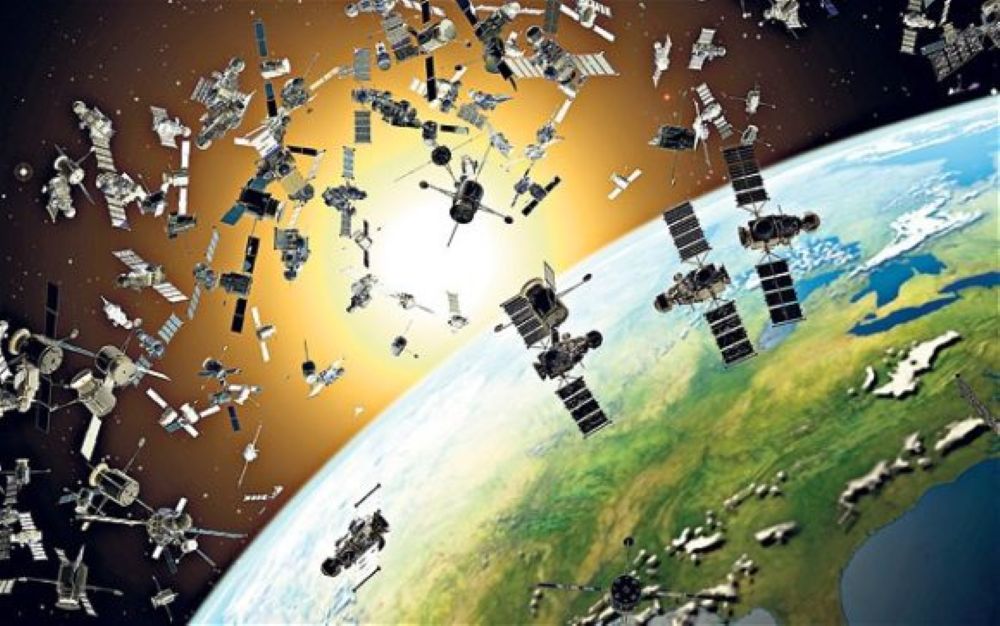
Although artwork of the situation looks frightening (Figs. 2 & 3), it represents all of the problem objects in one place, and as Douglas Adams said in The Hitch-Hiker’s Guide, space is actually very big. Figs. 2 & 3 are like an exhibition which Linda and I saw in Carlisle, representing all the Mars probes to date gathered in one scrapyard (Figs. 4 & 5), rather than spread over the surface of a world with more land surface than Earth’s (because Mars has no oceans).


Most of the possible solutions below involve de-orbiting unwanted objects into the atmosphere, but there are two exceptions. One is that when satellites in geosynchronous orbit go wrong or simply run out of fuel, they’re moved into ‘graveyards’, gravitational lows where they can’t interfere with still-functioning counterparts (Fig. 6).

Or that’s how it should be; Britain’s Skynet 1 turns out not to be there, having been put somewhere else altogether after being handed over to the USA for disposal (see ‘Westwind and Skynet’, ON, 17th November 2024.) In 2020 Northrop Grumman’s

Mission Extension Vehicle MEV-1 (Fig. 7) docked to Intelsat 901 in the graveyard and refuelled it for a further 5 years of life; MEV-2 docked to Intelsat 10-02 in 2021 and is expected to have a similar result (Figs. 8 & 9).


Once the principle had been demonstrated, a number of follow-on proposal have appeared, for example the rescue of the Landsat-7 Earth Resources satellite in Sun-synchronous orbit, which did not go ahead. The Astrium DEOS programme, announced in 2012, has likewise made no headway, and nor has the US DARPA defence agency’s Phoenix programme, on which I can find no updates since 2014. The Japanese company Astroscale intends to refurbish two US Space Force satellites with hydrazine in 2026, but bringing defunct satellites back to life is evidently not as easy as first thought.

The three main phases which have to precede any such activity are tracking, rendezvous and capture. Tracking was the responsibility of the ‘space fence’ (Fig.10), the Air Force Space Surveillance System, which began in 1961 and continued until 2013 with high-frequency radar stations in the southern states of the USA, because anything orbiting the Earth would have to pass over it or within view of it to the south. Following the Chinese ASAT test described in Part 1, in 2011 a major extension of the system was initiated at the top secret Harold E. Holt naval communications station at Exmouth, Western Australia, in a major expansion of US military presence announced during Hilary Clinton’s visit in October that year (Fig. 11), like the Ronald Reagan Ballistic Missile Defence Test Site, whose components are spread over the islands of Kwajalein Atoll.


The map is undated, but significantly it doesn’t show the ESA space radar facility (Fig. 12), whose prototype in Spain successfully became operational in 2014, and its capability was expanded in 2022, but that’s the most recent news I’ve found. The Midcourse Space Experiment, which was shown as an insert on a previous version of the map, was a satellite tracking space objects optically, launched in 1996 and retired in 2008, but as shown in Fig. 11, it has a small fleet of successors: for example the ORS-5 satellite was launched in August 2017, covering space debris from LEO to GEO (Figs. 13 & 14).


According to the Kessler and Lewis paper cited last week, as of 28th March 2025 there were over 12,000 intact objects below 1020 km, with 10,000 of them between 450 and 1020 km. The total population may be as large as 700,000 objects, many of them in the 1-10 cm range on the lower limit of detectability.
Rendezvous
Only the larger objects can practicably be approached and dealt with by active spacecraft, and it’s not as easy as generally supposed. Prof. Carl Sagan’s misgivings about asteroid deflection (Pale Blue Dot, Headline, London, 1995), were comprehensively answered by my friend Jim Oberg, then with NASA at Houston (see ‘Eyewitness to History: Shuttle Trainer, Houston, 27th July 1986′, ON, August 14th, 2022). In a submission to a conference organized by the U. S. Space Command in 1998, Jim wrote:
The concern fails to account for operational issues in navigation, targeting, guidance and control, issues which real-world spaceflight operators deal with on a daily basis. By assuming that a space rendezvous – bringing two objects into contact – is merely an inverse process of avoidance – guaranteeing that two objects do NOT come into contact, this concern is unrealistic.
The ‘avoidance’ maneuver is already in the repertory of spaceflight operators today, in low Earth orbit. If the predicted path of a piece of debris comes ‘close enough’ (defined in the dimensions of the avoidance zone around the shuttle), the shuttle makes a small orbital adjustment to take it (and the zone centered on it) away from the predicted path of the candidate impactor.
Rendezvous is also routine in low Earth orbit, but it is a far different process than merely reversing the avoidance maneuver. As the active vehicle nears the target it receives more and more precise relative position data (navigation), which it converts into desired course corrections (targeting), which converts into required rocket burns (guidance), and which it then performs – to the required level of precision – using onboard rockets (control).
As the range and time-to-contact drops, so does the size of the uncertainty zone around the target, where the chaser is aiming. At the same time, the effect of rocket maneuvers on miss distance can easily drift outside the ‘uncertainty zone’ to such a great distance that the active vehicle’s rockets simply cannot bring the aim point back onto the target fast enough. In other words, there is not enough ‘control authority’ in the system. And the active vehicle flies past the target. The rendezvous fails.
Applying Jim’s considerations to the novel Orbital Cloud by Taiyo Fujii (review, ON, 6th July 2025), the underlying difficulties become more obvious. The plot device is that multiple Iranian satellites collectively called ‘the rod from God’ are used to deflect one of their own spent boosters into a collision course with the International Space Station. Although Fujii gets round the fuel problem by having them propelled by electromagnetic forces, each of the ‘rod’s’ hundreds of satellites will require individual guidance and feedback to achieve the impact with the booster, and that radio traffic alone will make them conspicuous.

Even if the computers of the ‘space fence’ have been duped into ignoring the booster’s radar echo, its change in orbit should make it and its threat detectable (Fig. 15). If it’s still invisible to radar, the optical trackers will pick it up (a detail overlooked by the makers of Moonraker.

However well Drax’s space station was concealed from radar, it would have been brighter than the Full Moon – Fig. 16) Furthermore, a booster with its fuel spent is just an empty, very thin metal can – see Dr. Nordley’s story about the difficulty of hauling a discarded Shuttle tank into orbit (Review, ‘A World Beneath the Stars’, ON, June 8th 2025). Even if the booster goes where you want it to, and ground control isn’t alerted, there’s still every possibility that the ISS will see it coming. Japan’s JEM-EUSO telescope (Fig. 17), to be mounted on the ISS, is primarily to study cosmic-ray phenomena in Earth’s atmosphere, but will also look for small space debris, in the 1-10 cm range, so it would certainly see an oncoming booster – and a single thrust impulse would be enough to move the ISS out of harm’s way.

Such avoidance manoeuvres are routinely undertaken now, normally using the engines of Progress and Dragon ferries to conserve the station’s own fuel.

On February 26th 2024, the Japanese company Astroscale launched ADRAS-J (Fig. 18), and on 15th July 2024 it flew round and imaged the spent upper stage of the H-2A booster which had launched the Earth resources GOSAT in 2009 (Figs. 19 & 20). After 15 years in space it was in remarkably good shape, but if you had to remove it from orbit, the first question would be, how would you get hold of it, and with what?


Capture and Disposal
In 2012 the US defence agency DARPA announced a proposal called ‘Phoenix’ for satellite refurbishment (Space.com staff, ‘Photos: DARPA’s Futuristic Phoenix Satellite Recycling Project’, Space.com online, 9th July 2012). The study began with a vehicle using no fewer than 6 remote arms to grapple with a target, with 4 more in reserve (Fig. 21), and also studied the use of a net (Figs. 22 & 23) – but how is that to work, if the target is rotating on even one axis, let along three?


In the same year the Swiss Space Centre announced Cleanspace One, a project to fly on Ariane 5 in 2015-16 (Fig. 24), to pursue and capture either the ‘Swisscube’ picosatellite launched in 2009 (Figs. 25-26), or its cousin Tisat (2010), either then to be captured and deorbited by the catching vehicle (Figs. 27-28).


Alternative gripping mechanisms were to be considered, based on ‘animal or vegetable’ originals (Figs. 29-31).


The date slipped to 2018, since when the name has changed to ‘Clearspace’ and the target commissioned by ESA has become PROBA-1, a technology demonstrator launched by India for Belgium in 2001, continuing operation for over 20 years and now scheduled to be deorbited in 2026.


On December 9th, 2016, the Japanese space agency JAXA launched a tether experiment on the cargo carrier HTV-6 to the ISS, and subsequently released an ‘end mass’ on a current-carrying tether which lowered the vehicle towards the atmosphere (Figs. 32-34). Similarly on March 22nd, 2021, Astroscale had launched the ELSA-D demonstrator and ‘client’, to test magnetic capture for disposal (Fig. 35).

The launch was from Baikonur in Kazakhstan (those were the days), and it showed how the method would work if the target had a suitably diamagnetic capture plate and could be held stationary with respect to the disposal vehicle. But a target you don’t take up with you is likely to be more recalcitrant, hence the importance of the Clearspace test.
Another tether deorbiting demonstration was provided by the PROX-1 satellite, built by Georgia Institute of Technology, primarily to deploy and make a record of the Planetary Society’s Lightsail-2. After that it also paid out a 230-foot segment of electrically conducting


tape, the ‘terminator tape’ (Fig. 36), which successfully lowered PROX-1’s orbit as intended. ESA’s e.Deorbit mission was intended to bring down a defunct satellite in polar orbit using a combination of net and tether (Fig. 37), but in 2018 that priority was shelved in favour of the Cleanspace One mission, and e.Deorbit is now being expanded to a general purpose vehicle for refurbishment, refuelling and other on-orbit tasks. (‘ESA e.Deorbit Debris Removal Vehicle Reborn as Servicing Vehicle’, ESA/Space Safety/Clean Space, online, 21st December 2018).


In 2016 NASA’s Innovative Advanced Concepts (NIAC) funded a study of a 2-D wraparound spacecraft to capture defunct ones and debris for disposal (Fig. 38), and ESA had a 100 kg RemoveDebris test satellite, built by the Surrey Space Centre at the University of Surrey and operated by Surrey Space Technology Limited (Fig. 39), released from the ISS in June 2018.


It tested a net, harpoon and drag sail (Figs. 40 & 41), all of them successfully, starting in September 2018 and ending in a natural decay into the atmosphere 2.5 years later. (G.S. Aglietti et al, ‘RemoveDEBRIS: An in-orbit demonstration of technologies for the removal of space debris’, Cambridge University Press, online, 26th November 2019).
While all the removal methods tested have proved successful, they are only applicable to ‘intact objects’ or to large pieces of debris, and with at least 10,000 of those to be dealt with as high priority, it’s never going to be economic to do so by those methods.

Clearspace has long-term plans to launch multiple e.Deorbit satellites using robot space planes (Fig. 42), but that will never be enough. In Kessler’s 1999 study it was assumed that payloads would generally be smaller than booster stages, but nowadays the larger payload fairings are well filled and the payloads are larger than the upper stages. There’s still virtually no experience of capture or subsequent operations, except for the synchronous orbit comsats mentioned above.

Texas A & M University has a proposal for a ‘Sling-sat’ which would speed up the removal process (Fig. 43), but not to anything like what’s needed to deal with the 10,000-plus ‘intact objects’. None of those methods are applicable to smaller debris, down to the paint-flake size. One method which would work for all of them would be a ground-based ‘laser broom’ (Fig. 44), sweeping the sky.

The attraction of the proposal is that the same target can be hit again and again, without having to launch another interceptor each time or wait, possibly years, for the first one to come back. It can be hit multiple times on each pass, never hard enough to break it up, so deceleration will take effect faster. If enough power is available, one might imagine the fixed laser surmounted with a multiple beam-splitter, like the ball of a classic Zeiss projector (Fig. 45), hitting multiple targets on a continual basis and systematically reducing the orbital velocity of every unwanted thing that passes through the surveillance net, till they’re all gone.


The ‘tapered honeycomb’ scoop of Fig. 46 suggests two other ways to sweep near space clear, though they have drawbacks. One such idea is to orbit a huge rubberised disc like a circus hoop, but self-repairing rather than tearing when punctured, like the ‘meteor bumper’ of Part 1. Small objects hitting it would vaporise and anything passing through it would be decelerated, bringing forward its descent into the atmosphere. The other related idea is to inflate a giant sponge, which would absorb most of what hit it, and decelerate anything big enough to pass right through. As it soaked up the debris, including deactivated satellites, it might make possible the usually impractical idea of a ‘scrapyard in space’. As Kessler and Lewis point out, the problem with such systems is that they’re non-discriminatory, and could damage or absorb satellites that are still active. But there is also some really nasty stuff up there which you wouldn’t want to encounter with either – the other exception to de-orbiting into the atmosphere which I mentioned in my second paragraph.

During the Cold War, the Soviet Union orbited 33 Radar Ocean Reconnaissance Satellites (RORSATS), spy satellites with onboard nuclear reactors, and initially didn’t take adequate precautions with them, much less provide for disposal. In 1977 one designated Cosmos-954 broke up over Canada and required a clean-up effort costing huge amounts of money. (Leo Heaps, Operation Morning Light, Paddington Press, 1978 – Fig. 47). The Soviet Union accepted responsibility, and eventually paid Canada $3 million, which was half the estimated cost of the partial recovery.
A similar satellite failed in 1973, falling into the Pacific north of Japan, as did Cosmos 1402 into the South Atlantic in 1983. Later RORSATs had a core ejection mechanism, which succeeded in raising the one from Cosmos 1900 in 1988 to a ‘safe disposal orbit’, between 683 and 748 miles, from which it will eventually come down. But in 16 reactor core ejections, approximately 128 kg of dense liquid coolant was released as droplets of highly radioactive material, many of which were still in orbit in 2012, along with frozen drops released from earlier satellites by meteoroid and debris impacts – true ‘Deadly Litter’ of the kind which concerned James White in his short story with which I began Part 1. The orbital scrappies will have real trouble cutting those or the intact RORSATS out of the sponge, and it cannot be allowed to fall into atmosphere and perpetrate multiple Cosmos 954 events.

The only answer seems to be the You Only Live Twice method of swallowing the RORSATS whole (Fig. 48) and bringing them back to Earth for dismantling and disposal, sending the long-term waste to underground repositories. The SpaceX Starship is capable of doing that (Figs. 49 & 50), though it might prove difficult to decontaminate the vehicle afterwards. Again Russia should meet the cost, but that doesn’t seem likely in present circumstances.


The quoted paper by James E, Oberg, ‘Planetary Climate Modification and the US Space Command – As-Yet Unrecognised Missions in the Post-2025 Time Frame’, (“Terraforming Earth”. Futures Focus Day Symposium, US Space Command, Colorado Springs, Colorado, 23rd July 1998), was reprinted in full by the Cambridge Conference Net, and quoted at more length in Duncan Lunan’s Incoming Asteroid! What Could We Do About It? (Springer, 2013), available from the publishers or through Amazon. Details of that and Duncan’s other books are on Duncan’s website, www.duncanlunan.com.



Leave a Reply