
New scientific techniques are enabling archaeologists to re-evaluate previously excavated sites and artefacts.
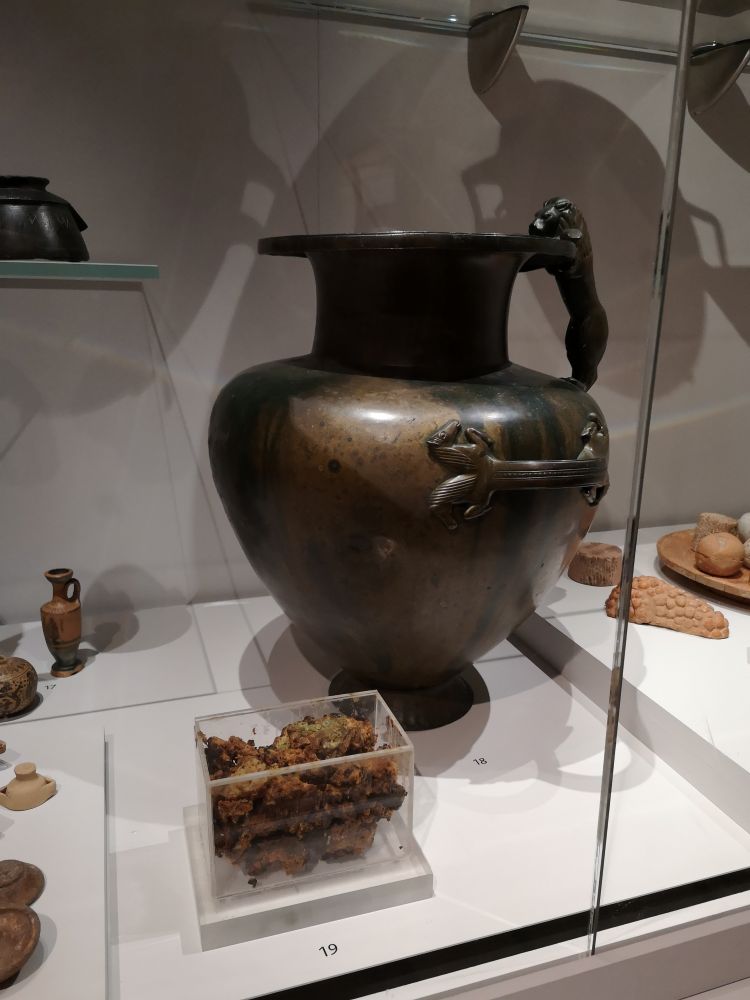
Chemical analysis of a sticky substance found in a copper jar in an ancient Greek shrine has determined that it’s likely the remains of ancient honey. A conclusion that was once rejected.
Honey was an important substance in the ancient world, sometimes left in shrines as offerings to the gods or buried alongside the dead.

In 1954, one such underground Greek shrine dating to around 520 BCE was discovered in Paestum, Italy — about an hour and a half’s drive from Pompeii.
Inside were several bronze jars containing a sticky residue. At the time, archaeologists assumed it was honey, originally offered as honeycombs.
Then, three different teams over the course of 30 years analysed the residue but failed to confirm the presence of honey, instead concluding that the jars contained some sort of animal or vegetable fat contaminated with pollen and insect parts.
But when the residue came to the Ashmolean Museum for an exhibition, a team of researchers led by Luciana da Costa Carvalho, James McCullagh had a chance to re-examine the mystery substance and collect new scientific evidence.
The researchers analysed samples of the residue using several modern analytical techniques to determine its molecular makeup. They found that:
- The ancient residue had a chemical fingerprint nearly identical to that of modern beeswax and modern honey, with a higher acidity level that was consistent with changes after long-term storage.
- The residue’s chemical composition was more complex than that of the heat-degraded beeswax, suggesting the presence of honey or other substances.
- Where the residue had touched the bronze jar, degraded sugar mixed with copper was found.
- Hexose sugars, a common group of sugars found in honey, were detected in higher concentrations in the ancient residue than in modern beeswax.
- Royal jelly proteins (known to be secreted by the western honeybee) were also identified in the residue.
These results suggest that the ancient substance is what is left of ancient honey. However, the researchers can’t exclude the possibility that other bee products may also be present.
Luciana da Costa Carvalho explained:
“Ancient residues aren’t just traces of what people ate or offered to the gods — they are complex chemical ecosystems.
“Studying them reveals how those substances changed over time, opening the door to future work on ancient microbial activity and its possible applications.”
Click on this link to access, A Symbol of Immortality: Evidence of Honey in Bronze Jars Found in a Paestum Shrine Dating to 530-510 BCE, published in Journal of the American Chemical Society.



Leave a Reply