
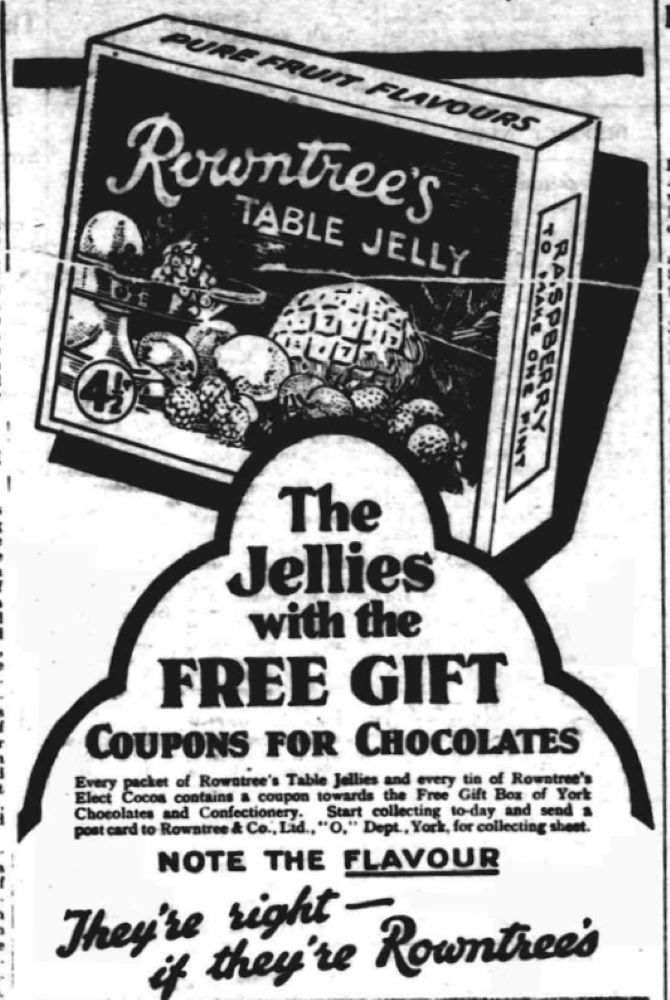
Recipes for sweet dessert jellies can be found dating back to the 18th century. Then, however, they were solely for the tables of the wealthy. The ingredient which formed the dessert into a jelly (or jello in the US) was taken from the gelatine extracted from a calf’s foot.
The process of extraction took a long time and the whole preparation of a sweet dessert jelly required great skill from the cook. Various jelly moulds ensured that the final jelly produced looked magnificent upon the stately dinner tables.

Founded in 1862, in York England, Rowntrees produced not only sweets and chocolates but an affordable way for the ordinary housewife to prepare a sweet jelly. In 1881, Rowntree introduced Fruit Pastilles, competing against French imports of the time, and the product proved to be a great success, accounting for about 25% of the company’s tonnage by 1887. In 1893, the company introduced Rowntree’s Fruit Gums.

The Rowntree’s table jelly, was still a treat, kept for birthday parties and special events, or used as part of a trifle, but it meant that ordinary households and not just the rich could enjoy this sweet dessert. It was a culinary revolution.
In the late 1980’s Nestle won control of Rowntree’s. Between 1988 and 1994, the Nestlé Rowntree workforce was reduced by 2,000. The Nestlé Rowntree factory in Norwich closed in 1994, and Rolo, Yorkie, and Easter-egg production was moved to York. In September 2006, it was announced that the manufacture of Smarties would be relocated to Hamburg, resulting in 645 job losses at the York factory. Production of Dairy Box was relocated to Spain, and Black Magic to the Czech Republic.
In 2005 the Rowntree’s Jelly Brand name was dropped and became Hartley’s jelly which can now be found in stores. Today the animal gelatine is no longer used and the mixture is either sugar free, or low sugar in content.
Fiona Grahame

Donate to The Orkney News
£2.00




Leave a Reply