
After the First World War (1914-18), food security became of great importance and farmers started to look at improvements they could make to the crops they produced. Many tried different varieties and the use of chemical fertilisers.

A hundred years ago (1925), in Orkney’s West Mainland several farmers were experimenting with different crops. The trials were carried out under the direction of The North of Scotland College of Agriculture.
Caperhouse, Harray was growing varieties of potatoes, including : Great Scot, Field Marshall and Rhoderick Dhu. The production of seed potatoes, popular sellers to England, was put forward as an area for expansion.
Caperhouse had also experimented with the use of slag being applied to old pasture on poor ground. Where this was applied there was an abundance of white clover growing in contrast to the area where none had been used.
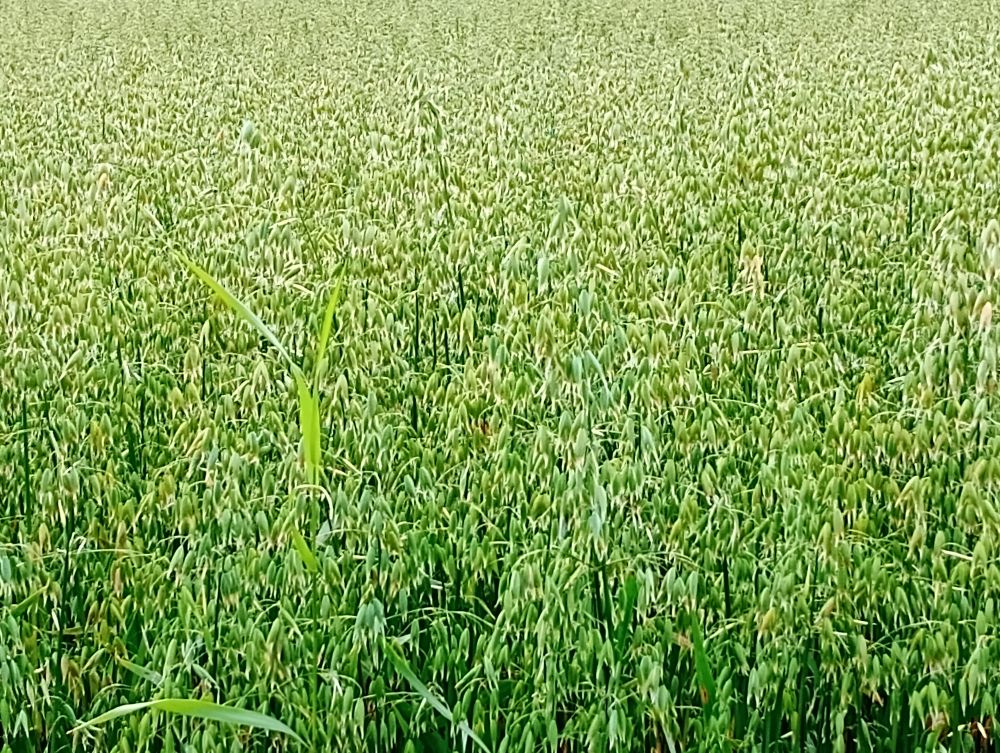
Dounby Farm was experimenting with oats planted after the turnip crop. An oat variety ‘Dala’ was being grown at Dounby but was thin although the straw it produced was ‘of a good length’. Also being grown was ‘Superb’. It was shorter and stronger than ‘Dala’, but also thin.
The new oat varieties of ‘Golden Rain’ and ‘Garton’s Early’ were producing promising results in contrast to ‘Odal’ which was very thin.
At Saither Farm, Dounby, experiments were taking place in the use of different kinds of phosphate to fertilise the fields for turnip sowing. There were several strips of land laid aside where varying combinations of phosphates were being trialled. It was felt that superphosphates combined with soluble slag was proving to be the best.
Howan Farm was trialling the growing of ‘Golden Wonder’ potatoes. One section was planted in seed potatoes which had been soaked in a solution of formalin prior to planting. This was to see if it limited mosaic disease in the leaves. Potato crops in England had been seriously affected by mosaic disease. The test at Howan showed that steeping in formalin had no effect on the foliage and the crop was weakened in comparison to the non-treated potatoes.
Howan was growing different varieties of Early Potatoes which were all immune to wart disease. Doing well were ‘Witchill’ and Edzell Blue‘. Not doing so well were ‘Dargill Early’ and ‘Immune Ashleaf’.
Eastbist Farm was growing two types of oats: ‘President’ and ‘Sandy’. There was also a very fine field of ‘Victory’ oats being grown. (Ref. The Orkney Herald, 2 September 1925, page 8).
These trials on actual working farms were very important when new varieties were being produced but older ones were still proving to be popular because they were reliable. Most of the varieties listed above are no longer available and others are classed as ‘heritage’ crops.
William Shearer’s publishes an excellent catalogue of seed potatoes, a service they have been providing for the growers of Orkney for generations.

Fiona Grahame


Leave a Reply