
By Callum Potter.
Comet Lemmon, or C/2025 A6 (Lemmon) to give it its full name, will be well placed for Orkney star gazers over the next few weeks of October. Discovered on January 3rd this year, it is heading in from the Oort Cloud and it will pass closest to the Sun on November 8th by about 42 million miles.

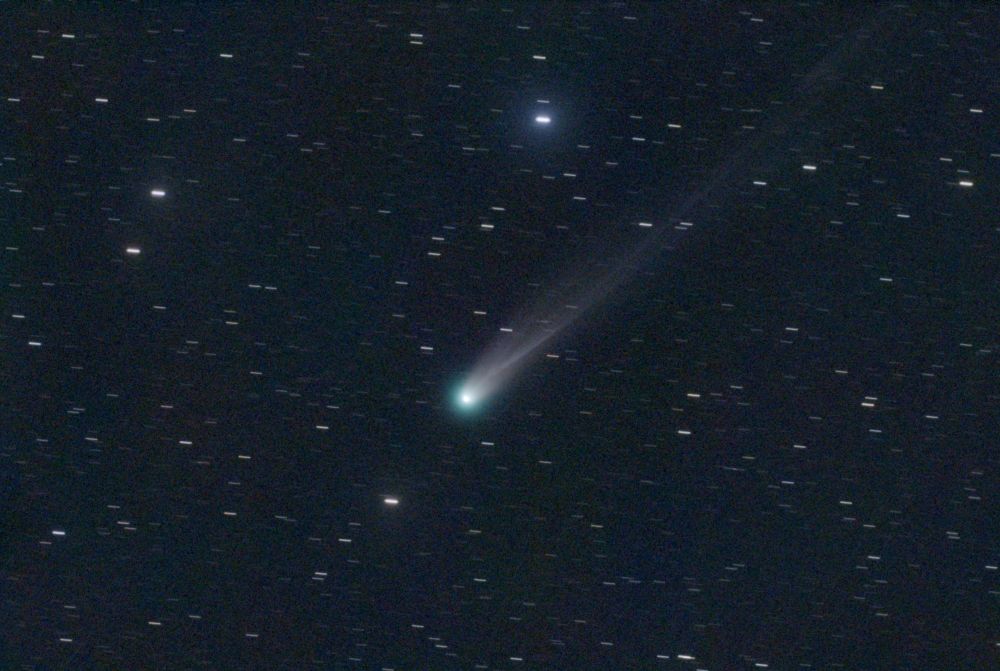
This image of Comet Lemmon was taken on the morning of October 9th from Chelmsford, England by Nick James, Director of the Comet Section of the British Astronomical Association. The comet is moving fast across the sky relative to the stars, so by tracking on the comet, the stars are trailed. Image used with permission.
However, for Orkney observers, it will be highest in the sky and near full brightness around the 20th/21st of October, which is just around the New Moon so moonlight will not interfere.
In the days leading up to the 20th, it will be visible all night, but will be very low, just skirting the northern horizon at midnight. It will be well placed to be seen in the early evening or before dawn. After the 20th you will be best to look out after sunset.
Recent observations of this comet show a bright head, the coma, and a fainter ion tail. How bright it will get is very difficult to predict. It should be easy to see with binoculars, and will likely be visible to the unaided eye as a fuzzy greenish patch. However it is unlikely to have a very long, bright dust tail. But comets are notoriously unpredictable, so the only way to be sure is to go out and have a look for yourself. Let us know if you see it!
On October 10 Comet Lemmon sits below Ursa Major and over the following days will travel though Canes Venatici and then onto Boötes.

This chart shows the position of the comet in the evening sky over the coming weeks, looking north-west to west, at around 8 pm BST.
And this chart shows it in the pre-dawn sky, looking north-east, at around 5 a.m. BST.



Leave a Reply