
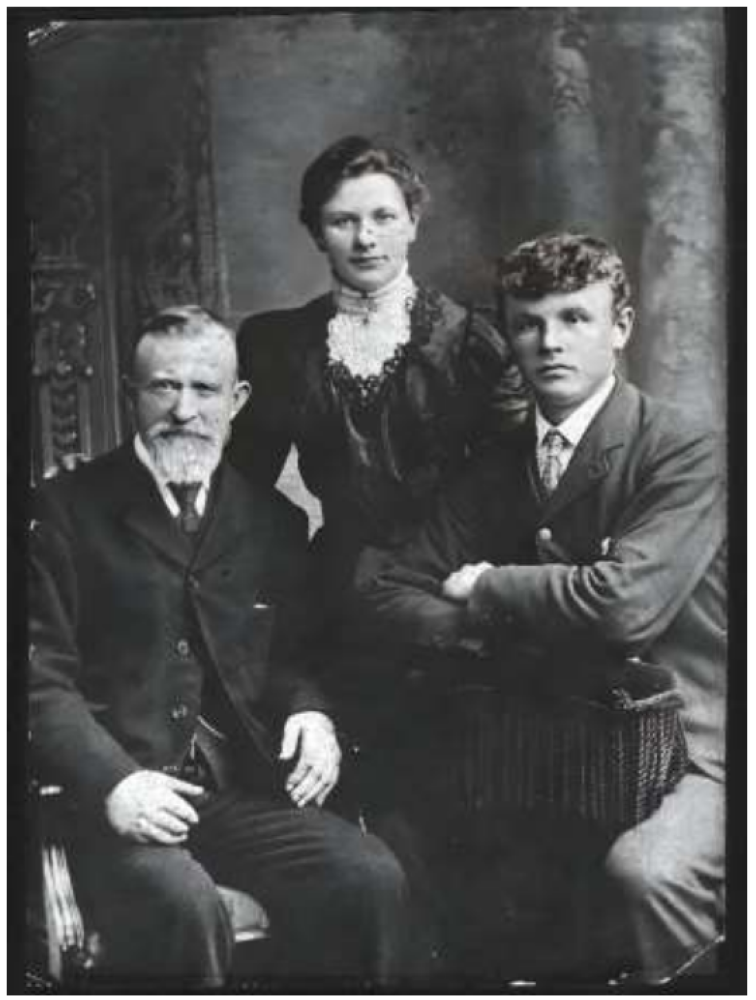
By Ian Cooper from his excellent series Records of a Bygone Age, first published in The Stronsay Limpet and republished here with kind permission.
In last month’s article about James and Rebecca Miller, the young Eday couple who met a tragic end on their way to a new life in Australia, mention was made of their nephew William Croy, who lost his life in the Great War.
With nationwide Remembrance Services held recently to honour those British and Commonwealth servicemen and women who had made the ultimate sacrifice in two World Wars and other conflicts I thought I should expand on William’s life and death, one of the millions of ordinary men and women whose service to their country had been remembered that day.
William’s mother Mary Meil, a sister of Rebecca who had perished on the way to Australia, had moved from Eday to Stronsay and there, in November 1880, married widower Robert Croy and moved to Lower Midgarth with her six year old daughter, also Mary, to live with Robert and his six children from his first marriage. Their daughter Janet was born in November the following year, then William came along in August 1884. By his early teens William was employed as a farm servant and ploughman, firstly on the farm of Midgarth beside his father, then with the Twatt family at the Lodge, employment he was to hold for 12 years.


Following the death of William’s father Robert, aged 72, in March 1909 William decided that, as so many had done before him, he would seek out a new life for himself on the other side of the world. These plans quickly materialised and, on 12th November 1909, he boarded the 500ft White Star passenger liner Corinthic in London bound for Wellington in New Zealand. On arrival there he travelled to his cousin Robert Croy’s farm at Chertsey, near Ashburton on the Canterbury Plain, where he had been assured of employment as a ploughman and farm worker. William would probably have felt quite at home there as there were already a number of Stronsay immigrants and their descendants settled in the Ashburton area.

As the years passed William became very settled in his new life but still kept in regular contact by letter with his mother and sister back home. Copies of some of these letters are still to the fore, and William was always seeking news of the friends and relatives he had left back home. Letters and gifts from Stronsay were apparently a regular occurrence, with William noting in a 1914 letter to his sister that ‘I will do for socks for a while now as I have four pair’.
A further letter from 1916 shows William in pensive mood, perhaps already giving thought to joining up, as he writes ‘What is going to be the end of all this men slaughtered we don’t know. It looks as if they are going to kill all the men before they will stop.’
Later that year, with the war in Europe still raging and no end in sight, he felt called to what he saw as his duty to return to his homeland to do his bit for King and Country. On 29th June 1916 he enlisted in the New Zealand Expeditionary Force ‘For the term of the present European war and for such further period as is necessary to bring the Expeditionary Force back to New Zealand and disband it’.
The regiment he joined was the 1st Otago and he and others of the regiment from that area made their way by ship to Wellington where, on 11th October 1916, they embarked on the Union Steam Ship Company’s 350ft passenger and cargo ship Tofua which had been requisitioned as a troop carrier for the duration of the war. After a long but fairly uneventful 79 day voyage they arrived in Plymouth, disembarking there on 29th December. From there William and his comrades transferred to Sling Training Camp on Salisbury Plain to undergo basic training. This completed, he and the others of the regiment left for France on 11th February, reaching the military camp at Etaples in Northern France on the 13th then joining their Battalion at the front on 14th March 1917. William was apparently attached to a tunnelling company for a time before returning to his battalion at the front on 28th June.
A month later the battle began for the strategically important village and ridge at Passchendaele in Belgium, a battle that was to rage on until November. The New Zealand forces were heavily involved in this fighting and, in what became known as the First Battle of Passchendaele on 12 October 1917, suffered massive casualties in what was later described as the blackest day in New Zealand’s military history. This battle left 843 New Zealanders lying dead and dying on the battlefield, one of whom was to be William Croy.
He lies near where he died, buried at Passchendaele New British Cemetery where his grave, numbered VII.C.30, is one of thousands tended and remembered with honour by the Commonwealth War Graves Commission. He is also remembered and honoured on our War Memorial back home in Stronsay.

His personal effects were sent back to his mother in Stronsay and included a Stronsay postcard sent to him by his sister Janet in 1911 and surely kept close to his heart as a memory of his family and birthplace.
A treasured postcard from William’s sister Janet Craigie Croy, found among his personal effects and returned to his mother in Stronsay.


Following the end of the war the British Government began issuing bronze Memorial Plaques (commonly called the ‘Dead Man’s Penny’) to honour the sacrifice of the fallen but it was to be 1923 before William’s mother Mary received the plaque inscribed with her son’s name – one of over 1.3 million such plaques sent to grieving widows and parents.

This plaque, the postcard previously mentioned, copies of some of William’s letters home and a number of other certificates, documents and photos were carefully kept and treasured, passing down through the generations to William’s grandniece Margaret Reid (nee Stevenson), originally from Kirbuster. Margaret felt that these items should be passed on and cared for where more people could be made aware of the story behind one man’s sacrifice for King and Country and kindly donated these to us the Heritage Centre. This has enabled us to display William’s photo, together with the Memorial Plaque, and to put together a small booklet containing the documents and photos that tell William’s story.
In another of life’s strange coincidences a visitor to Stronsay, this past August a young man named Shane with a keen interest in Military history, had a short holiday on the island. He was staying with family friends on the island and spent some considerable time in the Heritage Centre during his holiday.
He was very interested to discover there the story of William Croy and his journey to a new life in New Zealand, drawing a number of strong similarities between William and his own great granduncle John Raphael Baker who had been born in Cork in Ireland the year before William’s arrival into the world in 1884. John Baker had also travelled to a new life in New Zealand, some three years after William’s emigration there, and he too felt called to join the forces, signing up as a rifleman with the 2nd New Zealand Rifle Brigade, just a month before William joined up with the 1st Otago Regiment.
The regiments of both men were sent to France as part of the New Zealand Expeditionary Force fighting there, they both took part in the First Battle of Passchendaele and both were to lose their lives, along with so many others, in that ferocious battle on 12th October 1917. In yet another coincidence, Shane discovered that William had been born and brought up at the house of Lower Midgarth, the very same house where Shane was staying with his friends!
Later that year Shane went on a previously arranged visit to Belgium, taking with him two little wooden crosses purchased from the British Legion back in Britain. On arrival in Belgium he sought out the area where his great granduncle John Raphael Baker had died, laying a cross in his memory near the spot where he had fallen.
He then visited the Passchendaele New British Cemetery and sought out the grave of William Croy. He was rather disappointed to find that the gravestones in that area looked as if they were badly in need of cleaning but was informed by a caretaker that, in that area of Belgium, the stones were subject to attack from a type of black coloured fungus and the Commonwealth War Graves experts had as yet been unable to find a cure which could remove the fungus without damage to the stones.
Passchendaele New British Cemetery


Shane placed this second simple little wooden cross, complete with its poppy symbol of remembrance and hope, at the foot of William’s grave, adding the inscription:
William Croy, 1st Otago Regiment
Lower Midgarth, Stronsay, Orkney, Scotland
12-8-1884 to 12-10-1917
Loved and remembered still in Stronsay
We will remember them.
Leave a Reply