
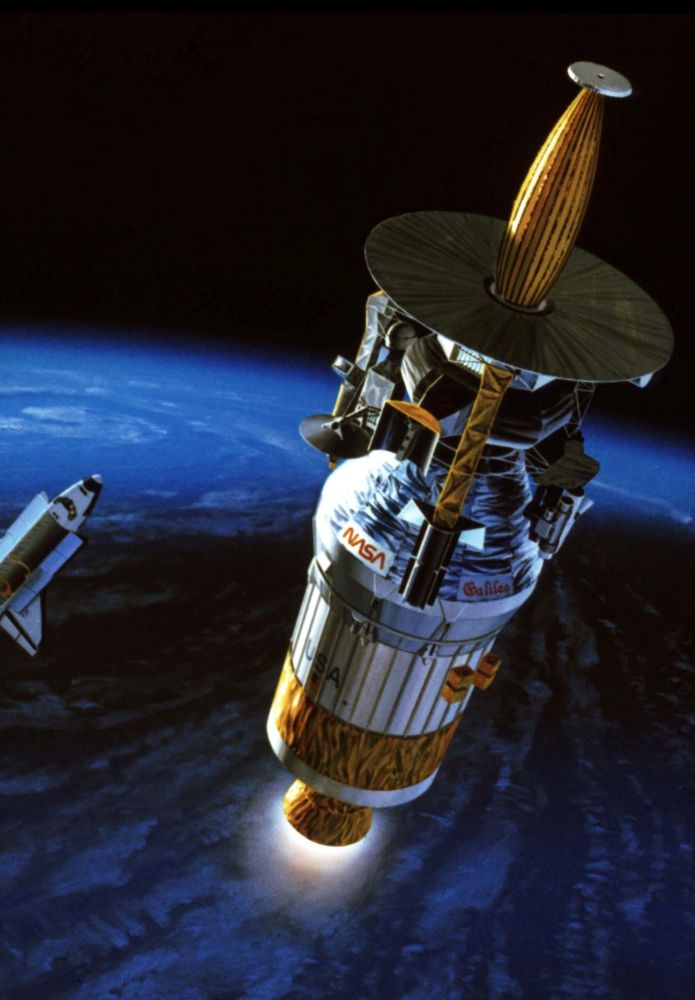

The Galileo spacecraft is back in the news again, which is not bad going for one which was launched in October 1989 (Fig. 1) and came to a fiery end in September 1995 (Fig. 2).

Although there was a struggle to complete its mission over those years, its mapping of Jupiter’s major moons remains the most comprehensive to date, and as I remarked in ‘Spacecraft, by Jupiter’ (ON, April 16th, 2023),new discoveries are still being made from it today.

I was lucky enough to see the spacecraft at a key moment in its troubled early history. Galileo began life as the Jupiter Orbiter Project, aka Pioneer Jupiter Orbiter (Fig. 3), using backup hardware from the Pioneer 10 and 11 missions. It grew into something much more sophisticated against determined opposition from senators and congressmen representing the farming states, seeking to halt what they called the ‘boondoggles’ of science in general and space exploration in particular. As well as the US supersonic airliner, they had successfully cancelled NASA’s Search for Extraterrestrial Intelligence, shut down the scientific stations left on the Moon by the astronauts, halted analysis of the moonrock they’d brought back, done their best to prevent NASA from saving the Skylab space station, and passed bills preventing NASA from using Martin Marietta’s Aft Cargo Carrier, or any other Shuttle applications which involved making use of the External Tank in space (see review, G.D. Nordley, A World Beneath the Stars, ON, 8th June 2025). But when it came to Pioneer Jupiter Orbiter, the space enthusiasts fought back. Organisations like the Planetary Society, the L5 Society, the National Space Institute, and the American Institute for Aeronautics and Astronautics, formed ‘phone trees’ to lobby their own congressmen and senators, insisting they stay for the votes on space projects rather than going home for the weekends. The JOP mission was saved, and after the trials it had been through, it seemed only right to call it ‘Galileo’.
But in 1984 I had just been keynote speaker at the ‘View from Earth, 1984’ seminar in California, (see ‘Eyewitness to History – 3’, ON, August 7th, 2022), and I was invited to a VIP tour of the Jet Propulsion Laboratory in Pasadena by two of the other speakers, Mike Urban (a team controller on Voyager 2), and Warren James, of the Galileo Project (Fig. 4).

The highlight of my visit was the sight of the Galileo spacecraft and its engineering backup in the glass-walled clean room of JPL, seen from the viewing gallery above. Galileo was to have been launched by the Space Shuttle, on a liquid-hydrogen-fuelled Centaur upper stage, and the proposal was highly controversial. Though the Centaurs were no longer subject to the massive explosions of its early development (Fig. 5), liquid hydrogen remained extremely temperamental and difficult to handle (Fig. 6).


In the pages of Analog Jerry Pournelle argued the case for a ‘dry Centaur’ launch which would be fuelled from the Shuttle’s External Tank, on-orbit. But NASA was already banned from using the Tank in orbit (see above), and when I visited the Atlas-Centaur plant, no one I spoke to had heard of the idea. After the loss of the Challenger in 1986, the use of Centaur on the Shuttle was dropped for good (Fig. 7).

By 1984, the window for Shuttle launches was closed and Galileo was to be launched by a Titan-Centaur combination. When I was there the spacecraft had been disassembled for the necessary modifications, and I could see the complete engineering test model of the spacecraft at the rear, with its communications antennae folded (Fig. 8).

The main body of the spacecraft (the ‘bus’) was to the right, with the scientific instruments spread on benches around it (Fig. 9). Directly ahead of me was the high-gain antenna, fully open (Fig. 10). It was of the type used on the Tracking & Data Relay Satellites which had been maintaining communications with the Space Shuttle since its first launch in 1981.


I had a rare opportunity to see the other side of the conversion, as well. At the View from Earth symposium, an elderly gentleman had invited me to tour the Atlas-Convair plant at San Diego, where the Centaur boosters were made. He had been brought out of retirement because his outdated speciality was suddenly in demand. What he used to do was to build wooden ‘dynamic models’ of spacecraft, which could be subjected to simulated vibrations of launch and separation from the boosters, without breaking the spacecraft itself if there was a problem. As Galileo had never been intended to launch on Titan-Centaur, he’d been called on to exercise that special skill one more time. What he had built was like a misshapen wooden hut, looking nothing like the spacecraft I’d seen at JPL, but he assured me that on a vibrating table, it would behave just like the Galileo would during the stresses of launch. The Atlas booster was still at the forefront of US military launches, outdone in throw-weight only by the Titan III at the time, so no photography was allowed within the plant and you must take my word for the remarkable construction I saw. But by the time the modifications has been done, the Shuttle launch window had reopened and Galileo had to be converted back for launch from it, on a solid-fuelled Interim Upper Stage, as in Fig. 1.
Still it wasn’t the launch vibrations, which were so carefully allowed for, which were to give the mission its biggest problem. During the Voyager 2 flyby of Saturn, the camera platform had jammed due to overwork. Its liquid lubricant had spun out of the bearings and took 24 hours to seep back in, after which all went well. Galileo’s high-gain antenna was not to be deployed until it was well away from the Sun, and its liquid lubricant had been replaced by graphite. Unfortunately, all that unscheduled travel by road and rail, adapting the spacecraft for different boosters, had shaken the graphite out of the bearings, and because it wasn’t a liquid, it didn’t seep back in.


Three of the 18 ribs failed to open (Fig. 11), making the antenna unusable, and data and images could only be returned using the low-gain antenna at much slower transmission rates (Fig. 12). Adrian Berry of the Daily Telegraph made the original suggestion that the engineering test model which I’d seen should be reconfigured as a communications relay and sent to Jupiter on a faster orbit. That too fell on deaf ears, though the relay technique is now routinely used, for instance to pass on data from the Curiosity and Perseverance rovers on the surface of Mars. Nevertheless, the engineers managed to reconfigure the low-gain antenna to send back the highest-resolution images of the planet and moons to date, and returned a huge amount of data during its years in orbit.
Many of the new discoveries, still being made from it today, focus on the icy moon Europa. It’s been known since the Voyager flybys of 1979 that Europa has a crust of water ice, up to 10 miles thick, surrounding a moon-wide ocean which may be as much as a hundred miles deep, kept liquid by tidal action. In 2014, Hubble Space Telescope observations of Europa in transit across the face of Jupiter found possible plumes of water vapour (Fig. 13), happening to coincide with a close flyby by Galileo, and a previously unexplained glitch in the Galileo data confirmed their existence.

In ‘Space Notes, February 2024′ (ON, 4th February 2024), I reported on new observations from the Juno orbiter showing possible crustal movement on Europa, and in ‘Going under the Ice’ (ON, 21st September 2025), I discussed whether the outbreaks are from fractures going down into the ocean (Fig. 14), or from melted pools nearer the surface (Fig. 15), possibly overlaid by ‘chaotic terrain’ pierced by geysers (Fig. 16).


Now comes a remarkable report suggesting water activity in Europa’s Manannán impact crater (Figs. 17-18).


Due to the tidal forces acting on the crust, impact features are expected to be short-lived, erased by movement and slow melting of the ice, and only a few are known (Fig. 19).


A team of researchers have now published results comparing an asterisk-shaped dark feature at the centre of Manannán (Fig. 20) to ‘lake stars’, aka ‘ice octopi’, ‘spring holes’, ‘ice rosettes’ and ‘dampfloecher’, found on Earth as seasonal features in lakes and possibly first reported by Thoreau at Walden Pond in 1845. (Lauren E. McKeown et al, ‘Lake Stars as an Earth Analog for Europa’s Manannán Crater Spider Feature’, The Planetary Science Journal, Vol. 6 No. 12, 2025.) On Earth, they form when snow falls on thin ice and water forces itself up from below, forcing itself outward through cracks to form a ‘dendritic pattern’ (Figs. 21 & 22).


The authors have gone to great lengths to study their formation both in nature and in the laboratory, and compare them to the similar-looking ‘spiders’ which form in carbon dioxide ice during spring around the south polar cap of Mars, thought to generate geysers, though pointing out major differences in composition, but possibly similar physical processes. (Figs. 23 & 24.


The ‘Dalmatian spots’ on Mars have been attracting speculation since the Mars Global Surveyor mission, when Arthur C. Clarke suggested they might be evidence for plant life.) By analogy with other Europan landforms, the researchers suggest naming the Manannán one ‘Damhán Alla’ to distinguish it from other ‘spiders’ elsewhere. I suspect that list might be extended to include the ‘spider’ features around impact features on Mercury (Figs. 25 & 26), particularly the one in the huge impact feature of Caloris Basin – different composition again, but similar processes, perhaps.


All this suggests that the Manannán ‘star’ might be a promising place to attempt penetration of the Europa interior, as discussed in ‘Going Under the Ice’, but especially if the water melted by the impact is clearing the way for us, as the Fig. 19 caption suggests. Unfortunately the last week’s news has suggested that there’s an unchancy predecessor already under way on Earth. The story resurfaced in Jeffrey Gettleman’s article, ‘How Did the USA Lose a Nuclear Device in the Himalayas?’, New York Times, 13th December 2025, but as that’s only available on subscription, perhaps it’s best to quote Wikipedia:
‘The Nanda Devi Plutonium Mission was a series of attempts by the United States Central Intelligence Agency (CIA) and the Indian Intelligence Bureau (IB) to spy on ballistic missile testing being conducted at Lop Nur in Xinjiang, China. The agencies cooperated in October 1965 in a failed attempt to install a SNAP-19C plutonium-238 radioisotope thermoelectric generator-powered remote sensing station on the peak of Nanda Devi in the Garhwal Himalayas [Fig. 27] to gather signals intelligence via telemetry from missiles during their tests.

‘The mission was aborted during a strong blizzard, and the generator was lost. Three recovery attempts failed, leading to fears of radioactive contamination of the Ganges or repurposing for a dirty bomb. Another CIA RTG-powered mountaintop device installed from spring 1967 to 1968 melted down into the ice [my italics], blocking its signal-gathering. A third device was successful from 1973 but quickly made obsolete by reconnaissance satellites.’


Although the generator was based on those used on spacecraft (Figs. 28 & 29), it was a radioisotope generator and not one of the much more dangerous nuclear reactors deployed on Soviet spy satellites such as Cosmos 954 (see ‘Space Debris, Part 2’, ON, 20th July 2025). But health and safety did not rate highly among the priorities – seemingly Sherpa porters were allowed to snuggle up to the beast at night. That does at least tell us that the radioactive material was still encapsulated, because the ones used on the Moon were red-hot once exposed (Fig. 30). In 80-90 years it will lose much of its potency, no longer able to contaminate a river system perhaps, but it will still be dangerous at close quarters. Wreckage of the Star Tiger Lancastrian which crashed in the Andes, in 1947, took over 40 years to surface at the foot of the glacier which it hit, so we must hope that the lost generators on Nanda Devi take longer.



Leave a Reply