
A study led by Professor Marco Springmann, a UCL (University College London) researcher shows that healthy, sustainable school meals could cut undernourishment, reduce diet-related deaths and significantly lower environmental impacts.
Professor Springmann explained:
“Our modelling shows that healthy and sustainable school meals can generate substantial health and environmental gains in every region of the world.
“Importantly, the climate and health savings that result from healthier diets and lower emissions can help offset the costs of expanding school meal programmes.
“The evidence is clear: investing in school meals is both effective and economically sound.”
Global food systems are responsible for a third of human-induced greenhouse gas emissions while also contributing to rising malnutrition and diet-related diseases.
At the same time, national school meal programmes feed 466 million children every day, representing 70% of the global public food system – a scale that provides governments unparalleled leverage.
Scotland
The Scottish Government has pledged to expand free school meal provision. All children in Scotland’s Local Authority schools in Primaries 1 to 5 get Free School Meals which save the average family who take up the offer £450 per child per year. Older children are also entitled to a Free Meal if their families are on certain benefits. The Scottish Government also announced that more breakfast clubs will be introduced.

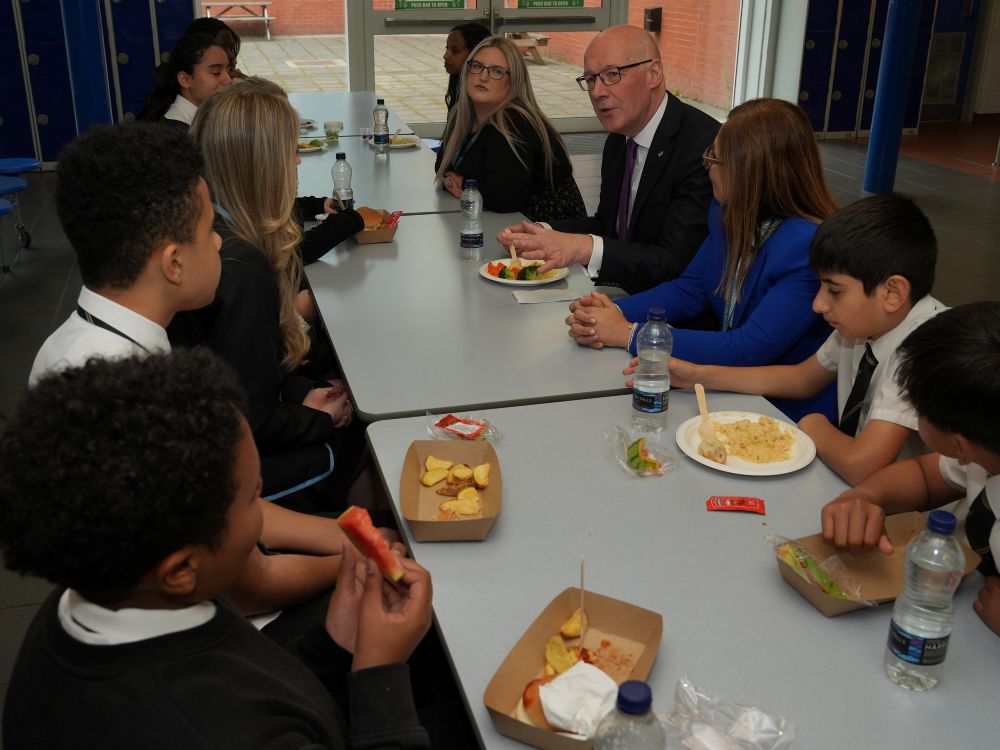
360,000 children and young people are offered a Free School Meal in Scotland. The First Minister, John Swinney, visited Springburn Academy, Glasgow, in June 2025, to announce the expansion of provision.
The Scottish Government state that Free School Meals must be balanced and nutritious. Last year there was a slight increase in the uptake of Free School Meals in Scotland. More than two thirds of those eligible (67.7%) took up the offer.
Estimates for all school meals (free and paid for), Scotland 2017-18 to 2023-24
| Sector | 2017-18 | 2018-19 | 2019-20 | 2021-22 | 2022-23 | 2023-24 |
| Primary | 59.2 | 58.8 | 53.7 | 50.3 | 58.1 | 61.5 |
| Secondary | 39.9 | 41.5 | 38.8 | 30.0 | 31.8 | 36.7 |
| Special | 68.6 | 74.1 | 61.7 | 62.2 | 67.5 | 63.8 |
| All sectors | 51.5 | 51.9 | 47.6 | 41.8 | 47.0 | 50.8 |
Last year just over half ( 50.8%) of all school pupils had a School provided meal, both Free and Paid for.
Currently only one in five children in the world receive a school meal.
Professor Springmann’s research finds that providing a healthy, sustainable meal to every child by 2030 could:
- Generate major health and climate savings, significantly offsetting investment needs
- Reduce global undernourishment by 24%, with particularly strong impacts in food-insecure regions. This translates to 120 million fewer people in the world not getting enough vitamins, minerals, and energy from food
- Prevent over 1 million deaths every year from diet-related illnesses such as diabetes and coronary heart disease, assuming today’s schoolchildren retain, at least in part, preference for healthy foods into adulthood
- Halve food-related environmental impacts, including emissions and land use, when meals follow healthy, sustainable dietary patterns, for instance by increasing the proportion of vegetables and reducing meat and dairy products
Dr Silvia Pastorino, Diets & Planetary Health Lead for the Research Consortium and curator of the collection based at the London School of Hygiene & Tropical Medicine (LSHTM), said:
“When meals are healthy, sustainable and linked to food education, they improve children’s wellbeing today and foster long-term sustainable habits, while helping countries protect biodiversity, reduce emissions and build resilient communities. Few interventions deliver such wide-ranging, long-lasting benefits.”
In partnership with international organisations and government partners, the Research Consortium is now developing a Planet-Friendly School Meals Toolkit to help countries assess the costs, environmental impacts and health benefits of shifting to sustainable school meal models. Co-created with partners in Kenya and Rwanda, the first results are expected in spring 2026.
Click on this link to access: The health, environmental, and cost implications of providing healthy and sustainable school meals for every child by 2030: a global modelling study, published in The Lancet Planetary Health.
Fiona Grahame



Leave a Reply