
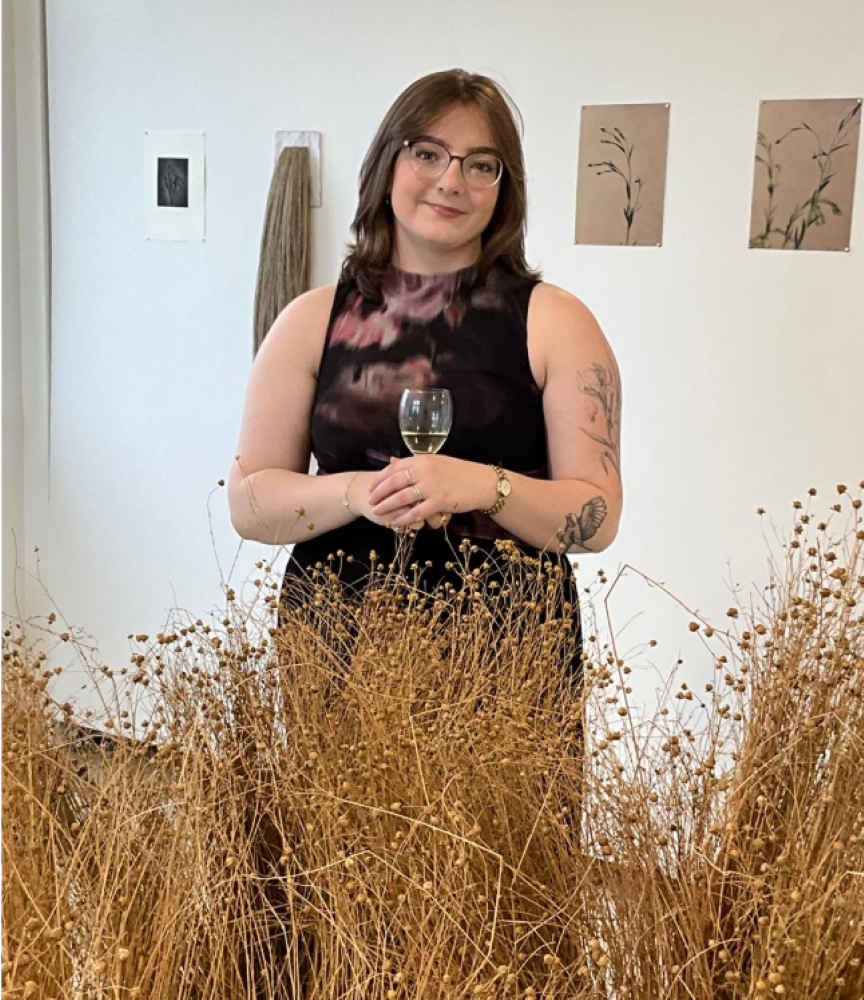
By Eamonn Keyes.
On Friday June 5th the Department of Art at UHI Orkney began hosting the Orkney 26 Degree Show exhibition, featuring the end of year exhibitions of student work. The exhibition runs from June 6th until June 17th.
Three students graduating from the BA Fine Art course this year, Alex Muir, Hilary Swanney and Mia Train, are the main focus of the exhibition, along with art from continuing BA students and NC students.
I have always gone to Fine Art exhibitions with a degree of preconception of what to expect, and each time I have been proved utterly wrong. These exhibitions provide both a fascinating insight into the minds of the creators and allows wide room for interpretation and appreciation of the aesthetic inherent in the exhibits.
I invariably come out with a new appreciation of what art can be each time, the form, the personal appeal, and sometimes even the visceral effect of the work.
This was an enticing wander through the unexpected, and although not all work will appeal to everyone, there has to be great respect for the creative process that has brought a mere concept to a tangible or accessible form.

I had been anticipating seeing the work of Alex Muir, as she has been working with flax, unusual these days and a long time after flax growing and linen-making have almost died as industries.
My mother, grandmother and grandfather all worked in Belfast’s linen mills, beginning at the end of the 19th century and going right up to the late 1960s and early 1970s. The mills were all based in the same area, around the appropriately named Flax Street.
Alex says
“My practice is rooted in place; it is process-driven and linked in all its forms and stages by flax as a material. Most fundamental to my work is creating personal connection through experience.
“During the spring and summer months of 2025, I dug, seeded, weeded, tended, and harvested around 15 square meters of flax. This process has become the focus through which I explore my relationship to the earth, place, and environment.
“My work is grounded in two major elements. The first is the land: experiencing and being in the land, working the land, and having a relationship to the land.
“The second is material: extracting and working with plant fibre, involving labour-intensive crafts that demand sustained focus and attention. Both elements are connected by their dependence on direct experience and physical handling, as well as the ongoing transformation of my materials, by nature and by my own hand; from seed to stem to thread.
“Alongside growing and fibre processing, I utilise a broad range of media and techniques – including interventions and installation, photography, filmmaking, drawing, printmaking, papermaking, artist’s books, tapestry, textiles, and writing”

Alex said that unlike wool, flax fibres could be quite difficult to combine, unlike wool which seems to want to combine to form fibres. There is currently a massive revival in an attempt to re-establish flax growing and linen making in Scotland

On Monday 15th June at 2pm there will be a Flax Sharing session, exploring the material that is central to Alex Muir’s exhibition.
I then came to Mia Train’s exhibition, which was both challenging and a little bit scary.
Mia explains
“Within my practice I collect the remains of dead animals and use these found treasures in my creative work, physically combining them into hybrid creatures inspired by myth and imagination. I also create drawings of these creatures and recombine them into repeat patterns, introducing a further abstraction to the original forms.
“This scavenging practice I have developed is fundamental to my creative process. It originated from an interest in local bird populations and the use of natural materials and traditional crafts, together with a fascination for the world of fantastical creatures, rooted in local folklore and global mythology.
“My current project takes the form of a curiosity cabinet or ‘Wunderkammer’, displaying a collection of source materials and experiments along with the resulting work they inspired. The act of collecting in itself is fascinating and is a habit that many can share regardless of their passions. This collection represents the transmutation of death and decay through creativity and the imagination into new and fantastical forms, towards the creation of my own personal mythology.”

In Renaissance Europe the original concept of the ‘Wunderkammer’ was to gather all the wonders of the world into one private space to reflect the owner’s erudition, wealth, and worldview. These rooms featured a crowded, non-taxonomic display designed to provoke awe and facilitate philosophical contemplation. Mia’s version does no less, featuring a variety of bones, books, feathers, paper birds, dead birds and various boxes of dubious delights.
We talked about her art, and Mia talked about her interest in the collection of unusual items and how both this and all things gothic and mythological had fuelled her art, pointing out that her ‘Wunderkammer’ contained books on Celtic Mythology and Scottish Mythology, with creatures like the Nuckelavee, which supposedly originated in Orkney.
This art pictured these monsters and demons, often repeated until they form pictures that can occasionally resemble fractals. The style is quite unique and the artwork readily identifiable and would work well as graphic novel illustrations or perhaps even as tattoos for those of a gothic temperament!


The final graduate from the Fine Arts BA course is the elusive Hilary Swanney. I had tried to catch up with Hilary for a chat about her work but was unsuccessful on a couple of occasions, unfortunately. I’d certainly have liked to talk directly to her about her initial inspirations and the reasons behind her being drawn to producing her work. Another time, perhaps.

To me Hilary’s work has the feel of quiet domesticity, of times past, familiarity and tranquillity observed from a different and personal angle, and I apologise to her if this possibly comes across as nonsensical.


The exhibition also contained work from continuing BA and NC students.
Among this work, which was always fascinating and highly varied, I came across the work of Yvonne Harcus, dealing primarily with form and using plaster within cloth sheets and, of course, with gravity adding its effect to them when they were hung in different ways. These were very open to interpretation, and I discussed some of the interpretive possibilities with Yvonne in a very interesting conversation that ran from Macedonian linen armour to ice cube bags to surgical operations.


There was a lot more to see and this exhibition is certainly worth a visit if you have some time to spare. There is an extraordinary amount of work on show, innovative, decorative, challenging and occasionally even a bit scary.
Well done to all concerned and to the tutors involved.

The Show is open daily from Saturday 6th June to Wednesday 17th June 10am—4pm (closed Sunday). Late openings on Wednesdays to 7pm. Department of Art and Design, East Road, Kirkwall KW15 1LX.


Leave a Reply