
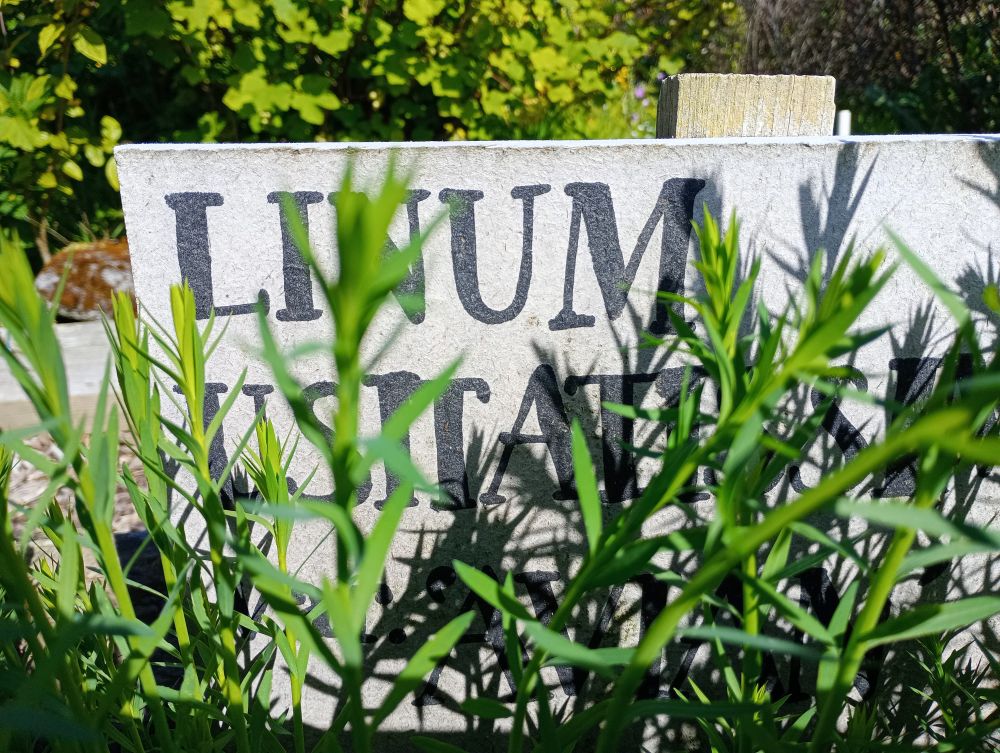

Alex Muir took us on an intriguing journey on Monday 15 June following her project on growing flax which has culminated in an exhibition of her work as part of Orkney UHI Department of Art 26 Degree Show.
In the workshop Alex described the process of producing fibres from the Flax plant which she herself had grown from seed. The seeds had been planted in prepared strips of ground at UHI Orkney, and also at her own home. In this way Alex could compare different growing conditions related to soil types, and time of planting/harvesting. A film show, part of her exhibition, provides visual evidence of how she did this.

From the harvest of the Flax, Alex spoke about how the stems are prepared so as to end up with fibres which can be spun into threads. No part of this plant is wasted.

Attendees were also given the chance to make a simple cord from twisting and plaiting the fibres. I plan to string a shell bead onto mine – something I made at another super event, the Tomb of The Eagles Open Day.

Finally, the weaving and production of linen cloth. All the stages of the production process can be viewed at Alex Muir’s exhibition along with other aspects of this impressive body of work.


Linen was produced in Orkney from the times of the Norse Settlers, a skill and process which continued into the 19th century. The Old Statistical Account for Holm (1793) states:
“The parish has been in the practice of sowing flax seed for 100 years back, and for the last 30 years for a very considerable extent”
Rev James Alison goes on to report that this is sent annually to the east coast of England…“By an accurate account… there were upwards of 20,000 yards manufacture and bleached yearly in the parish.”
“This seed is sewn the first of May, and pulled after the middle of August. Since the year 1765 ( when the crop was blasted by a hurricane on the 7th August, over the whole of this county), potatoes have been introduced. “
Flax for linen was a manufacture which employed thousands of women in Orkney till its demise in the 19th century – to be replaced by strawplaiting.


After the workshop, a trail led to the small plot outside where Alex was growing her next lot of Flax.
Alex Muir’s work is impressive, but the workshop was also a great opportunity to look around all of the exhibitions which can be viewed in separate spaces. It really is of credit to both the students, and their lecturers that in this AI age we have on display a diverse array of creative, imaginative, and original art at varying stages of an artist’s journey.

Wednesday 17 June is the last chance to see the exhibition – one not to be missed.
Fiona Grahame
Leave a Reply