
By Ian Cooper, from his excellent series, ‘Records of a Bygone Age’, first published in The Stronsay Limpet and republished here with their kind permission.
Last month’s article ended with the description of the epic 10-day journey of the newly built John Gellatly Hyndman from Cowes on the Isle of Wight to her new station in Stronsay.

Stronsay after her maiden voyage – a 10 day journey from Cowes in the Isle of Wight.
Note that much of the walls of the old Stronsay Hotel are still standing, as are the
walls of what was Watt’s Supply Stores at the top of the east pier. Also to be seen are
some of the buildings that were demolished or modified when the Fish Factory was built in the 1970s
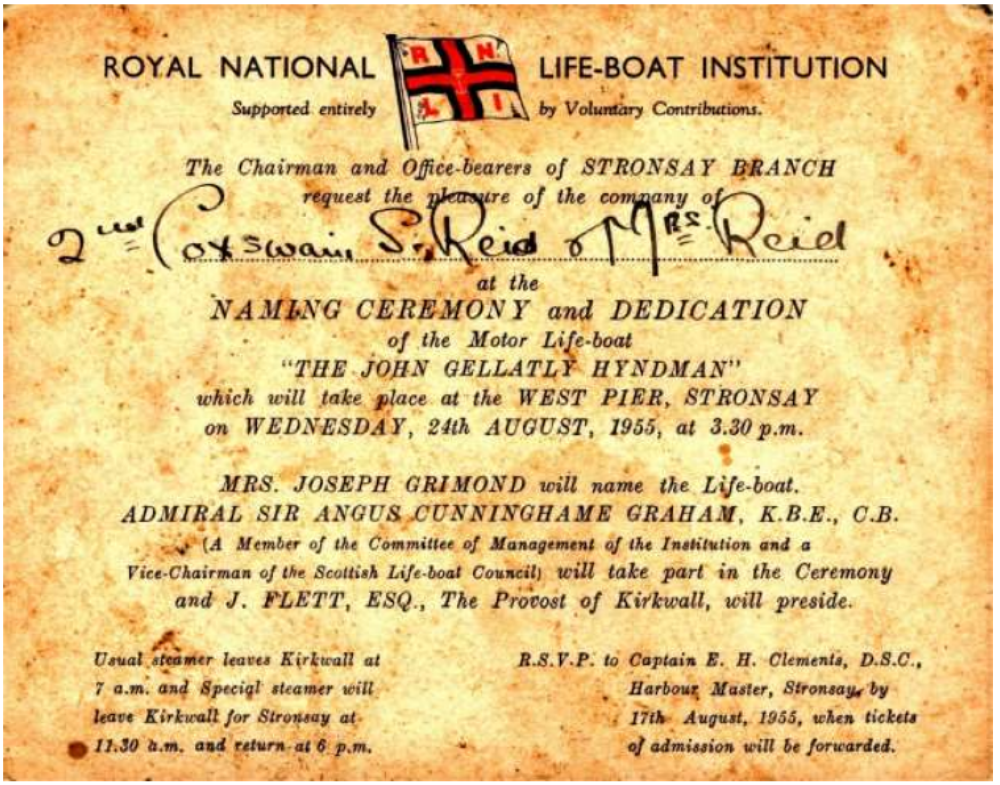
With the arrival of this lifeboat to her new home, arrangements were put in hand for the official naming of the vessel and 24th August 1955 was set for the great day. Printed invitations were sent out to dignitaries, both local and from further afield, while a general invitation to all islanders was to be taken up by most of the population on the day. A grandstand was erected for the dignitaries involved in the naming ceremony and the Church choir was enlisted to lead the singing, accompanied by the band of the Salvation Army from Kirkwall. The Orkney Steam Navigation Company (the forerunner of Orkney Ferries), in addition to its scheduled service to the isles by the Earl Thorfinn, laid on a special excursion by the Earl Sigurd to convey passengers to Stronsay for the event, returning later that same day.

nd Coxswain Sammy Reid and his wife Maggie’s invitation to the even

very crowded place. The Church Choir, who led the singing, are seated on the right of this
photo.

Jo Grimond, MP for Orkney and Shetland. Assisting her is Lieutenant Stogdon of the
Royal National Lifeboat Institution. Crew members to be seen are Jimmy Stout, Sydney
Swanney, Jim Reid, Jim Work jnr and Sammy Reid, with others aboard on the day being
Coxswain Tom Carter and crewmen John Dennison and Jim Work snr.

This notable event was reported in the RNLI’s ‘Lifeboat’ magazine as:
The naming ceremony of the new Stronsay life-boat, The John Gellatly Hyndman, which has been provided out of a legacy left by Miss Elise Amelia Hyndman of Greenock, took place on the 24th of August, 1955. The life-boat was named by Mrs. Joseph Grimond, wife of the Member of Parliament for Orkney and Shetland. The Provost of Kirkwall, Mr. J. Flett, took the chair. Admiral Sir Angus Cunninghame Graham, a member of the Committee of Management and a Vice-Chairman of the Scottish Lifeboat Council, thanked the donor and handed the life-boat over to the branch, Captain E H Clements, honorary secretary of the Stronsay branch, accepting her. The new lifeboat, which is a 52 -feet Barnett boat, was described by Lieut. E. D. Stogdon. The Rev. E. P. G. Fox, Minister of Moncur Memorial Church and chairman of the Stronsay branch, dedicated the lifeboat. A vote of thanks to Mrs. Grimond was proposed by Mrs. John Groat, vice-president of the Stronsay Ladies’ Life-boat Guild, and a vote of thanks to the chairman and others was proposed by Mr. William Work, County Councillor for Stronsay. The singing was led by the choir of the Moncur Memorial Church and music was played by the Kirkwall Salvation Army Band

Moving on now to 1956, a strong north-westerly gale on 12th May saw a fleet of around 20 Norwegian whalers heading for the safety of Kirkwall Harbour. While making their way down the Wide Firth toward Kirkwall one of them, the Leidulf, ran hard aground on the Vasa Skerry to the west of Shapinsay. One of her sister ships, the Astor, attempted to tow her off and, in doing so, ran aground herself. The Stronsay lifeboat, under the command of coxswain Tom Carter, was called to their assistance, finding on arrival that the crew of the Leidulf had abandoned their vessel for the temporary safety of the skerry.
With the skerry due to be submerged at high water and the tide rapidly rising the Norwegian sailors were in imminent danger of being swept off the skerry. With a strong tide running past the skerry, it was obvious that any rescue was going to be extremely difficult and so it proved. After four failed attempts to get close enough to take the men off, the coxswain took the decision to run the bow of the lifeboat ashore on the skerry near where the men had gathered, enabling the lifeboatmen to pull all 7 of the crew aboard the lifeboat, before pulling clear with the rising tide.
Attention now turned to the Astor, now badly holed and lying on her port side a mere 50 metres away from the Leidulf. Pulling away from the skerry, the coxswain ordered the anchor dropped and the chain gradually paid out, making use of tide and engines to manoeuvre close enough to the bow of the Astor to also rescue her 7 crew members, landing all 14 men at Kirkwall Harbour a short time later. The John Gellatly Hyndman returned to her moorings at Stronsay at 2.30 a.m. the following morning after 13 hours at sea.
Tom Carter, who had been coxswain since the Station re-opened and had taken the lifeboat out on service 17 times, resigned his post in October 1956. Jimmy Stout was appointed as the new coxswain, a role he was to hold until the Station was closed.
One of the first launches under the command of the new coxswain came at 5.00a.m. on 2nd January 1957, when a request came through to take an injured crewman off a Grimsby trawler and convey him to hospital. The crewman, who had been badly scalded by escaping steam in the engine room, was aboard the Grimsby trawler Neath Castle. The Neath Castle herself was in difficulties, leaking badly and under tow by another trawler, the Stoke City, when the call went out.
The position of the trawlers which was given to the lifeboat turned out to be incorrect and it was only when a BEA plane enroute from Shetland spotted the trawlers and gave their true position that the lifeboat, which by then had been searching fruitlessly for 10 hours, was able to locate the ships. Despite heavy seas and a large swell at the time the lifeboat was able to get alongside to take the injured seaman off the Neath Castle and convey him to Balfour Hospital in Kirkwall, finally returning to her Stronsay moorings 22 hours after having left and having covered a distance of around 150 miles.
Some years later, Jimmy Stout recalled that some of the crew weren’t quite in their best fettle that day due to New Year celebrations the day before!
Just a few days later, on 7th January, the lifeboat was again called out, this time to the rescue of two men marooned on the wreck of an old tanker in Inganess Bay on the Orkney Mainland. The two men had been doing salvage work on the tanker when a gale blew up and they were unable to get back to shore. On what was a bitterly cold night, the lifeboat was able to come alongside the wreck and rescue the two men who were by then suffering from the effects of exposure. They were landed at Kirkwall soon after, little the worse for their ordeal.
On October 5th 1958, the Stronsay lifeboat was in the news again. Commanded by Coxswain Jimmy Stout it went to the aid of the Grimsby registered seine-net boat Tanana, aground and badly holed on a skerry near Wart Holm in the Westray Firth. With the Tanana listing badly, the six crewmen had all scrambled onto the comparative safety of the skerry and soon after, with the tide ebbing, she toppled over onto her side. The circumstances and subsequent rescue were recorded in the ‘Lifeboat’ magazine as follows:
CREW OF FISHING VESSEL RESCUED FROM ROCKS Stronsay, Orkneys.
At 1.15 early on the morning of the 5th of October, 1958, the coastguard at Kirkwall told the honorary secretary that a distress message had been sent from a vessel in the Westray Firth. While the life-boat crew were being assembled further enquiries were made, and the coast guard reported that flares had been seen on the west side of the Island of Westray. At 2.35 the life-boat The John Gellatly Hyndman put out in a moderate sea, with a moderate south westerly wind blowing and an ebb tide. She made for the position in heavy rain squalls and found the fishing vessel Tanana of Grimsby stranded on Wart Holm. Her crew of six were ashore on the rocks close by. The coxswain, with the aid of the searchlight, brought the life-boat alongside the rocks, and the six men scrambled
aboard her. They were transferred to the fishing vessel Capella, which was close at hand, and the life-boat returned to her station, arriving at 7.50. The Tanana became a total wreck.
Jimmy Stout, the coxswain at the time, remembered this as a very straightforward rescue. With her shallow draught, the lifeboat was able to approach right up to the stern of the stranded Tanana and, with the fishing boat now lying completely over on her side, the six crewmen were able to scramble back up onto the bow of their boat, walk the full length of the now more or less horizontal side and jump down into the waiting lifeboat.
The Tanana had been operating out of Buckie for some time previously and her crew were all from the Buckie area. The wreck was later bought by Captain William Dennison from Shapinsay.
Another of the more memorable rescues was on 14th December 1959, when the Stronsay Lifeboat was launched in a strong southerly wind and rough seas at 12.28 a.m. in response to red flares being spotted in the Westray Firth. The boat in difficulty was the Kirkwall fishing boat Amber Queen, whose engine had broken down and had subsequently lost her anchor. When the lifeboat arrived on the scene, near Fersness Point on Eday, the Amber Queen and her crew of 3 were in imminent danger of being swept onto rocks at the Point of Scaraber on the little island of Faray.
With great difficulty, Coxswain Stout was able to manoeuvre close enough to get a line aboard and tow the disabled vessel to the more sheltered waters of Fersness Bay where a better tow rope was rigged. The John Gellatly Hyndman then proceeded to tow the disabled vessel back to Stronsay Harbour but, with the gale force wind increasing, the tow parted off the point of Spurness on Sanday. The tow was quickly re established and both vessels reached the safety of the Stronsay harbour at 5.05 a.m.
For this rescue the RNLI granted the crew a reward of 16 guineas (£16.80), which was promptly dispatched by them to the Broughty Ferry disaster fund in memory of the 8 men who had lost their lives when the Broughty Ferry lifeboat had capsized earlier that month.
Two more notable but fairly straightforward rescues were carried out the following year, the first on 10th August 1960 when the John Gellatly Hyndman was called to the rescue of the Girl Jean and her two-man crew, in difficulties close to the Point of Warness on Eday. The Girl Jean’s engine had broken down and the lifeboat succeeded in getting a line aboard and towing her to the Eday Pier. On this occasion the lifeboat was back at her moorings within 3 hours of being called to the rescue.
In a busy week for the John Gellatly Hyndman, at 4.40 a.m. on 16th August she was called to the assistance of the Westray fishing boat Lily near the Aikerness Holm at the north end of Westray. She was later recalled as her services were no longer needed there.
Then the following day, the 17th, the lifeboat was called out once more, this time in response to a report of red flares sighted off Papa Westray. The lifeboat set off in a gentle westerly breeze, to find the fishing boat Press On and her crew of two disabled and drifting close to the north shore of Eday. A tow was again quickly established and the vessel towed to a safe berth in Calf Sound with the lifeboat being back on station, again just 3 hours after being called out.
Part 4, Next month.


Leave a Reply