
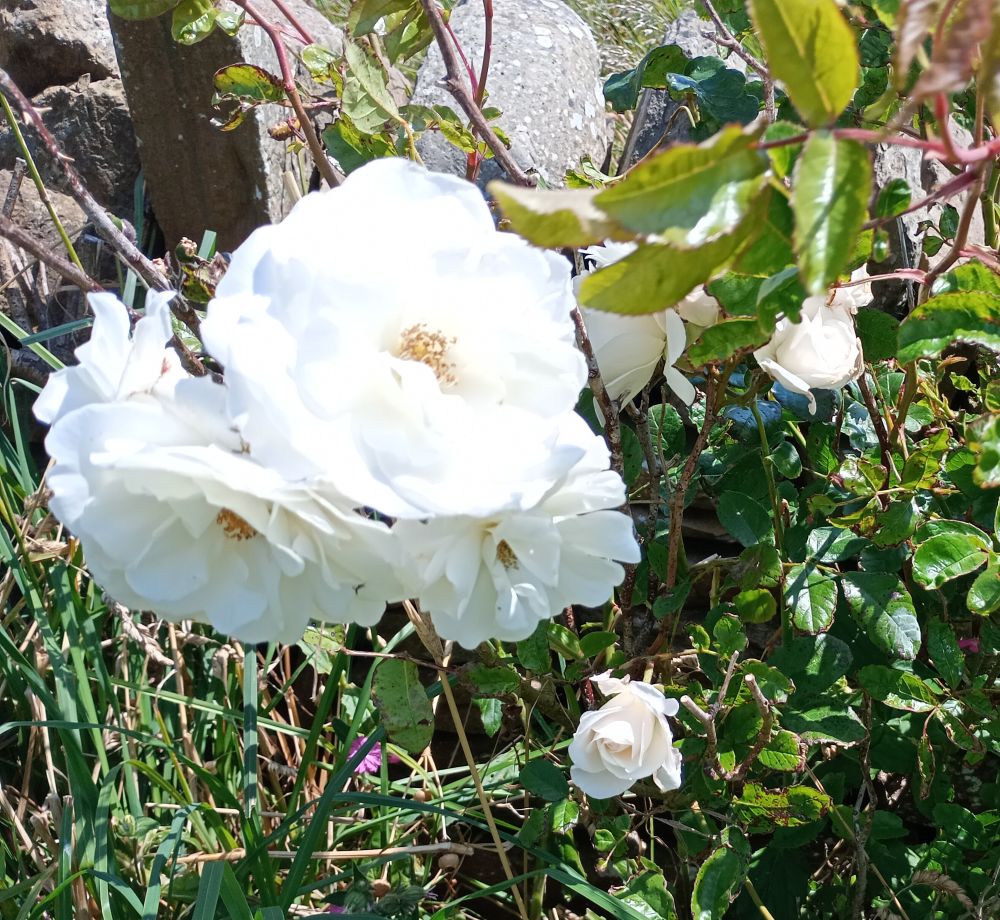

Flowers are not only things of beauty, important feeding stations for pollinators, but have a symbolism attached to them and are markers at special events in our lives.
Flowers are presented as gifts at both ends of the human life span from birth to death and all those important dates in between. Most often they are used to indicate love of one person to another. Brides on their wedding day will carry a bouquet often made up of flowers which have meaning to her. At the end of the marriage ceremony the bride will throw her bouquet into the crowd of well wishers, and it is said that whoever catches it will be the next to marry.

At the end of our lives flowers will be placed with the coffin and for years after loved ones will visit the graves of those they have lost and place fresh flowers where they lie buried.

Through time flowers have had other messages attached to them. In November we commemorate those who have fallen in two world wars, and other conflicts. The red poppy has become a symbol of the appalling loss of life in both world wars. The story of Flanders Field after being churned up by years of war and bloodshed became awash with red poppies springing from the ground. This event was memorialised in the famous poem by John McCrae, ‘In Flanders Fields’.

Today a variety of colours of poppies are worn to mark Remembrance in November: white for Peace; purple for animals; black for Black, African, and Caribbean communities . The different colours were added because it was felt by some that the red poppy had become too much linked to the glorification of war rather than as a mark of remembering lives lost.
There are national flowers which represent how a country sees itself: the thistle in Scotland, the rose of England, the daffodil of Wales. Political movements use flowers.
The Primrose league was founded in 1883 England to promote Conservative values. It was the favourite flower of Benjamin Disraeli and on his death Queen Victoria sent a wreath of yellow primroses with a handwritten note – “His favourite flowers: from Osborne: a tribute of affectionate regard from Queen Victoria”.
In 1986 the Labour Party adopted the red rose as its symbolic flower. In an attempt to distance itself from Labour in England, the Labour Party in Scotland got rid of the red rose and introduced a red and purple thistle.
A thistle may have been the inspiration of the logo of the Scottish National Party. The design has evolved over the decades but is believed to be a combination of the saltire cross of the Scottish flag and the thistle dating back to the 1960s. SNP politicians, however, can often be seen wearing the white rose of Scotland on important occasions such as the opening of the Scottish Parliament. The white rose inspired Hugh MacDiarmid with his poem:
The Little White Rose
By Hugh MacDiarmid
(To John Gawsworth)
The rose of all the world is not for me.
I want for my part
Only the little white rose of Scotland
That smells sharp and sweet—and breaks the heart.

In the late 1960s and 70s a ‘Flower Power’ movement grew in the US and spread far beyond its borders. It used passive resistance and non-violence to promote its opposition to the US war in Vietnam. A whole cultural community expressed their political sentiments in art, clothing, music, and a growth of what became known of as ‘hippies.’
This year, as part of Fair Saturday, The Orkney News, in conjunction with The Northlight Gallery in Stromness, will be hosting an exhibition ‘Say it with Flowers’. There is an Open Call for works in any format ( AI assisted/generated works will not be accepted), on the theme. The organisers are looking forward to seeing how ‘Say it with flowers’ is interpreted. Full details in the poster below.

In Part 2 – what more can flowers say ?
Fiona Grahame

Leave a Reply