
Victorian women of ‘respectable’ middle class households faced numerous restrictions on what they could and could not do. Despite the limitations of what was permitted by a sexually repressed male dominated society, women from wealthier backgrounds found a way to educate and express themselves. For the majority of Victorian women, that’s those from poorer households, they had to work – in factories or in the fields, whilst bearing children, and providing for their families.
This series is exploring the Power of Flowers – and one way middle class women could express both themselves and the world around them was through botanical art. This was seen by society as a respectable pastime.
There had been female botanical artists before the 19th century but it was during the reign of Queen Victoria, with the explosion of interest in collecting plants, botany, and in nature, that drawing and painting specimens became acceptable and known as – Ladies Botany.
Through botanical paintings women were able to study science, and for those who became successful to have payments for their works in illustrating the scientific books which were being published to go with the new plants the collectors were returning with from overseas. There was a growth in interest in gardening and their illustrations were also printed up in magazines.
Augusta Hanna Elizabeth Innes Withers (1792 – 1876) produced illustrations for John Lindley‘s Pomological Magazine. She was appointed “Flower Painter in Ordinary” to Queen Adelaide and later to Queen Victoria. She also produced illustrations for Benjamin Maund‘s Botanis, the Transactions of the Horticultural Society of London, the Illustrated Bouquet (1857-1863) and Curtis’s Botanical Magazine.

Gompholobium splendens, Hemiandra pungens, and Grevillia elegans. Biodiversity Heritage Library,Augusta Innes Withers, Public domain, via Wikimedia Commons
Her drawings are stored at the Natural History Museum, London, at the Royal Horticultural Society, and at the Fitzwilliam Museum of the University of Cambridge.
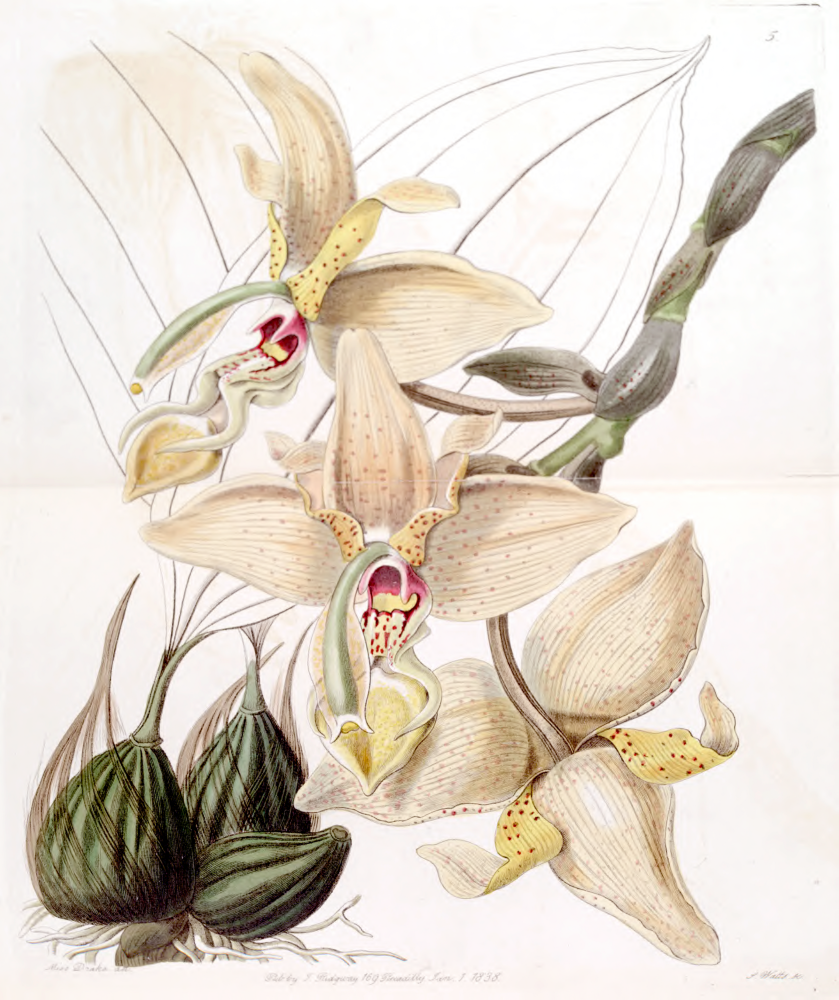
Sara Ann Drake (1803 – 1857) produced over 1000 drawings and paintings.

Drake is perhaps best known for her collaboration with Augusta Innes Withers on the drawings for the monumental Orchidaceae of Mexico and Guatemala by James Bateman. This was elephant folio size (pages about 58 cm (23 inches) long) and issued in parts between 1837 and 1843. She did the drawings for 16 of the 40 drawings while Withers did the others (apart from one by Jane Edwards). – Wikipedia.
Kew Gardens has the Marianne North (1830 – 1890) Gallery with 800 paintings. She didn’t remain closeted at home to create her paintings but travelled the world and her paintings show the plants within their natural landscapes.

Lilian Snelling (1879 – 1972) was described as ‘the greatest botanical artist of her time’ by botanist Dr Henry Noltie. Over 600 of her works are cared for by the RHS (Royal Horticultural Society) Lindley Library.

Rhododendron forrestii, illustrated by Lilian Snelling
No respectable Victorian Lady would be permitted to describe the sexual parts of the Human Body, (or even look at pictures of them) but through botanical art, they could draw and paint in intimate detail the reproductive parts of flowering plants.
Beatrix Potter (1866 – 1943) might mostly be remembered today as the creator of Peter Rabbit and those charming little books for children with her illustrations on every page. Her botanical paintings and drawings are remarkable.

There are many more Women Botanical Painters and Illustrators to find out about and I apologise to all those whom I have left out.
Fiona Grahame



Leave a Reply