
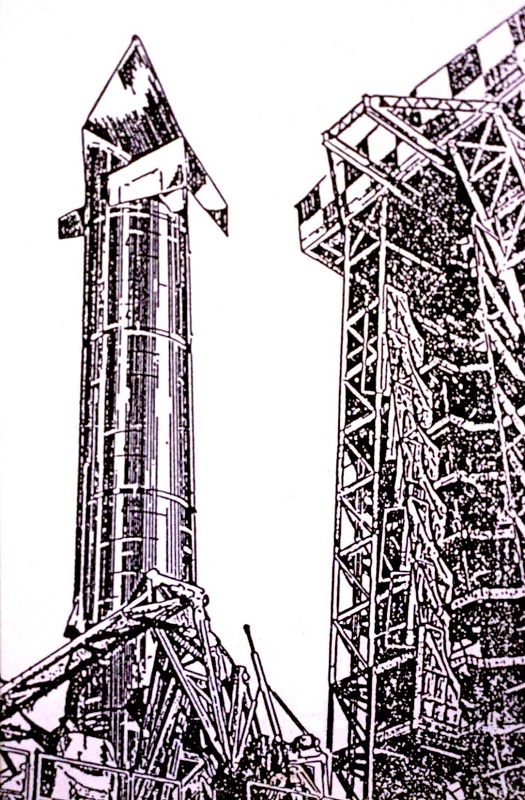
The big news at the outset is the successful launch on Monday January 8th of the first Vulcan booster, propelled by methane and liquid oxygen, with BE-4 main engines supplied by Jeff Bezos’s Blue Origin company. After that breakthrough, which foreshadows the end of the US dependence on launchers derived from Cold War ballistic missiles, should have come the inauguration of another new era, using commercial landers under contract to put multiple payloads on the Moon. But soon after the launch of the Astrobotic Peregrine lunar lander, attitude control failed, and there was a risk that battery power would run out. A temporary fix reoriented the spacecraft to regain solar power, but then it became apparent that an ongoing leak of propellant was fast using up what remained, to keep the vehicle stable. Apparently the problem was caused by a stuck valve which over-pressurised the fuel tank until it burst. All propellant was expected to be lost by Thursday, but by Friday evening it was expected to last another 48 hours, after which Peregrine will tumble uncontrollably. In what might seem a gesture of defiance, but was actually an important practical demonstration, Astrobotic powered up all 10 of the active onboard payloads, including the Open University’s Exospheric Mass Spectrometer, to communicate successfully with the lander, before contact is lost. (Nilima Marshall, ‘UK Technology on Doomed Moon Mission Performing Well, Scientists Say’, Evening Standard, 12th January 2024.)
Britons in Space

In the late 1950s, when the RAF was still making dangerous reconnaissance forays into Soviet airspace with Canberra jet bombers, they wanted to shift such missions into orbit, carrying up to four aircrew. The ‘Pyramid Wing’, designed by Dr. William Hilton, would have been launched by Blue Streak, with the second stage a Black Knight rocket redesigned by Geoffrey Pardoe (Fig. 1, The Aeroplane and Astronautics, 1959). Aerodynamic studies commissioned by Hilton led the late Prof. Terence Nonweiler to inventing the Waverider re-entry vehicle (see ‘Waverider’, ON, 27th November 2022). The British government of the day had no interest in spaceflight, manned or otherwise, and for crewed spaceflight that has remained the case until fairly recently.
However, in the shift to private ventures in the US space programme, one of the major players is Axiom Space of Houston, who are under contract to produce the spacesuits for the Artemis III Moon landing, now scheduled provisionally for September 2026, and who plan to build their own commercial space station, assembling the modules while attached to the International Space Station. Axiom have already launched two private missions to the ISS, using the SpaceX Crew Dragon spacecraft, and a third all-European one is scheduled for January 27th 2024.
Remarkably enough, that raises the possibility of an all-British 4-person Dragon mission to the ISS, perhaps to be commanded by Tim Peake. Some press coverage has treated this as definitely going to happen, but a more thoughtful article in the British Interplanetary Society magazine Spaceflight points out that it may not be so easy (Rob Coppinger, ‘Britannia astra’, February 2024). The difficulty might come not in assembling the prime crew, since there are three more British astronauts in training with the European Space Agency, but in putting together an eligible backup crew – Spaceflight suggests it might have to include Michael Foale, a very experienced astronaut with dual US-UK nationality, who retired from NASA in 2013, and Helen Sharman, on the strength of her ‘Project Juno’ mission to Mir in 1991. Both are long shots in view of their time away from spaceflight – though NASA did re-fly John Glenn on the Space Shuttle in 1998, after 36 years. And, in response to Navaho objections to sending human remains to the Moon, NASA replied that Peregrine was a commercial mission and NASA couldn’t tell them what or what not to carry. (Josh Dinner, ‘ULA’s Vulcan rocket launches private US moon lander, 1st since Apollo, and human remains in debut flight’, Space.com, January 8th 2024), and the same might apply to a British Axiom mission, though NASA might forbid ISS access to any backup astronaut whom it considered to be ineligible.
Prestwick Spaceport Candidates
In ‘Wings into Space’ (ON, December 3rd 2023) and ‘Prestwick Spaceport’s Past – and Future?’ (December 10th), I pointed out that all of the spacecraft portrayed in 2015 Prestwick Spaceport artwork were either out of business, or a very long way in the future. Only Astraius, planning horizontal launches from a C-17 carrier, are still intending to use Prestwick. In May 2023 they signed a deal for aircraft processing with Spirit Aerosystems, Inc., who now own the Palace of Engineering at Prestwick, formerly the home of Scottish Aviation Limited.

There were two other vehicles I might have included, one of which I briefly mentioned in Wings Into Space, above: the Boeing X-37B, a highly secret USAF unmanned lifting body (Fig. 2). Hitherto it has mostly been launched by Atlas V boosters, but its fifth launch was on a SpaceX Falcon 9, and its most recent, on 29th December, was sent into much higher orbit by the SpaceX Falcon Heavy (Fig. 3). That was the seventh launch of Falcon Heavy, and as it happened, the seventh launch of the X-37B. It normally goes into orbit at heights between 150 and 500 miles. Its purpose is said to be development of technologies and materials for long-term space missions; initially it was to remain in orbit for up to 270 days, but on the sixth mission it was in orbit for 908 days, with an aft service module to enable the longer endurance (Fig. 4). All launches to date have been from Kennedy Space Centre, though there have been landings at Edwards and Vandenburg Air Force bases on the west coast, as well as at KSC itself.


Details of the missions online are fairly sketchy, but the first was to an orbital inclination of 39.9 degrees, typical for military reconnaissance operations, the second at 41°.1, the third and fourth at 43°.5, and the fifth was to ‘a higher inclination than previous missions’, 54°.5. Its cross-range capability is less than the Space Shuttle’s, and that was only 600 miles: consequently only the fifth mission could have landed at Prestwick, had any purpose or emergency warranted it. One might almost think that the initial purpose was to check out its suitability, since the X-37B is normally transported around by C-17s, which use Prestwick frequently. The US military does still have a small presence there, if ever the need arises, but the X-37B is not likely to use Prestwick on any regular basis.
The sixth mission was to 44°.6, and the inclination of the seventh isn’t online yet, though it’s in an elliptical orbit, possibly to geosynchronous height, prompting speculation that it might be bound for the Moon (Joey Roulette & Steve Gordon, ‘US Military’s Secretive Spaceplane Launched on Possible Higher-Orbit Mission’, Reuters, December 29th, 2023) – for which it isn’t at all suited. Apart from all other limitations, it would require re-entry at 7 miles per second, where the X-37B is engineered for entry at 5 mps.
(There have been suggestions that the X-37B might deliver payloads to Saturn’s moon Titan, for instance to deliver a submersible into one of its methane or ethane lakes. Leaving aside the changes and additions that would have to be made for the X-37B to remain operational at that distance from the Sun, it does make aerodynamic sense, since Titan’s surface gravity is half Earth’s and atmospheric density is twice Earth’s. So even with its small wings, it would fly much better than it does here. See ‘Saturn and Its Moons, Part 1, ON. 31st October 2021.

The other vehicle which I didn’t mention, because I’d heard nothing about it lately, was the Dream Chaser, built by Sierra Space. Originally it was intended for crew transfers to the ISS, but it lost out to the Crew Dragon and the Boeing CST-100 Starliner, which has yet to fly a crewed mission, though it has been launched twice and reached the ISS once. Both of those are capsules, but the Dream Chaser is a lifting body, for runway landings (Fig. 5). Sierra Space announced that it would continue its development as a cargo vehicle (Fig. 6), and it now has a NASA contract for at least seven cargo deliveries to the ISS (Fig. 7). The cargo version is designated DC-100, Tenacity, and the pressurised cargo module, ‘Shooting Star’, can remove discarded material and waste from the ISS to be jettisoned before re-entry, as the Russian Progress module does at present. That’s a useful capability, because now that the Shuttle is no longer available to clear out the ISS, it’s becoming cluttered, as Mir was before it. The second Dream Chaser under construction is to be called Reverence, which inevitably recalls the verger of Dad’s Army: “His Reverence won’t like that, Captain Mainwaring. He won’t like that at all.”


But an even more useful capability is the runway landing. The DC-100, and a crewed DC-200 in preparation, will come back at maximum loadings of 1.5 g (Anon, ‘Tenacity’s Next Challenge’, Spaceflight, February 2024), gentler than Crew Dragon’s water landings and much gentler than the land touchdowns of Soyuz. To bring back delicate experiments and products, to say nothing of astronauts after months of zero-g, that will be very useful indeed. And some of those experiments and astronauts will be European – Dream Chaser was originally intended to launch on Ariane V as well as Atlas V – which makes it highly relevant that Sierra Space has had a landing agreement with Spaceport Cornwall since June 2021, and the Prestwick Spaceport already has an arrangement for cooperation with the proposed spaceport at Houston, Texas, home of the Johnson Space Center. If Dream Chaser’s cross-range capability is no worse than the Space Shuttle’s, it will be able to reach Prestwick from the ISS.
Major New Possibility

I had heard, vaguely, that the new European vehicle Vega had been used on its second flight, on 11th February 2015 but originally scheduled for 2014, to launch an experimental re-entry payload called IXV (Intermediate eXperimental vehicle, Fig. 8), which some people speculated was a garbled version of the Latin for ‘14’. I assumed from the lack of publicity that it was part of ESA’s ongoing low-key studies of reusable and re-entry technologies, which have thrown up various designs in the past such as Mistral, Bumerang and Sänger, the latter named after the designer of the ‘Silver Bird’ antipodean ‘skip bomber’ proposed in World War 2. All of those would be horizontally launched two-stage winged or lifting body orbiters, but they featured along with flyback boosters for Ariane in FESTIP (Future European Space Transportation Investigations Programme), often derided by its critics as a series of ‘paper planes’, none of which would ever fly. An early example which did fly was the ARD (Advanced Reentry Demonstrator), a 70% scale model of the Apollo capsule which flew on the third launch of Ariane V in 1998 and successfully tested new heat shield technology (Fig. 9).


After all this time, ARD has turned out to be the direct ancestor of the IXV (Intermediate eXperimental Vehicle) which was launched in February 2015 on Vega (Fig. 10), on a suborbital mission, with complete success. IXV turns out to have been the research vehicle for VERTEX (Fig. 10) or VERTA (Vega Research and Technology Accompaniment, Fig.11), rising to 420 km. (Fig. 12) and returning to Earth (Figs. 13 & 14). IXV turns out to be the prototype for an uncrewed lifting body called Space Rider (Fig. 15), to be launched on the more powerful Vega-C which is about to enter service. (Ironically, it has the name which the Daily Express originally gave to Sydney Jordan’s ‘Jeff Hawke’ strip – see ‘Jeff Hawke Part 1: Space Rider’, ON, October 8th 2023.) Space Rider is being described as ‘a civilian X-37B’, which will go into near-polar orbit for up to two months, with a detachable service module (Fig.16), for satellite launches (Fig. 17) and for scientific and materials technology experiments.


On return, instead of a runway landing like Dream Chaser, Space Rider will return by parafoil (Fig. 18), like Gordon Ross’s proposed Waverider space ambulance (see ‘Waverider’, above). The parafoil technique was originally proposed for the X-38 ISS crew escape vehicle, to which Europe had a 40% contribution, and which was unilaterally terminated by the USA at the stage of successful drop tests (Fig. 19), to great anger in Europe and near-withdrawal from the ISS programme. For return of casualties to Earth, Gordon has since come round to thinking that runway landing would be preferable, for the same reasons as for the Dream Chaser’s – and that opens up still more possibilities.


While still in the dark about IXV and Space Rider, I came across proposals for a similarly shaped escape capsule, ‘HYPMOCES’ (Hypersonic Morphing for a Cabin Escape System, Fig. 20) for a vehicle called ‘Spaceliner’. Although it wasn’t identified as such, the only ‘Spaceliner’ I’ve come across was still another FESTIP study, by the German DLR space agency, for a suborbital rocket airliner (Fig. 21). Such an escape system was portrayed by William Golding in his classic novel Lord of the Flies, but it’s never been adopted for any commercial airliner. The weight penalty and consequent loss of payload would be immense: when a similar system was proposed for the ESA Hermes spaceplane, after the loss of the Space Shuttle Challenger, the payload was so reduced that Roy Gibson, the former Director-General of ESA, called it ‘a taxi for two men and a ham sandwich’ – hence the decisions to remove the free-flying capability of Europe’s Columbus module, attaching it to the ISS, and cancelling Hermes altogether.

The 12 portholes on the side of HYPMOCES (Fig. 22) imply 24 occupants, about a quarter the carrying capacity of Elon Musk’s Starship, and given its similarity to Space Rider, my thought would be to do the opposite to the Hermes decisions – cancel the winged vehicle and keep the lifting body., sending it into orbit. It would still need a very big booster, and coincidentally or not, the February issue of Spaceflight describes European studies of just such a rocket, to be developed from Ariane 6 (Anon, ‘Europe’s Starship’, pages 42-43). Spaceliner would launch vertically and the assumption was that it would be winged for flyback (Fig. 23). SpaceX now routinely brings back its Falcon 9 first stages on rocket thrust alone, and the Superheavy booster for Starship is intended to do the same – the second launch began the manoeuvre, but it had to be terminated due to damage by the Starship exhaust. The same February issue of Spaceflight features ESA’s plans to develop the technology, starting with an experimental flyback second stage for Ariane 6 called Themis (Anon, ‘Themis Leg Test’, page 4).

If a later version of the Space Rider does have undercarriage for runway landings, and especially if a larger crewed version is developed, for near-polar missions it will need high-latitude landing sites, if only for emergencies – but once the capability exists, some entrepreneur may well find a use for it, and all being well, the Prestwick Spaceport will be ready and waiting.
STOP PRESS

Three months after the OSIRIS-REx spacecraft returned its sample capsule from the asteroid Bennu, it has finally been opened. Two screws on the container lid were found to be stuck (Fig. 24 – possibly because it was full to overflowing?), and a special tool had to be designed and manufactured to prize them open within the sterile environment where the capsule has been stored (Fig. 25). Even the overflow found when the outer shell was opened proved to be more than the 60 gram target for the mission (Fig. 26), and fragments have already been distributed around the world for study, as well as one placed in the Smithsonian Museum (Fig. 27). Access to the full sample has been eagerly awaited.


Duncan Lunan’s latest books are available from the publishers or through Amazon, and details are on his website, www.duncanlunan.com.



Leave a Reply