
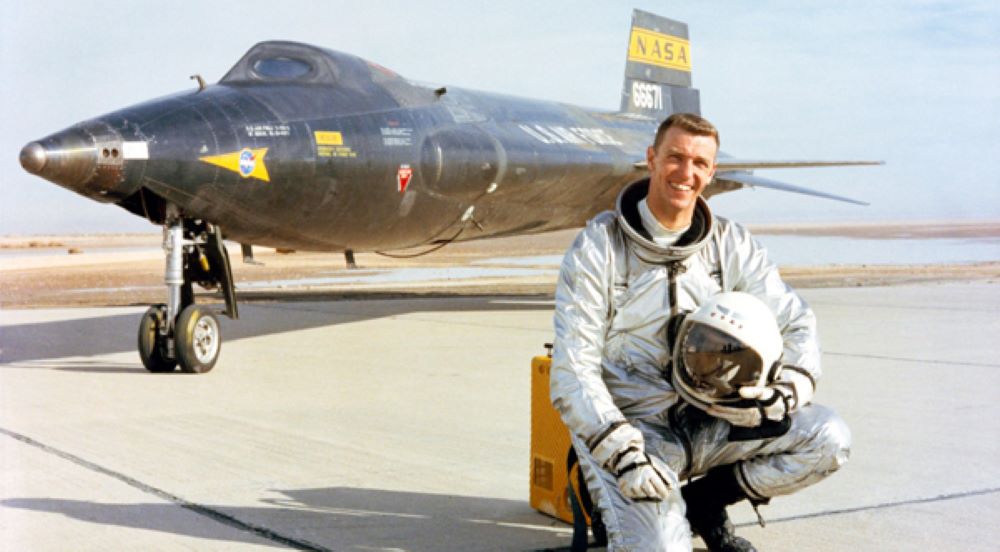

Joe Engle, who flew the X-15 (Fig. 1), was the scheduled commander for Apollo 17, would have commanded Apollo 18 but for its cancellation (Fig. 2), and afterwards commanded the second and 20th Space Shuttle missions (Fig. 3), died on July 10th.


He was the only X-15 pilot whom I met, apart from Scott Crossfield, the test pilot for the rocket aircraft’s development (see review, ‘Paul Beaver, Winkle, The Extraordinary Life of Britain’s Greatest Pilot’, ON, 6th August 2023). He was replaced on Apollo 17 by Harrison Schmidt, the only scientist-astronaut to go to the Moon, of whom he said, “I think I could have picked up rocks just as well as Jack did”. His STS-2 mission was the first to deploy the Shuttle’s Canadian remote arm, and on the 20th (STS-51i, by the confusing nomenclature then in use), it was used to launch several communications satellites, as well as retrieving and hotwiring the Leasat payload which was stranded in orbit on a previous mission.
On July 20th Axiom Space confirmed that the proposed all-British space mission will take place on a Crew Dragon capsule, despite the current grounding of its Falcon 9 booster (see below). It will be commanded by Major Tim Peake, coming out of retirement, for launch in late 2025 or early 2026. The other three astronauts may be those selected for flight training by the European Space Agency in 2023: British Paralympian John McFall, the world’s first disabled astronaut, astronomer Rosemary Coogan, and Meganne Christian, an industrial chemist. The news report (Sarah Knapton, ‘Tim Peake to Command Britain’s First Independent Space Mission’, The Telegraph, 23rd July 2024) did not go into the question previously raised by the British Interplanetary Society magazine Spaceflight ((Rob Coppinger, ‘Britannia astra’, February 2024), and repeated here in ‘Update on Spaceflight’, ON, January 14th 2024. Finding a prime crew of four British astronauts is easy enough, but who will be the backups? Before Helen Sharman’s mission to the Mir space station in 1991, three backups were appointed to train with her in case of problems. I met them all at the UK Space School run by Prof. Heinz Wolff in Uxbridge in 1990, and I invited the backup backups, Clive Smith and Gordon Brooks, to lecture at the Dome of Discovery during Glasgow’s year as European City of Culture. The visit had to be curtailed because both were serving military officers, and one or other of them had to be recalled due to the invasion of Kuwait. Rob Coppinger suggested that both Helen Sharman and Michael Foale might have to be recalled for the Axiom mission backups, and even then, NASA might forbid them access to the International Space Station if it considered them to be insufficiently trained for it.


On July 11th the upper stage of a Falcon 9 booster exploded two hours after launch from Vandenburg Air Force Base in California (Figs. 4 & 5). The ‘Rapid Unexpected Disassembly’, to quote Elon Musk, occurred after the scheduled reignition of the second stage, to put its cargo of 20 Starlink satellites into orbit, after a shortage of liquid oxygen was detected and suggesting a leak (since confirmed, Fig. 6), from a ruptured oxidiser line.

Such breaks in fuel or oxidiser supply were not uncommon in the early days of rocketry, and in Martin Caidin’s Worlds in Space (1954), the artist Fred L. Wolff depicted a crewed upper stage breaking free from a booster in similar trouble. The failure occurred after more than 300 successful launches of Falcon 9, and was the 354th in seven years. The previous failures were a pad explosion on September 1st, 2016, and a second stage explosion in June 2015, which was due to industrial sabotage. This time the satellites were released, but in too low an orbit, and rapidly re-entered the atmosphere.
The Federal Aviation Authority grounded the Falcon 9 and ordered an investigation, which would have happened in any case. After the 2016 episode the FAA cleared Falcon-9 to resume flights after four months, so it was hoped this delay would be no more severe. Groundings are never at a convenient time, and this one came before the scheduled launch on July 31st of the Polaris Dawn mission, to test Crew Dragon’s capabilities and new technologies for advanced missions, including the proposed refurbishment of the Hubble Space Telescope (see ‘How Long for Hubble’, ON, 12th May 2024), and also before the launch in August of Mission 71 to the ISS (Fig. 7 – NASA’s Crew-9), both of which had to be postponed. Ironically that generated extra time for tests on the Boeing Starliner, because it’s docked to the forward port of the Harmony module and that will probably be needed for the Crew 9 mission.

In ‘Space Notes – June 2024’ I compared the helium leak on the Boeing Starship to the failure of a 1-penny washer which doomed my vintage Wolseley 15/50, back in 1970. I didn’t give full details, but the washer was on a long screw which held a plate to the side of the engine block. In hot climates, the plate was to be removed and replaced with an extra air cooler, which wasn’t required in the UK. The brakes on Concorde were a more tragic, comparable instance: they were never used, because the pilots could control the aircraft on the ground without them. But the piece of metal thrown from the runway which ruptured the port wing fuel tank also shorted out the brakes, and the sparks ignited the escaping fuel, which melted the control linkages. But for that, the French pilots might have made the emergency runway they were making for. In the subsequent modifications, the brakes were removed altogether, the tanks were made self-sealing and the wing underside was lined with Kevlar. But the UK had closed its maintenance facilities to save money, and when the French closed theirs there was no choice but to ground the aircraft, though they were only half-way through their operational lives.

The Falcon 9 hairline fracture was on an oxygen line to a pressure sensor which wasn’t required for uncrewed launches, and to get past the FAA grounding, SpaceX undertook to remove it from all future uncrewed launches, so a launch of Starlink satellites was immediately rescheduled for July 27th and went ahead without incident (Fig. 8). Intensive work to clear it for crewed launches is under way, with the launch of Crew 9 now provisionally set for August 18th, and the high-altitude Polaris Dawn mission with the first private spacewalk now postponed to the second half of the month. Both of these are likely to splash down off the West coast, because SpaceX is responding to concern about the ‘trunk’ sections of the Dragon spacecraft. These are discarded before re-entry, and weren’t expected to reach the Earth’s surface, but pieces have been landing all over the world. SpaceX intends to de-orbit them purposefully from now on, into the Pacific, but it will require moving their recovery ships to the West coast.
Clearing the Falcon 9s for flight also allows resumption of Cygnus cargo flights to the ISS. The next Cygnus payload was due to be be launched by Falcon-9 in August, so a longer grounding would have left the ISS temporarily back to dependence on Russia’s Progress ferry for supplies. An August launch may be in time to bring Butch Wilmore and Suni Williams their personal preference kits, which had to be pulled off the Starliner to make room for urgently needed replacement parts for the ISS toilet. They’ve been having to use standard supplies from the ISS store rather than their personal choices, and Sod’s Law being what it is, those will probably arrive just before or just after NASA decides to bring them back. It would be even more ironic if they’re finally delivered after the Starliner crew has gone.

Meanwhile the next SpaceX Superheavy Booster (B12) had a static firing on July 15th, and the Starship upper stage already had a static firing on June 26th (Fig. 9). The Superheavy has been moved to the launch pad, waiting for FAA clearance of the next Superheavy/Starship combination, now simply called ‘Ship 5’. A prediction by Elon Musk in early July that the launch would take place ‘in four weeks’ ran out on August 2nd, but current indications are that the launch may be in late August or early September.

SpaceX has also announced details of the modified Cargo Dragon capsule it will use for its contract to deorbit the ISS in 2030, the major difference being the addition of extra thrusters, making 72 in all, plus enlarged solar panels (Fig. 10). The artist’s impression on Universe Today shows it docked to Japan’s Kibo module for the deorbit, so supposedly that has not been removed beforehand as I suggested in ‘Space Notes – July 2024’ (ON, 7th July), but I still think it might well be.
Back in the early 2000s, there was a lot of concern about the asteroid Apophis, named after the Stargate villain, which will make a close flyby of the Earth on April 13th, 2029. At first there was estimated to be a serious chance of collision, and many studies of asteroid deflection at the time chose Apophis as the target. I was often asked why the discussions which led to my book Incoming Asteroid! What Could We Do About It? (Springer, 2013) didn’t focus on Apophis, and the reply was (a) that the Apophis impact was still only a possibility, and our project needed a certainty to focus the attention of governments; (b) that Apophis wasn’t discovered until our project had been running for 18 months, and we had already created our ‘designer hazard’, a ‘Goldilocks asteroid’ which was neither too hard to reach or too hard to deflect, but would provide a major technical challenge that we could make a book out of; (c) even preliminary observations indicated that Apophis was about a third the size of Goldilocks, a ‘nation-buster’ rather than a ‘continent buster’, and not likely to raise enough concern from nations that weren’t directly in its path (Fig. 11).

Still, Apophis will pass at less than 20,000 miles, within the ‘comsat ring’ of geosynchronous communications satellites, close enough to be visible to the naked eye. After the successful return of samples from the asteroid Bennu to Earth, NASA has redirected its OSIRIS-REx spacecraft to rendezvous with Apophis about a month after the flyby. ESA has now decided to make a rendezvous in February 2029, before the event, with a new spacecraft called RAMSES (Rapid Apophis Mission to Ensure Safety – Fig. 12), given that Apophis will make more close passes in 2036 and 2068. Commendably, the project has been given priority to achieve launch in April 2028, although the final decision will not be taken until a Ministerial Council Meeting in November 2025. Given the success of NASA’s DART asteroid impact in 2022, and ESA’s follow-up launch of the HERA mission this October (Fig. 13), to assess the effects at first hand (Fig. 14 – the target Dimorphos may have been resurfaced by the impact), it’s to be hoped that the Council of Ministers will keep up the momentum.


In the August ‘Sky Above You’ (ON, 1st August 2024) I’ve covered the plans for the Intuitive Machines’ IM-2 and IM-3 lunar missions, which will be attempting again to use NASA’s PRIME rock and ice drill, as well as deploying a free-flying rover to the shadowed Marsden crater near the south pole of the Moon, and attempting in 2026 to land a NASA rover at the Reiner Gamma ‘swirl’, which has been a mystery since the Lunar Orbiter missions of the mid-60s. Another second attempt, scheduled for later 2024, will be with Japan’s iSpace commercial Hakuto-R lander, the first of which crashed in the northern Mare Frigoris in May 2023 when its landing radar was confused by a crater. The second Hakuto-R, ‘Resilience’ will be carrying a miniature rover called ‘Tenacious’ for the European Space Agency (Fig. 15 & Fig 16), and the third in 2026, under contract to NASA, will deploy communication satellites for future mission in lunar orbit, and attempt to deliver a NASA lander to the tempting but difficult vicinity of the lunar south pole.

That’s about the time that NASA intends to accomplish the first human landing on the Moon since 1972, with the third mission of its Artemis booster and Orion spacecraft. The core booster for the second Artemis mission, which will send humans into lunar orbit for first time since then, has been delivered to the Vehicle Assembly Building at Kennedy Space Centre (Fig. 17), but will not fly till 2025 at the earliest. Artemis-3 will also be making for the lunar south pole, which makes me wonder whimsically how close to the third Hakuto-R it will be. When Apollo 12 landed 535 feet from the Surveyor III lander in 1969 (Fig. 18) and returned pieces of it to Earth, the lander was found to have suffered more from flying dust during the Apollo landing than it had from micrometeoroids in its time on the Moon since April 1967. Researchers in Switzerland have suggested the possibility of a robot which would build a wall around lunar surface installations to protect them from subsequent nearby landings (Fig. 19; Andy Tomaswick, ‘Lunar Infrastructure Could Be Protected By Autonomously Building A Rock Wall’, Universe Today, online, July 19th 2024).


Less good news is that because of the failure of the Peregrine lander in January, the delay of the follow-on Astrobotic Griffin lander to September 2025 has caused the budget to run out for NASA’s VIPER (Volatiles Investigating Polar Exploration Rover), which was to have spent 100 days or more exploring the south polar region. The science teams involved are understandably distressed, but there’s no help for it: although VIPER is complete and packaged ready to go (Fig. 20), there is no room in NASA’s inflexible budget to keep it waiting any longer.

NASA has offered the complete vehicle for sale to any interested buyer, otherwise the components will be sold off separately. Given the threat to the Chandra x-ray telescope, critics are predicting that this is the start of cancellations to the science budget in order to meet the growing costs of the crewed lunar programme, as happened before with Project Apollo and the Space Shuttle. At the same time as announcing the premature shutdown of Chandra, with a potential 10 years of life still ahead of it, NASA has released a celebratory set of the best images from its first 25 years (Fig. 21). (Sharmila Kuthunur, ‘Happy 25th anniversary, Chandra! NASA celebrates with 25 breathtaking images from flagship X-ray observatory’, Space.com, online, July 23rd, 2024.) A clearer example of the left hand not knowing what the right hand is doing would be hard to find. Over 700 astronomers who have formed the “Save Chandra” coalition continue to urge NASA to reconsider the decision, with the backing of the Smithsonian Institution.


After the threats to VIPER and Chandra, there’s better news from the Gaia space telescope, which was struck in April by a meteoroid ‘at just the wrong angle’ (Fig. 22), cracking the shield over its sensors. In May, the software which eliminates false detections from those sensors also failed, possibly due to the major solar storm between May 10th and 12th which generated worldwide auroral displays. The combined problems allowed thousands of spurious results through. ESA engineers have reprogrammed it to eliminate those, and for now Gaia is continuing its task of mapping the stars in the Milky Way. Gaia was originally planned for a 6-year lifetime and has already served for 10 years, out at the Sun-Earth L2 point along with the James Webb Space Telescope, but it’s expected to run out of fuel for attitude control around the end of 2025.
STOP PRESS. The Falcon 9 launch of the NG-21 Cygnus cargo spacecraft is scheduled for Sunday, August 4th, at 16.02 BST, and can be watched live on Space.com




Leave a Reply