
To everyone’s surprise, although it wasn’t impossible, Japan’s SLIM lander survived the lunar night, though it wasn’t insulated to do so. Just after Full Moon on February 24th, the spacecraft responded to a command from Earth, and as it was then at high temperature with the Sun overhead, it was promptly powered down again in hopes of reactivation when it cooled down.

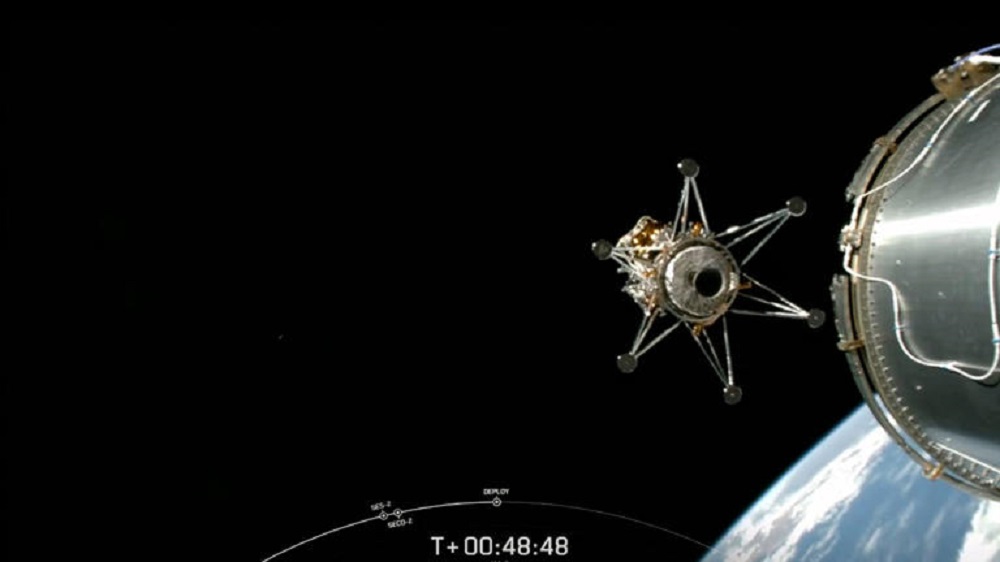
The next attempt at a commercial US Moon landing, IM-1, aka Nova-C and Odysseus (‘Odie’), was launched successfully on a SpaceX Falcon 9 booster on February 15th (Fig. 1). After launch, it sent back sharp images of the receding Earth (Fig. 2), and entered 60-mile lunar orbit on February 21st, at the same height used by the Apollo spacecraft after releasing the Lunar Modules for landing. Its target was the crater Malapert-A, 180 miles from the lunar south pole, on February 22nd.

Although everyone was talking about ‘a complete success’, there was a worrying lack of confirmation for any signals except a faint one from the high-gain antenna, and as of Saturday 24th, it seemed that the lander is lying on a rock, having caught a foot while landing at a horizontal velocity of two miles per hour (Fig. 3). By February 26th, imagery from Lunar Reconnaissance Orbiter had confirmed the situation (Fig. 4). I must admit, comparing the 14-feet high vehicle with others in its class, that seemed a likely problem to me (Fig. 5).


Wernher von Braun’s original proposal for Project Apollo had to been to land the entire Command and Service Module on the Moon, after launching it with the Nova booster, even larger than Saturn V, but it was felt that even that would be unstable (see review, “Seven Stars, Ancient Astronomy and the English Public House”, ON, 3rd September 2023. The alternative proposal to land horizontally would have risked standing the vehicle on its nose, as SLIM did due to a last-minute engine problem,) Sorting out the sequence of images as they’ve been released has been difficult, because photos taken during the descent have repeatedly been described as ‘from the surface’, but a last two released on 29th February, before power failed, definitively show the lander on its side with one leg broken (Figs. 6 & 7). Whether it too will come back after lunar night remains to be seen,


There was a similar scare during the Apollo 11 Moon landing, when Neil Armstrong found that the computer was bringing him down in a crater filled with boulders, and took over manual control to land it helicopter-fashion further on, with no time to explain to Mission Control what he was doing. The late John Braithwaite and I both noticed the rise in horizontal velocity and were seriously concerned that the Lunar Module might land that way and tip over. This time, Apollo history was to be repeated in another way. During the descent of the Apollo 14 Lunar Module to the surface, the landing radar refused to turn on until near the point where the astronauts should have aborted the landing. Alan Shepard was flying it by eyeball and dead reckoning, and after the successful touchdown, Edgar Mitchell asked what he would have done if the radar hadn’t begun to work. “You’ll never know,” was the reply. Odysseus was using laser altimeters instead of radar, and before descent, they too failed to operate. But NASA had a second experimental system onboard, under test, and with a quick software patch sent up from Earth (just like that), it was connected to the onboard computer and brought Odysseus down, though not safely, as it turns out.


The lunar capture manoeuvre was the first methane-propellant burn in space, also used for the landing. Arthur C. Clarke had recommended using methane instead of liquid hydrogen in the first edition of his Interplanetary Flight (Fig. 8), in 1951, and the Saturn mission described in his novel The Sands of Mars, the same year (Fig. 9), refuels from the atmosphere of Titan, which was thought to be methane after its discovery by Kuiper in 1948. The Odysseus system was developed from Project Morpheus, an experimental NASA programme in 2010-14 for possible use on Mars, manufacturing propellant from the Martian atmosphere. Methane is the main propellant for the United Launch Alliance’s new Vulcan launcher, first fired in January, and will be for will be Blue Origin’s New Glenn launcher, which has just been stacked for the first time (Fig. 10).

In the immediate aftermath of the landing, as Intuitive Machines was trying to re-establish contact with Odysseus, there was a moment of nostalgia when it was announced that ‘Goonhilly’ in the UK was taking part in the search. Goonhilly Downs was the receiving site for the first transatlantic TV signals broadcast to the UK via Telstar, in 1962 (Fig. 11), and the search for them was satirised by David Frost on That Was the Week That Was, for repeatedly going back to “And there’s Captain Booth, and there’s the vast dish”. The ‘vast dish’ was named ‘Arthur’ (Fig. 12) in honour of Arthur C. Clarke, who first suggested satellite communications in 1945, and the site is increasingly used for deep space communications as well as commercial satellite links. Mixing mythology with fact, later antennae have been named ‘Merlin’ and ‘Guinevere’.


In May 2024 China plans to launch its Chang’e-6 mission, to retrieve samples from the Farside of the Moon. The mission is planned to last 53 days and collect up to 4.4 pounds (2 kilograms) of lunar materials, from a site around 43 degrees south latitude and 154 degrees west longitude, in the south of the Apollo basin, part of the huge South Pole-Aitken (SPA) basin (see ‘The Lunar Farside’, ON, April 18th 2023). The double-ringed Apollo impact feature had been considered as an alternative landing site for Chang’e-4 and its Yutu-2 rover (Fig. 13). A new communication satellite, Queqiao 2, will be positioned to relay signals to Earth, from L2 Halo orbit, first suggested by Robert Farquhar in the 1960s for an Apollo mission to the lunar Farside (‘The Control and Use of Libration-Point Satellites’, NASA TR-R-346, US Govt. Printing Office, September 1970). Its predecessor, Queqiao 1, has done the same for Yutu-2 since 2018 (Fig. 14).


Chang’e-7 is planned for 2026, and Chang’e-8 in 2028 is to be a precursor for a crewed lunar base, carrying biosphere and materials processing experiments (Fig. 15; Andrew Jones, ‘China to launch 1st-ever sample return mission to moon’s far side in 2024’, Space.com, May 3rd 2023, Anon, ‘China’s Chang’e-8 Mission Will Try to Make Bricks on the Moon’, Universe Today, online, February 17th 2024).


The Perseverance rover in Jezero crater has sent back its last image of the Ingenuity Mars helicopter. It’s sitting on a sand dune (Fig. 16), in a field of them imaged on the 70th flight (Fig. 17), and it’s thought that difficulty in plotting them led to the hard landing on the 72nd flight in which at least two rotor blades were damaged. At some distance to the left of it in the ‘Valinor Hills (quoting Tolkien, Fig. 18) lies a piece broken off one of the rotor blades, making more stable flights impossible (Fig. 19). Although the Curiosity rover previously scaled one of the mysterious black dune fields which dot the Martian landscape, in 2015, the general rule is to steer clear of them since the Spirit rover became bogged down in soft sand in 2010. Ingenuity and the fragment are definitely inaccessible.


For notes about the returned samples from asteroid Bennu, new volcanic peaks on Io, and subsurface oceans on Mimas, Eris and Makemake, see ‘The Sky Above You, March 2024’, ON.

45 years after launch, Voyager 1 is now in difficulties beyond the edge of the Solar Wind, in interstellar space (Fig. 20). It’s now so far away that a signal exchange with Earth takes 45 hours, impeding diagnosis of the memory fault which is causing its Flight Data System to return meaningless information. (Its backup stopped working in 1981, after the probe’s Saturn flyby in 1980 – the last time it passed near anything larger than a grain of dust.) JPL is still in contact with it, and they’re working on the problem. But it has to be said that Voyager’s onboard radioactive power source is fading, and one by one its instruments are having to be turned off. Even if it comes back from the current crisis, Voyager 1 and Voyager 2 will both have to be turned off around 2030 when they can no longer return data. That might seem extreme, but even now the Voyagers are the most powerful radio sources in their immediate region of sky, and turning them off will make it easier to study objects far beyond.

I’ve had occasion more than once to mention my friend Gerry Nordley’s novella ‘Empress of Starlight’ (G. David Nordley, Analog, Nov/Dec 2018 (Fig. 21), reprinted in Around Alien Stars, Brief Candle Press, 2019; see ‘’Oumuamua Part 1’, ON, 17th December 2023.’, and ‘Unbuild Your own Solar System’, ON, 13th August 2023). The start point of the story is that stars are disappearing, for no known reason. When I was researching Children from the Sky (Mutus Liber, 2012), I tried to look up the characteristics of the star 58 Virginis, and found to my surprise that it was missing not only from Norton’s Star Atlas but from the Atlas Coeli, and every other atlas and catalogue in my collection. It was amazing to find how casually a star could disappear from the record, and the late Prof. Archie Roy said I had given him an idea for a new thriller. My friend Ian Ridpath got the answers for me from the Royal Greenwich Observatory, and there’s nothing particularly odd about the star, so its ‘disappearance’ remains unexplained. But in Gerry Nordley’s story something more sinister is going on: the weaponization of stars, turning them into Dyson Spheres capable of huge destruction even at interstellar distances (Fig. 22). The motivation for doing this is not apparent: it could be a robotic programme whose creators are gone, or it could be even more sinister than Arthur C. Clarke’s comment about the frequency of novae in Aquila, ‘Is the front line moving in our direction?’ (see ‘Humour in Science’, ON, 31st December 2023).

What seemed a harmless if startling speculation has suddenly taken a new twist in the March 2024 issue of Astronomy Now (Keith Cooper, editorial, ‘The Vanishing Stars’, article, ‘Disappearing Act, the Mystery of the Vanishing Stars’, pp. 32-35, summarising a presentation by Dr. Beatrix Villarroel of the Nordic Institute for Theoretical Physics in Stockholm, at this year’s European Astrofest in London. Dr. Villarroel heads the VASCO project (Vanishing and Appearing Sources during a Century of Observation), which compares photographs taken in the 1950s by the US Naval Observatory and the Palomar Sky Survey (Fig. 23). The latter was covered by the National Geographic Magazine in two articles, Albert G. Wilson, ‘Our Universe Unfolds New Wonders’, February 1952, and Ira Sprague Bowen, ‘Completing the Atlas of the Universe’, August 1955 (Fig. 24).


The VASCO team have been comparing those images with more recent ones of the same areas of sky. Initially they were looking for previously unnoticed events such as exploding stars, particularly supernovae in distant galaxies, which could refine the scale of the Universe and the speed of its expansion. But as G. K. Chesterton’s ‘Father Brown’ said, disappearances are far more interesting than apparitions: ‘after all, the family ghost is only keeping up appearances’. (‘The Blast of the Book’, first published in The Scandal of Father Brown, 1935.) A 2016 pilot study found a clear case of an object photographed by the US Naval survey, which was simply not there in later surveys, nor in fresh images taken by Tiede Observatory on Tenerife, and the Nordic Optical Telescope on La Palma. All categories of possible short-lived astronomical object were eliminated (Keith Cooper’s article works systematically through them). Esoteric explanations, like individual radioactive atoms from nuclear fallout happening to land on the plates before development, were ruled out, likewise more prosaic instrument errors and photographic faults – the starlike object had just vanished.
An expanded VASCO project was set up, matching the USNO plates with the first all-sky survey completed by the Panoramic Survey Telescope and Rapid Response System (Pan-STARRS) on Hawaii. Starting with 1 billion objects in the USNO survey, they made an initial selection of 600,000, narrowing the possible disappearances to 150,000, then eliminating the possible alternative causes above, and ended up with 100 apparently unshakeable cases of vanishing stars. If the percentages for the entire USNO survey are similar, there would be 700 disappearances in all with no known explanations.

Some of the instances are truly bizarre. A plate exposed by the Palomar Sky Survey shows no fewer than nine objects which were not there either half an hour earlier, nor six days later. A similar incident occurred with three stars on July 19th, 1952 (Fig. 25; Brian Koberlein, ‘In 1952, a group of three ‘stars’ vanished—astronomers still can’t find them’, Universe Today, online, October 25th, 2023.) If they were the results of collisions in the Kuiper Belt, it’s very hard to suggest that 100 or more occurred between 1950 and 1952, with no more since. The only other explanation anyone has come up with is bright reflecting objects in geosynchronous orbit. Objects in any other orbit, or in interplanetary space, would have left trails during the exposure. My friend Mark Runnacles, formerly of the Daily Record, got a similar result by chance on his first time exposure of stars near Procyon, capturing no less than four ‘geosats’ with his large Celestron telescope – but the nine objects above were imaged on 12th April 1950, more than seven years before Sputnik I and eleven years exactly before Yuri Gagarin flew into space, 15 years before the first satellites in geosynchronous orbit.
All of the 100 incidents occurred in the northern hemisphere, or the part of the southern hemisphere reachable by the two surveys – 24 degrees in the case of Mt. Palomar, extending to 30 degrees in some areas. If the phenomenon is general then extending the search to the far southern sky could be helpful and here I may have a suggestion. By 1970 it was known that there had to be some form of ‘missing mass’, around the Milky Way and other galaxies, because the stars in the outer parts of the spiral arms were orbiting too rapidly to be explained by the collective gravity of the stars which could be seen. One attempted explanation centred around MACHOS (Massive Compact Halo Objects, a ring of stray planets surrounding the galaxy). The ROE built a scanner called GALAXY to search a century worth of plates for evidence of MACHOS in the halos of other galaxies (Fig.26; Michael Latham, ed., Raymond Baxter and James Burke, Tomorrow’s World, BBC, 1970.)

The survey turned up many events such as exploding stars which had previously been missed, but not the multiple occultations which would be caused by huge numbers of stray planets. Coverage to extend the Palomar Survey southward was undertaken by the UK Schmidt Telescope in Australia, working with the European Southern Observatory in Chile, and GALAXY was upgraded to COSMOS and then SuperCOSMOS, now under the University of Edinburgh, which also holds the Plate Library. Linking their resources to the VASCO survey could extend the latter’s coverage significantly, both in latitude and in time.
Another point worth pursuing is that there was no infrared astronomy in 1950-1952. If the vanishing stars are being ‘Dysonized’ in the manner of Gerry Nordley’s ‘Empress of Starlight’ then they won’t have disappeared, simply shifted their output into the infrared. In the new ranges of frequencies being covered by the James Webb Space Telescope, they may still be detectable, and if they are, then, like it or not, we may be forced to ask whether stars in this part of the Milky Way are being weaponized, and if so, to what conceivable purpose. If there’s any kind of intelligence test involved, we would do well to think about what it is and how to pass it.
Otherwise we might have to think about another of Arthur C. Clarke’s famous endings, to ‘The Nine Billion Names of God’, first published in 1953:
“Overhead, without any fuss, the stars were going out.”
Duncan Lunan’s recent books are available through Amazon. For more information see Duncan’s website, www.duncanlunan.com.





Leave a Reply