
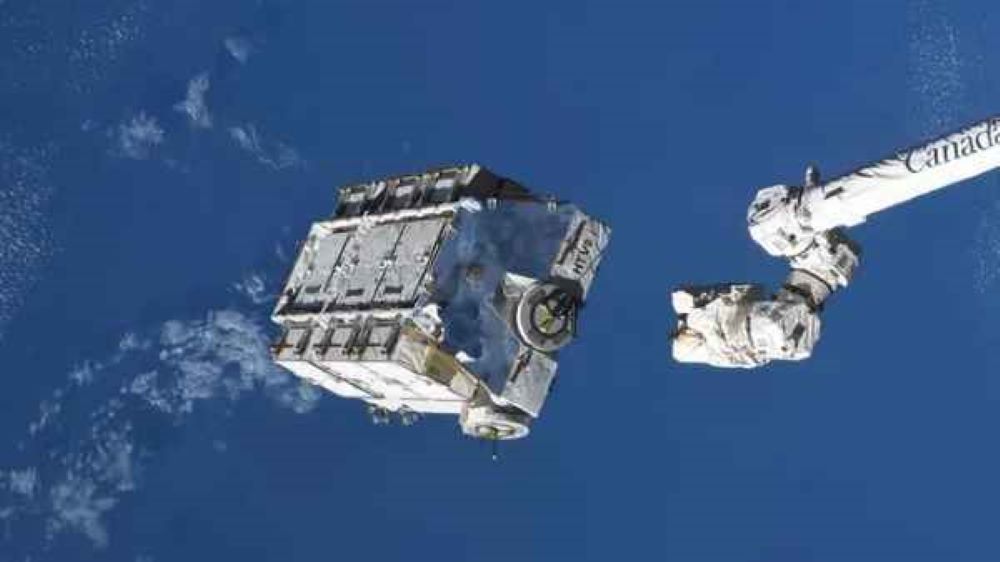

I began ‘Space Notes 44’, (ON, 5th May 2024), with the embarrassment for NASA when a piece of space debris, which struck a house in Naples, Florida, on March 8th, was identified as a bracing strut from a pallet-load of expired batteries, massing over a ton, launched from the ISS in 2021 (Fig. 1, Mike Wall, ‘Object that slammed into Florida home was indeed space junk from ISS, NASA confirms’, Space.com, 15th April 2024). It should have burned up in the atmosphere right away, or so I thought, and apart from why it didn’t, I questioned why it apparently wasn’t monitored in orbit meantime. As is so often the case, it turned out that the truth was already out there, though I had to search for it, and found it in Stephen Clark’s, ‘Trash from the International Space Station may have hit a house in Florida’, (Ars Technica, online, 2nd April 2024). Like the current problems with the Hubble Space Telescope (‘How Long for Hubble?’, ON, 12th May 2024), and the ones caused by the lack of an ambulance vehicle for the International Space Station (‘Waverider Part 1’, ON, November 27th 2022), it turns out to be another case where poor decisions taken long ago, with lack of foresight, have unintended consequences in the present.

The immediate chain of events started five years ago (see below), but actually it all started back in 1993 when what began as Space Station Alpha, then Space Station Freedom, suddenly became the International Space Station, when an invitation to the Russians to contribute minor features like docking latches brought back a major proposition: to integrate Freedom with the proposed Mir 2, and bring in the European Columbus station and the Japanese Kibo as contributed modules rather than the independent free-flyers they were then meant to be (Fig. 2). Despite pronounced misgivings on both sides, the ISS came to be, and instead of crewed spacecraft to service the free-flyers, Europe and Japan agreed to build uncrewed cargo capsules called ATV and HTV, respectively. Perhaps anticipating that the ISS wouldn’t last long, Europe built only five Ariane Transfer Vehicles, later called Automated Transfer Vehicles. I was lucky enough to catch the last of them passing over Troon on its way to the ISS in July 2014. The vehicle was later developed into the Service Module for the Orion spacecraft, which successfully orbited the Moon, uncrewed, at the end of 2022. More optimistically, Japan committed to building seven, later ten, of the H-II Transfer Vehicle, launched on the H-II booster, and also called Kounotori. ‘Oriental Stork’ or ‘White Stork’. After the Space Shuttle was withdrawn from service, only the HTV was capable of carrying International Standard Payload Racks, which are too big for the Progress or Cygnus ferries, or the more recent cargo Dragon. That meant that only HTVs could carry the ISS’s lithium-ion batteries to the station, or dispose of them into the atmosphere at the ends of their lives. And as they used to say in the comics at the start of an episode, Now Read On.


In October 2018, Flight Engineers Nick Hague and Alexey Ovchinin experienced a launch abort on their way to join Expedition 57 on the ISS (Fig. 3). On separation of the Soyuz launcher’s side boosters, one of them struck the core stage (Fig. 4) and the crew had to fire their capsule clear (Fig. 5). The escape system worked and they landed safely. (Eric Berger, ‘A Soyuz crew makes an emergency landing after rocket fails’, Ars Technica, online, 11th October 2018.) One of Hague’s tasks would have been participation in EVAs to install new batteries, just delivered by HTV. But Hague didn’t get there that year, so NASA put off the spacewalks, interrupting the entire multiyear plan for upgrading the batteries. Instead of replacing the new batteries on the HTV with old ones for destructive reentry over the ocean, NASA kept the cargo pallet on the ISS when the HTV departed.

In the new sequence, each subsequent HTV delivered fresh batteries and left with dud batteries from the previous HTV delivery. You can see this coming, can’t you? HTV-10 departed the ISS in 2020 with the cargo pallet and batteries from HTV-9 (Fig. 6), and with no more HTVs to fly, the next battery pallet was stuck on the ISS. For lack of space aboard, in March 2021 the problem pallet was launched from the ISS by the robotic arm (Fig. 1). The best that could be achieved was a decaying orbit which would bring it down in three years, and despite tracking by US Space Command, it was impossible to predict in advance when and where that would happen. 12 hours before the re-entry on March 8, there was still a 6-hour window of uncertainty, in which the pallet could orbit the Earth up to four more times, and there was a 40% chance that parts of it would reach the surface. On what proved to be its last circuit, as it was going over the Gulf of Mexico, towards southwest Florida (Fig. 7), Space Command recorded the pallet entering the atmosphere at 2:29 pm EST, and at 2:34 pm local time (19:34 UTC), Otero Nest’s family home took the impact, as recorded by their house security camera. Even if the piece of debris hadn’t been identified, there was no way NASA could get out of that one, and obviously it’s a big embarrassment when there’s been so much fuss about uncontrolled Russian and Chinese re-entries.

Starliner, Polaris Dawn and Starship Updates
The first crewed launch of the Boeing Starliner to the International Space Station was to have been on May 6th, but the countdown was halted two hours before liftoff because of a ‘buzzing’ valve (rapidly flipping on and off) in the Centaur upper stage of the Atlas V booster. This was not a problem with the spacecraft itself, though many news items used words like ‘failure-prone’ to describe it, and the delay wasn’t a catastrophe. The Centaur vehicle has been a workhorse of the US space programme since the early 1960s, and although there were plenty of difficulties in its early days, mastering its liquid hydrogen technology was crucial to establishing the US lead in space. The cover story of the US magazine Analog in January 1969 was a fact article (‘The Bugs that Live at -423°’ (Fahrenheit, of course) by Joseph Green and Fuller C, Jones, explaining how it had been done (Fig. 8).

The British Aircraft Corporation had done the necessary research in the early 1960s and could have produced a Centaur-equivalent stage for Blue Streak, which would have given us parity with the USA and Russia at least until the 70s, had the British government been interested in doing it. Russia took a lot longer to master liquid hydrogen and therefore couldn’t put satellites into geosynchronous orbit until the 1980s, seriously delaying its participation in the World Weather Watch, which has saved so many lives since. Another major benefit of space technology, buried under disparaging remarks about frying pans and ovenware, was that the valves developed in the Centaur programme found immediate application in heart surgery.
As one of the test directors said of the Starliner postponement, if that had been a satellite launch, the problem would probably have solved itself at liftoff or been able to work around, but chances like that can’t be taken with human lives involved. Initially the delay was to May 7th, but the valve couldn’t be fixed in situ and the rocket had to be rolled back from the launch pad, postponing the launch to May 17th. After the Centaur valve was replaced and the vehicle’s return to the pad (Fig. 9), a leaking helium valve was discovered in the spacecraft, and although that too wasn’t a catastrophe, it wouldn’t have done to have the astronauts talking like Donald Duck in space, so the date became May 25th. Meanwhile the Crew Dragon Endeavour has moved between ports on the ISS Harmony module, to make way for Starliner on the forward-facing one.

Despite all the disparaging remarks (and admittedly, it has been a very long time in development), Starliner has an important rôle to play in the coming years of the International Space Station. As I’ve previously pointed out, although the end of the ISS is now provisionally scheduled for 2030, it’s entering the most intensive phase of its use and I fully expect those six years to be extended. Russia keeps talking about pulling out, but the other international partners, particularly Europe, Japan and Canada, are looking to see longer lifetimes for the modules they’ve contributed. The SpaceX Crew Dragon and cargo Dragon have at last freed the USA of dependence on the Russian Soyuz and Progress modules, but Starliner’s ability to carry more people and cargo are very much going to be needed (Fig. 10).

Meanwhile, very important proposals were unveiled for the next Polaris mission financed by billionaire Jared Isaacman. (Josh Dinner, ‘How SpaceX’s private Polaris Dawn astronauts will attempt the 1st-ever ‘all-civilian’ spacewalk’, Space.com online, 14th May 2024.) After the Inspiration-4 flight of the Crew Dragon and the first Axiom missions to the International Space Station, in summer 2024 will come the very ambitious Polaris Dawn mission, whose 4-person crew have been in training for several years. On November 17th, 2023, they flew in training jets past Elon Musk’s Starship on its launch pad in Texas (Fig. 11), leaving little doubt about what the long-term objectives are. The last of the four missions in the Polaris programme is intended to be a flight to Earth orbit in the Starship, which SpaceX is developing for the US return to the Moon in the Artemis III mission, currently scheduled for 2026, and Axiom has every intention of putting a crew on it later.

Partly answering my question on May 12th as to how high an orbit the Crew Dragon can reach (still depending on what it’s carrying), the Polaris Dawn mission will go up to 780 miles, the highest crewed mission away from the Earth since Project Apollo, and then to over 800. At those altitudes they will be exposed to the inner Van Allen radiation belt, at the high points of their orbits, and the effects of that and the effectiveness of shielding will be under study.


At 700 miles, they will attempt the first commercial spacewalk in history (Fig. 12), using a ‘Skywalker’ ladder to exit the spacecraft through the nose hatch, after depressurising the capsule (Fig. 13). All four crew will therefore be in vacuum together, the largest number at one time to date. (Although four astronauts participated in the EVA repairs to the Hubble Space Telescope, they did so two at a time.) The Polaris Dawn crew will be wearing a new Extra Vehicular version (Fig. 14), of the SpaceX Crew Dragon suit, which is now being called the Intravehicular version. Although it’s not nearly so robust as the suit which Axiom is developing for Artemis III (Fig. 15), the Polaris Dawn mission will be an important rehearsal for what’s to come.


Meanwhile, anxieties are being expressed both within and outside NASA about whether SpaceX and Axiom hardware is ready for a job as exacting as a Hubble repair. (Ryan Whitman, ‘NASA Emails Show Growing Concern about SpaceX Plan to Save Hubble Telescope’, Extreme Tech, online, 17th May 2024.) The concerns are mainly about the untried aspects, like the new spacesuits and high-altitude Dragon missions – and with NASA now saying that the HST may last only three more years, a failed repair might deprive science of one or more of them. We’ve been through all of that before with the repair of the Solar Max space telescope in 1984, and the first Hubble repair in 1993. Having looked at the issues above, Ryan Whitman’s article concludes, “It would be a shame to let Hubble’s big, beautiful mirror crash to Earth when it could potentially gaze upon the universe for another 20 years. If Polaris Dawn goes well, NASA may be under more pressure to approve the mission.” Fingers crossed, then – and I’ll try to get the ideas that I published here last week to where they can at least be considered.
I mentioned that the answer might be to use Elon Musk’s Starship, if it can be ready in time. That might sound unlikely, with only three years to go, but Starship is supposed to be landing the first Artemis crew on the Moon before that, in 2026. Musk has announced that the fourth launch of the Starship/Superheavy will not be for 3 to 5 weeks, although the static fire of the fifth orbital Starship has already been done on May 8th. Media are making a big deal of the fact that he’s made a fresh application to the Federal Aviation Authority for permission to fly the fourth, but actually he’s applying for a modification to the flight plan, because he wants to land the Superheavy at Pad 39A in Kennedy Space Center. If he gets that, he may be planning to catch this descending booster or the next one in mid-air with huge robot arms which have been christened ‘Mechazilla’ (Fig. 16). Not to be outdone, the Chinese space agency has announced a similar but possibly better plan to catch their boosters with a fast-reacting rectangular net.

Chang’e-6 update.
The Chang’e-6 mission to the Farside of the Moon has been lowering its orbit around the Moon during May, and is expected to attempt a landing in early June, returning samples to Earth from the Apollo crater in the Aitken Basin (the largest crater in the Solar System today) on or around June 25th. More scientific details about the mission have now been released, and make interesting reading (Keith Cooper, ‘China’s Chang’e 6 probe to the moon’s far side has a big lunar mystery to solve’, Microsoft Start, online, 10th May 2024, and there’s more in Evan Gough, ‘Here’s Where China’s Sample Return Mission is Headed’, Universe Today, online, 10th May 2024.) A graphic from NASA’s Goddard Centre of the Aitken Basin, tangential to the south pole of the Moon, is a helpful start (Fig. 17). Dr. Qian of the University of Hong Kong and his colleagues provide maps of its interior in increasing detail. (Preview, Dr. Yuqi Qian, Department of Earth Sciences, The University of Hong Kong, ‘Long-lasting volcanism in the Apollo Basin: Chang’e-6 Landing Site’, Earth and Planetary Science Letters, for publication 1st July 2024.)

A big question to solve is why the lunar Farside has so few of the volcanic basalt plains (maria) which cover 31% of the Nearside and fill the craters of huge impacts there. The Aitken Basin is the largest and oldest of those in the Solar System, about 4.3 billion years ago, and isn’t lava-filled. NASA’s GRAIL probes found that the lunar crust is approximately 12 miles thicker on the Farside than on the Nearside – significantly that’s approximately the depth of the Aitken Basin and may suggest that it didn’t penetrate into the lunar mantle. It’s thought that the Nearside lava did some up from that depth, through cracks, and that map explain why there are lava-floored craters on the Farside around the Aitken rim.
There are two possible explanations at the moment for the comparative thickness of the Farside crust. One is that it was resurfaced by ejecta from the impacts forming the Nearside basins, after the Moon rotation became trapped with one side permanently facing the Earth. The other is that earlier, but after the rotation was trapped, when the Moon’s crust melted in the Final Bombardment 3.9 billion years ago, rock vapour from the Nearside froze out during the lunar night (but that would have been a lot shorter then than it is now). The deep penetrating radar on the Farside Yutu-2 rover recently discovered an apparently previous crust 300 metres down, which might support either hypothesis.

Fig. 18 shows the relationship between the Chang’e-4 landing site in Von Kármán crater, where the Yutu-2 rover is still operational, and the rectangle within which Chang’e-6 is targeted. Chang’e-4’s landing video shows a large crater ahead which might be Apollo, and if it is, that footage will have been very useful in choosing the landing site (Fig. 19).

But I’ve watched that film several times and I can’t see the Von Kármán ringwall, and Chang’e-4 landed within it, so my guess is that the start point is lower than it looks, and that crater ahead is consequently much smaller than Apollo. The Von Kármán crater is named after the founder of the Jet Propulsion Laboratory in Pasadena, where most US space probes are built and from where they’re controlled. It’s not to be confused with the Farside crater Van de Graaf, the deepest on the Moon and also the one with the highest emission of radon from decay of radioactive isotopes, detected by the Scientific Instrument Modules on the last three Apollo missions (I mixed up the two craters in my review of The Apollo Murders by Chris Hadfield, ON, 25th October 2022). The scientific payload of Chang’e-6 includes a French experiment to look for radon emissions at the new site – for a full list, see Matt Williams, ‘China is Going Back to the Moon Again With Chang’e-6’, Universe Today, online, May 6th 2024).
Change’-6 is going for a landing and attempted sample return from the region of crater Chaffee S, on the lava floor between the two rings of the Apollo basin (Fig. 20). There appears to be material there from two separate outflows, one about 3.25 billion years ago, relatively low in titanium, which covered the region between the rings, and the other more localised, about 3.07 billion years ago, of heavier, titanium-rich lava in the vicinity of Chaffee S (Fig. 21). Change’-6 will collect surface samples and drill down 2 metres as well, in hopes to bring back samples of both, as well as ejecta from Chaffee S. Another surprise, not revealed until well after launch, is that although Chang’e-6 is carrying the weight of the return module, it also has a rover attached (Fig. 22) – presumably a pretty small one.


Roger Chaffee, commemorated in Chaffee crater and its lettered secondary impacts, was the rookie astronaut killed in the Apollo 1 fire of 1967. Ed White and Virgil Grissom, who died with him, are also there, as are Dick Scobee and Gregory Jarvis, who died in the Challenger disaster in 1986. The eclectic mix also includes Borman and Anders from Apollo 8, Barringer, who was first to realise that Meteor Crater in Arizona was indeed meteoritic, and scientists who fared less than well at the hands of the US establishment, including Oppenheimer and Henrietta Levitt (see review, The Women of the Moon, ON, 23rd April 2023).
China’s current plans for the uncrewed lunar exploration extend as far as Chang’e-8 (Fig. 23), before going to crewed lunar missions (Fig. 24), for which the hardware is in development (Figs. 25 & 26). NASA’s current Director has said he’s not worried about competition from China, but other NASA officials have been more forthright: this may turn into a race for territorial claims, despite the 1967 UN Treaty which forbids ownership of extraterrestrial sites.






Leave a Reply