

Since my interim ‘Space Notes’ in mid-May, a great deal has already happened in the ongoing flurry of space activity. The return to flight of Jeff Bezos’s New Shepard spacecraft, after a long delay prompted by an unexpected launch failure on an uncrewed science mission in September 2022 (Fig. 1), was marked by another redress of an old injustice – or so it was reckoned to be at the time. Before flying William Shatner as a guest (who didn’t enjoy it), in October 2021 (Fig. 2), in July 2021 Bezos gave a place on the first flight to Wally Funk, one of the crack women pilots who qualified for Project Mercury in the early 1960s, outperforming the male astronaut candidates, but were excluded from the programme because those male astronauts refused to train with them (Fig. 3).


Another person omitted was Ed Dwight, a black test pilot (Fig. 4) who was selected for the short list of Mercury astronaut candidates in response to a directive from President Kennedy that minorities should be included in the programme. His appointment to astronaut training was never finalised and that is generally ascribed to Chuck Yeager, as head of the Test Pilot School, who has always insisted that he wasn’t good enough and ‘couldn’t keep up with the class’. In his recent book Winkle, The Extraordinary Life of Britain’s Greatest Pilot (Michael Joseph, 2023), Paul Beaver states that both the legendary Eric Brown and the equally well known Scott Crossfield cordially disliked Yeager, whom Beaver calls ‘a horrible person’ without going into details. (Review, ON, 6th August 2023.) Whatever the truth behind Dwight’s non-acceptance, he says that he gave up hopes of being selected for astronaut training after Kennedy’s assassination in 1963. Nevertheless the photograph most often reproduced from that time, showing him with models of the X-20 space plane and its Titan III booster (Fig. 5), is dated 1965, suggesting that he was still a candidate for the X-15 programme which would led on to the X-20 (‘Wings into Space’, ON, December 3rd 2023).

Dwight resigned in 1966. claiming that he had been pushed out of NASA into the regular officer programme, and went on to become a sculptor of international renown. But on May 19th this year he flew into space on the suborbital New Shepard, at the age of 90 years and 10 days (Fig. 6), just older than William Shatner and now the oldest person in space (Fig. 7). He enjoyed the flight a lot more than Shatner had, calling it ‘a life-changing experience’ and adding, ‘I never realised how much I needed this. I gave up too easily’.


On June 2nd, China’s Chang’e-6 spacecraft successfully landed in Apollo crater on the lunar Farside, 10 kilometres north of its target point (Fig. 8). Nevertheless the lava fields between the crater’s double ringwalls, which it was intended to sample, could be seen in the approach footage. Immediately after landing it was announced that sampling would be completed in two days (Fig. 9), and sure enough, on June 4th the ascent stage lifted off again.

At the moment of writing it has still to rendezvous with the return vehicle. As the landing on Earth is still scheduled for June 25th, and the direct return from the Moon takes 3 to 5 days, presumably it’s either going to wait in lunar orbit, or work its way outwards into the Earth’s gravity field with multiple burns, as India’s Chandrayaan-2 orbiter did earlier this year. The European Space Agency helped with the tracking on the Change-5 return in 2020 (Fig. 10), and probably will do again.


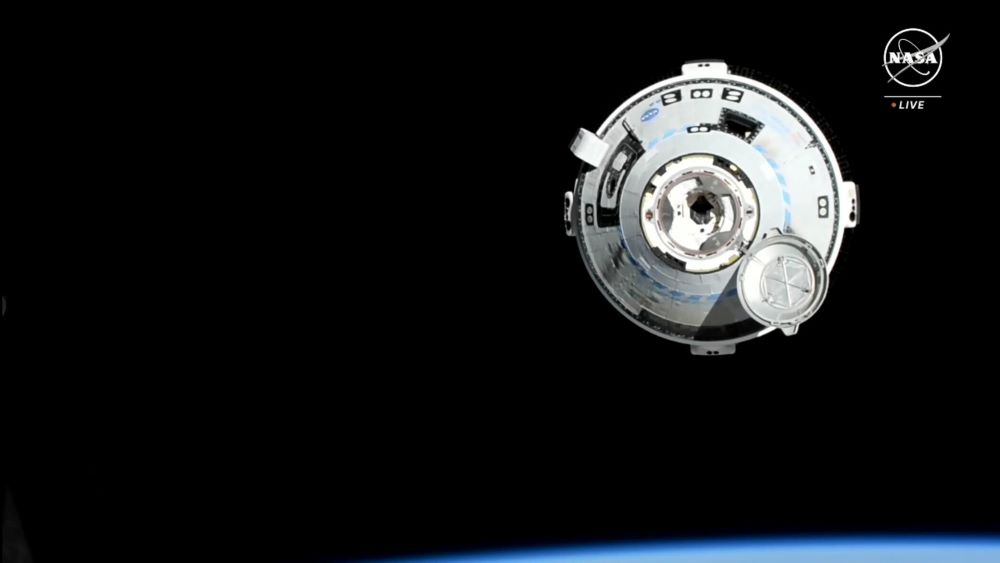
On June 5th the Boeing Starliner Calypso finally lifted off for the International Space Station (Fig. 11), bearing veteran US Navy astronauts Butch Wilmore and Suni Williams. The problem with the ‘buzzing’ valve on the Centaur upper stage was fixed when the booster and capsule were rolled back to the assembly building; as the Flight Director said, on an uncrewed launch they would have gone ahead on the assumption that the problem would probably solve itself at liftoff or staging, and if not it could be worked around, but with human beings involved no chances could be taken. Reports that the booster had returned to the pad in mid-May proved incorrect, and it was actually taken back on May 30th. The helium leak which had been detected was traced to a seal no bigger than a shirt button in one of the thruster groups on the outside of the spacecraft, but it couldn’t be fixed without rolling back again and adding at least 10 more days of delay. At that point any further delays would have meant still another rollback, to recharge the vehicle’s batteries, and the decision was taken to launch as things were.
I can sympathise with the dilemma because back in 1970, I had a similar problem with a 10-year-old Wolseley 15/50, which my father had presented to me when it needed a reconditioned engine and other repairs. When I got it back on the road with a lot of help from friends, there was a nasty oil leak which would manifest itself on long runs, and took too long to trace. It was due to a crack in a one-penny washer, which had been replaced as part of a whole new gasket set, and by the time it was traced, it was too late. The big-end bearings failed a month later, and as I couldn’t afford a second reconditioned engine, the problem was, whether to run it into the ground on heavy-duty oil, or to lay it up pending a change in my fortunes. I chose the latter, but as that change didn’t come in time, the car had to be scrapped anyway.
NASA went for the launch with the helium leak unchanged, and after all the delays, the launch took place bang on time on June 5th. I had to be elsewhere in the morning, and got back with literally a second to spare. I brought up NASA TV on screen to see the tanks no longer venting, and ignition occurred as I brought up the image to full screen. Everything went fine (Fig. 12) until the approach to the ISS on June 6th, when five of the 28 thrusters developed leaks and went offline. Three of them were restarted and the Starliner docked successfully (Fig. 13) at 1.34 p.m., Eastern Daylight Time, over five hours behind schedule, or seven years, depending how you look at it.


On the same day, precisely on time as advertised, Elon Musk’s private Starship/Superheavy vehicle took off for the fourth time (Fig. 14). Due to other commitments I had to miss the launch in real time, but I caught up with the mission just before the Starship re-entry (Fig. 15). By that time the Superheavy booster had already completed its flyback, which failed shortly before splashdown last time, and this time it went down successfully in the Gulf of Mexico off Texas (Fig. 16).


Observers noted that the catcher system on the launch tower went through its paces at the same time, practising to capture the booster in mid-air – and Elon Musk said they’d try to use it next time. The Starship’s attitude control system, which froze up last time, also worked perfectly and the Starship was rock-steady going into re-entry, keeping the heated plasma contained below it on the thermal protection system, and maintaining contact with TDRSS and Starlink satellites on the way down. When it was still 60 km up, a burnthrough was noticed on one of the forward flaps, and commentators predicted imminent failure (Fig. 17). But instead, despite worsening damage, the flap continued to function, all the way down until the Starship hit the sea in the Indian Ocean.

One interesting point here is that the late Prof Terence Nonweiler, Dean of Engineering at Glasgow University in the 1970s, has been proved right again. As far back as 1973, when the Space Shuttle design had recently been finalised, he said that US aerospace design had ‘taken a wrong turn’ in 1969, when the advanced metallurgy of the X-15 and X-20 had been abandoned in favour of aluminium hulls and ceramic heat-shields. For his design of Waverider re-entry vehicles (see ‘Waverider’, ON, November 27th 2022), stainless steel was the material of choice, and that’s what Musk has chosen for the Starship. Its greater strength and much higher melting point probably has a lot to do with the fourth flight’s survival, heavily compromised as it was. When the plasma penetrated the leading edge insulation of the Space Shuttle Columbia’s wing in 2003, it went through the aluminium structure behind it like a blowtorch, and both vehicle and crew had no chance at all.
Scientific calls have been mounting for a return mission to Uranus, which has been visited only once, by Voyager 2 in January 1986. Ongoing studies have revealed that as it orbits ‘on its side’, with its axis almost in the orbital plane, its weirdly inclined magnetic field interacts with the Solar Wind in ways which are far from understood. Its five major moons have many strange features calling for further study (see ‘Uranus, Neptune and Their Moons’, ON, November 14th 2021). Now NASA has invited ESA to join in drafting proposals for a joint Uranus mission, like the highly successful Cassini Saturn orbiter of 2004-2017. It remains to be seen whether the resulting proposal will be a single big orbiter and perhaps a lander like the Cassini missions, or a swarm of probes returning data through a ‘mothership’, as would be possible with more recent technology (Fig. 18).

A cautionary note has to be sounded. Uniquely among developed nations, it’s a requirement of the US Constitution that funding for all government projects has to be re-voted by Congress and Senate, every year. It allows any space project to be cancelled, however far advanced, and much as NASA would like to give guarantees to international partners, it’s not able to do so. Examples include the cancellation of NASA’s counterpart to ESA’s Ulysses mission, which was supposed to have two spacecraft passing over the poles of the Sun, in opposite directions, at the same time. Even Margaret Thatcher was moved to protest against that, to no avail. The most recent example is NASA’s withdrawal from the joint Exomars rover Rosalind Jackson, (Fig. 19), which left ESA without a booster to put it on. A new deal was made with Russia, only to be cancelled after the invasion of Ukraine. ESA now has a new agreement with NASA for a launch and a ‘landing platform’ to deliver the rover to the surface, but details online are extremely sketchy.

On June 5th NASA held a press conference to confirm the current status of the Hubble Space Telescope, which went into safe mode again the week before after more trouble with its remaining gyros. The HST has six of these (Fig. 20), and 22 of them were replaced during the five servicing missions of the Space Shuttle era. 15 years after the last of those missions, only three were still working and the one giving trouble has now been permanently shut down. In extremis the HST can operate with only one gyro, losing 12% of its ability to slew to new targets, and putting some regions of sky completely out of reach. Reports that the telescope has only three years left before it comes down due to atmospheric drag are exaggerated, and the HST is not expected to come dangerously low until 2035. Hence the decision to operate it in one-gyro mode from now on, keeping the other good one in reserve to replace that one when it fails.

One can see why the decision to keep most of the capability for eleven more years has such appeal, when the 2009 servicing mission was expected to add only a decade. The possibility of a rescue mission wasn’t explicitly mentioned, and it will be interesting to see how the international scientific community reacts to that. As I pointed out in ‘How Long for Hubble?’ (ON, 12th May 2024), many scientists opposed the first repair because they were sure the astronauts would break the telescope, and by contrast, when the fifth repair was cancelled to reduce the risk to the astronauts, after the loss of the Columbia, the scientific community demanded that it be reinstated. Axiom’s upcoming Polaris Dawn mission will do a great deal to demonstrate whether the SpaceX Crew Dragon can be used for a Hubble repair, and the good thing about this press conference is that provides breathing space. By 2030, say, when the Hubble may be down to one gyro only and there will be demands to bring it down for safety, Axiom intends to have its own space station, and the Polaris Dawn technology, now so problematical, will be tried, tested and in everyday use.
On the same theme as my discussion of Sirius in ‘Green Green, It’s Green They Say’ (ON, January 21st 2024), EarthSky has published an article by Bruce McLure titled ‘Is Zubeneschamali in the constellation Libra a green star?’ (EarthSky, online, May 31, 2024). Zubeneschamali is Beta Lyrae, and I remember the discussion of its colour from my teens. Indeed, as I was trying my hand at space painting back then, I bought a small tin of green paint specially to include it in the background to a painting of the Earth from space – only to discover that you can’t paint a large section of the celestial sphere on a flat surface, without having a lot of blank sky where the constellations don’t join up. Bruce McLure says that Zubeneschamali is the only star in contention, and adds physicist Ben Bartlett’s demonstration that stars can’t be seen as green. The nuclear processes of stars and the way light escapes from them simply don’t allow the green component to be distinguished by the human eye because it’s swamped by radiation in other wavebands. “But earlier observers often described Beta Librae as a green star. For example, the Incomparable Burnham’s Celestial Handbook quotes the famous amateur astronomer William Tyler Olcott (1873–1936) on this subject. Olcott referred to Zubeneschamali as the only star visible to the unaided eye: … that is green in colour.” And as I showed, Sirius is another case in point, I have to say that looking at the photograph of Zubeneschamali in the article, it looks greenish to me (Fig. 21).

Bruce McLure urged readers to look for themselves, and added percipiently, “Have your friends look at this star too. You might at least discover that people see colors differently.” As I showed, I am a case in point. I’ve rewritten my article to follow on from Bruce McLure’s, and submitted it to EarthSky, but I’ve had no reply, at least as yet.


Something to be aware of, in case it happens before the next ‘Sky Above You’, is that an outburst is expected from the recurrent nova T Coronae Borealis, 300 light-years away, ‘by September’, to last a week to 10 days (Fig. 22). The star is being robbed of material by a white dwarf orbiting around it (Fig. 23), and when enough hydrogen accumulates on the dwarf’s surface, it detonates spontaneously in a fusion explosion. When I was a student and novae were thought to be core explosions, recurrent novae were a real puzzle – see ‘Novae and Supernovae’ (ON, February 6th, 2022). The novae have been observed previously in 1217, 1787, 1866 and 1946, recurring every 80 years on average. The 1946 one was preceded by a dip in brightness the year before, and a similar one was seen in 2023, so if the pattern repeats it could brighten to second magnitude, equal to Polaris, any time now. (Nathan Falde, ‘Blazing Star Event First Recorded in a Medieval Manuscript to Return’, Ancient Origins, online, 27th May 2024.) More news as it happens…



Leave a Reply