
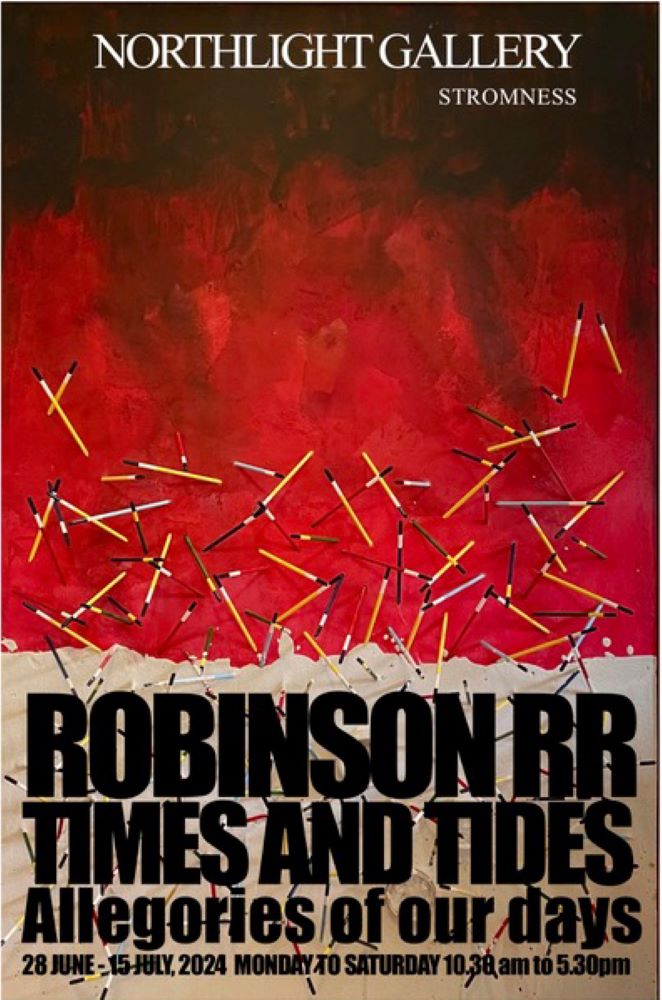
Northlight Gallery, Stromness. 28th June – 15th July 2024
There is a wonderful strength and continuity in this body of work as the artist moves seamlessly between printmaking, relief panels and sculptural constructions. Throwaway objects (found drift/scrap wood, broken pottery, old screws) are retrieved by the artist and transformed through care and almost tender attention. Rough driftwood is smoothed to the texture of silk (Small boat cruciform); polished and flattened screw-heads become stars in a glittering constellation (Haven: Libra – Scales of Justice); and broken fragments of china somehow float across seas of carefully crafted wood (Allocthon series). Each piece is a testimony to the artist’s skills and close attention to detail and finish, where the physical process and craftsmanship of creating the artwork by hand is paramount. The result is a tactile quality that invites the most basic of human connections: to reach out and touch.
Despite the fact that RR repeatedly insists he is not from a fine art background, perhaps determined not to elevate the work beyond the ‘lay’ understanding, there is a familiarity to some of the low-relief abstract wood collages that gives a nod to the likes of St Ives Modernist artist Margaret Ellis (Tetris Tide) and Ben Nicolson (Beach Bagatelle).
In the Haven series (Corona Borealis — the Northern crown; Haven — Libra, scales of justice) there are faint echoes of Picasso and Braques early cubist collages in the positioning of the wooden planes and the overall muted colour palette of the wood. The use of colour here is subtle and brooding, with dark tones briefly illuminated by small slashes of rich, warm yellows or shadowy purple blues.
This subdued use of colour stands in sharp contrast to the early works in the Allochton series, where primary colours vibrate with an urgency against the surrounding white, demanding attention. As the genesis point of a body of work over a sustained period of time, Allocthon I illustrates the ignition moment for RR; the moment when they, as a human being, felt driven to respond to the suffering of another through art, inspired by objects washed up on the local shore; the broken pieces of sea-pottery held securely within the bold, flag-like primary colours of the relief — the boundaries softened and worn between them.
In Small boat cruciform, the colour is once again symbolic, with the red and white cross of St George and the yellow stars of the European flag visible, yet the colours are faded here, appearing faintly as they ebb and flow into the driftwood board; the dissolve of hard boundaries, their edges softened by the ever-shifting movement of the tide. Like the piece itself, there is a simplicity to the answer at the heart of a complex question: we are one world, connected by the expanse of water that surrounds each shore, each touched by its time and tides.
At a time when political narratives are increasingly divisive, the metaphors that we use are important. Dehumanisation is the psychological process of demonising the enemy, making them seem less than human and hence not worthy of humane treatment. To see the ‘other’ as threat or waste removes the need to empathise. Migration is equated with natural disasters such as ‘surge’, ‘flood’ and ‘tidal wave’, equating asylum seekers with sea-born threat. War-metaphors are frequently adopted — from ‘army’ to ‘invasion’. Refugee is replaced with ‘illegal migrant’, and their arrival described as an ‘influx’, akin to a ‘plague’, further dehumanising and distancing the ‘other’ from ‘us’.
Historically, the act of dehumanisation of a certain group of people can been shown to lead to increased levels of violence, human rights violations, war crimes and genocide. Recent reporting on investigations into activities of Greek border authorities, describe incidences of border police throwing people back into the sea, their hands zip-tied, or leaving them to float on oarless rafts, aimless on the tide, to wash up wherever the sea may take them. Men, women, children — all reduced to rubbish in the sea. By taking what has been thrown away or washed up on the shore, and nurturing it into something of beauty, these works question our contemporary values of worth and worthlessness and asks us to reflect upon the language and metaphors we digest on a daily basis.
The increasing urgency of this issue can be seen in the artworks too. Where Haven (series) and Small boat in peril on the sea invite us to connect, King Canut and his councillors face a dawn reckoning, and Hostile shore are sharp, violent, filled with danger; the canvas is stabbed repeatedly, the jagged, cutting edges of broken glass points outwards, forcing us away. Gone are the softened forms, the guiding stars. Gone are the childlike primary colours and sea-worn pottery. This is where division will lead us: further and further into violence, war, literal bloodshed. RR is urging us to choose a different way.
The etymological root of respect is ‘re-see’, to ‘look back at’ — which is what these works ask us to do. RR asking us to stop, to re-see; to reach out and make that connection; to see humanity not as ‘us’ and ‘other’ but as a whole.
In many ways, the exhibition is a retrospective of a body of work that spans fifteen years, back to Allocthon I. Perhaps though, it is a body of work that goes back much further; a response to an older question asked by Rabbi Hillel over two-thousand years ago: If I am not for myself, who will be for me? If I am not for others, what am I? And if not now, when?
Review by Sheena Graham-George and Victoria Bennett

Leave a Reply to Last chance to view Robinson RR Exhibition – The Orkney NewsCancel reply